In many applications, choosing the right gas spring is not only about dimensions, stroke, or force range. Just as important is the ability to fine-tune the spring to match the actual movement of the system.
This is where adjustable gas springs offer a clear advantage.
Unlike fixed-force gas springs, adjustable gas springs allow the force to be modified within a certain range. That makes them especially useful when the final operating conditions are not fully predictable at the start of the project, or when the same product may be used in slightly different configurations. In practice, this gives engineers and manufacturers more flexibility during setup, testing, and short production runs.
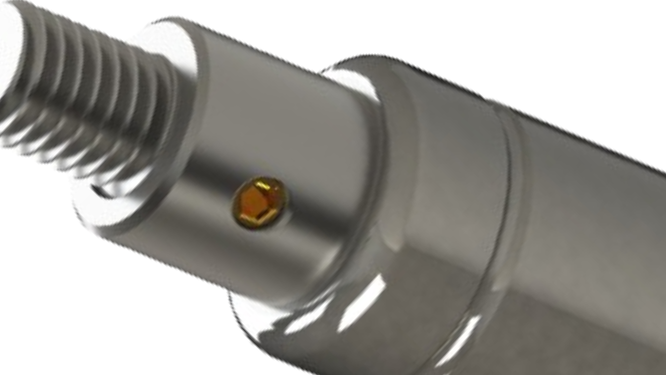
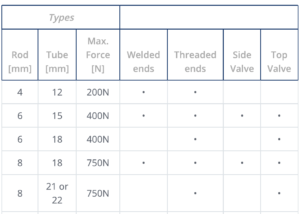
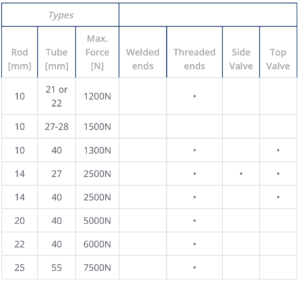
One of the features that makes a gas spring adjustable is the presence of a valve. Depending on the design and the intended installation area, this valve can be supplied in two main forms: side valve and end valve.
- 1 What makes a gas spring adjustable?
- 2 Why adjustable gas springs are useful
- 3 Side valve and end valve: what is the difference?
- 4 Choosing between side valve and end valve
- 5 How force adjustment works
- 6 Gas release and gas filling considerations
- 7 Adjustable gas springs in standard and stainless steel versions
- 8 Where adjustable gas springs are especially useful
- 9 Why adjustable gas springs are valuable during prototyping
- 10 What should be considered before selecting an adjustable gas spring?
- 11 Conclusion
- 12 Need help selecting the right adjustable gas spring?
What makes a gas spring adjustable?
An adjustable gas spring is designed so that its internal gas pressure can be modified when needed. In most cases, the spring is charged during manufacturing to a higher force level, and then the force can be reduced gradually by releasing gas in a controlled way until the desired performance is reached.
This gives the user an important practical advantage. Even if force calculations are made carefully, the real behavior of an application may still differ from what was expected on paper. Hinge friction, mounting geometry, lid weight distribution, center of gravity, and the preferred opening speed can all affect the final result.
That is why adjustable gas springs are often preferred when the exact force requirement needs to be confirmed on the actual product rather than assumed only by calculation.
Why adjustable gas springs are useful
In real projects, theoretical values do not always tell the whole story. A gas spring may appear correct based on technical data, but once installed, the movement may feel too fast, too slow, too strong, or not strong enough for the intended use.
An adjustable design helps solve this problem by allowing the force to be tuned more precisely after installation.
Some of the main advantages of adjustable gas springs are:
- force can be adjusted within a usable range
- the spring can be fine-tuned after installation
- adjustment can be carried out with the proper tool
- they are highly useful for prototype work and short production runs
- they are suitable for applications where lid or panel weights may vary
- they help define the correct force before moving to fixed-force production
- they are available in both standard gas springs and stainless steel gas springs
For many manufacturers, this is not just a convenience. It can reduce trial-and-error during development and make it easier to confirm the right specification before serial production begins.
Side valve and end valve: what is the difference?
The adjustability of a gas spring depends on the valve, but the location of that valve also matters.
The two most common options are side valve and end valve.
Side valve
A side valve gas spring has the valve positioned on the side of the tube. This option can be useful when the installation layout allows easier access from the side, or when the end of the gas spring is less convenient to reach once the product is assembled.
In some designs, a side valve can offer a more practical adjustment point during installation or testing, especially where surrounding components limit access to the end of the spring.

End valve
An end valve gas spring has the valve placed at the end of the tube. This is often preferred when end access is simpler, cleaner, or more consistent with the product design. In many applications, the end valve provides a straightforward solution for controlled force adjustment during setup.
The choice between side valve and end valve is not about one being universally better than the other. It depends on the available space, mounting position, accessibility, and the way the gas spring will be adjusted in the finished assembly.

Choosing between side valve and end valve
When deciding which valve type is more suitable, it is worth looking at the application as a whole.
Questions such as these usually help guide the selection:
- Will the valve still be accessible after installation?
- Is there enough clearance around the tube for side access?
- Is the end of the gas spring easier to reach during testing or service?
- Will adjustment be carried out only once, or may it need to be checked again later?
- Does the surrounding product design limit access from one direction?
In many cases, the valve location is chosen not for technical force reasons, but for practical installation and service reasons.
How force adjustment works
The basic principle is simple. The gas spring is initially charged to a higher force level during manufacturing. Then, using the correct adjustment tool, gas is released gradually until the force suits the application more accurately.
This process allows the spring to be matched to the real conditions of use rather than relying only on theoretical calculations.
The important point is that adjustment should be done carefully and in a controlled way. Releasing too much gas will lower the force beyond the required level, so the process should be approached step by step.
Once the ideal force has been determined on the application, that setting can be used as a reference for future production. This is especially useful when moving from prototype evaluation to repeat production with a fixed and confirmed force target.
Gas release and gas filling considerations
When people talk about adjustable gas springs, the first thing they usually think of is gas release, because that is how the output force is reduced during adjustment. This is the most common practical method for matching the spring to the application.
However, depending on the product design, valve structure, and manufacturing approach, gas filling or recharging may also be relevant in certain cases. This can be useful during technical evaluation, product development, or when defining a final force requirement under controlled conditions.
In practice, gas release is the main adjustment method used to fine-tune force. Gas filling, on the other hand, should always be treated as a controlled technical process and evaluated according to the specific gas spring design. It is not simply a general handling operation; it depends on the construction of the spring and the intended service method.
For that reason, force adjustment, gas release, and any possible gas filling work should always be approached with the correct equipment and proper technical understanding.
Adjustable gas springs in standard and stainless steel versions
Valve-adjustable designs are not limited to one material option.
This feature can be used in standard gas springs as well as in 316L stainless steel gas springs, depending on the needs of the application. That gives product designers more flexibility when both force adjustability and environmental resistance are important.
For general industrial applications, a standard adjustable gas spring may be a practical and economical solution. In more demanding environments, 316L stainless steel adjustable gas springs can be preferred where corrosion resistance, hygiene requirements, or exposure conditions are more severe.
This is particularly relevant in applications involving outdoor use, humid environments, washdown conditions, marine exposure, or certain medical and laboratory settings where stainless steel is often preferred.
Where adjustable gas springs are especially useful
Adjustable gas springs are often chosen in situations where the final operating feel matters just as much as the technical calculation.
Typical examples include:
- access lids
- machine covers
- inspection panels
- medical equipment covers
- laboratory devices
- industrial enclosures
- marine equipment
- outdoor compartments
- prototype assemblies
- short production runs
You can view the sectors we serve on our website.
They are also well suited to applications where panel or lid weights may vary slightly from one version to another. In these cases, having an adjustable force option can simplify development and reduce uncertainty during installation.
Why adjustable gas springs are valuable during prototyping
One of the most practical uses of adjustable gas springs is in prototype and pre-production work.
At that stage, many details are still being confirmed. The hinge friction may not yet be fully known. The exact weight of the moving part may still change. The preferred opening speed may be different from the original assumption. Even small design revisions can alter the force requirement.
An adjustable gas spring gives engineers the ability to test the real movement, make controlled corrections, and identify the force that feels right on the actual product. Once that value is confirmed, it becomes much easier to define the most suitable production specification.
This makes adjustable gas springs an effective tool not only for function, but also for development efficiency.
What should be considered before selecting an adjustable gas spring?
Before choosing an adjustable gas spring, it is useful to review the full application rather than looking only at nominal force.
Important points include:
- application weight
- hinge position and mounting geometry
- required stroke
- extended and compressed dimensions
- available installation space
- whether a side valve or end valve is easier to access
- environmental conditions
- whether standard steel or 316L stainless steel is more suitable
- whether the project is prototype-based or intended for repeat production
In many applications, the right answer comes from combining theoretical calculation with real-life testing.
For more questions and answers, please see our FAQ page.
Conclusion
Adjustable gas springs offer a practical solution when force needs to be refined according to the actual behavior of the application. Their key advantage is not simply that they can be adjusted, but that they allow a more accurate match between calculated requirements and real operating conditions.
With side valve and end valve options available, the valve position can be selected according to accessibility and product design. The same principle can be applied in both standard gas springs and 316L stainless steel gas springs, making adjustable solutions suitable for a wide range of environments and technical requirements.
For prototype work, short production runs, and applications where movement characteristics may vary, adjustable gas springs can make the selection process more reliable and more practical.
If the application requires careful force tuning, reviewing the valve type, material option, and installation layout together is usually the best place to start.
Need help selecting the right adjustable gas spring?
If you are working on a project that requires force adjustment, valve accessibility, or material selection based on the application environment, our team can help you evaluate the most suitable solution. You can watch a promotional video about our factory and production, or you can write to us directly or call us directly.