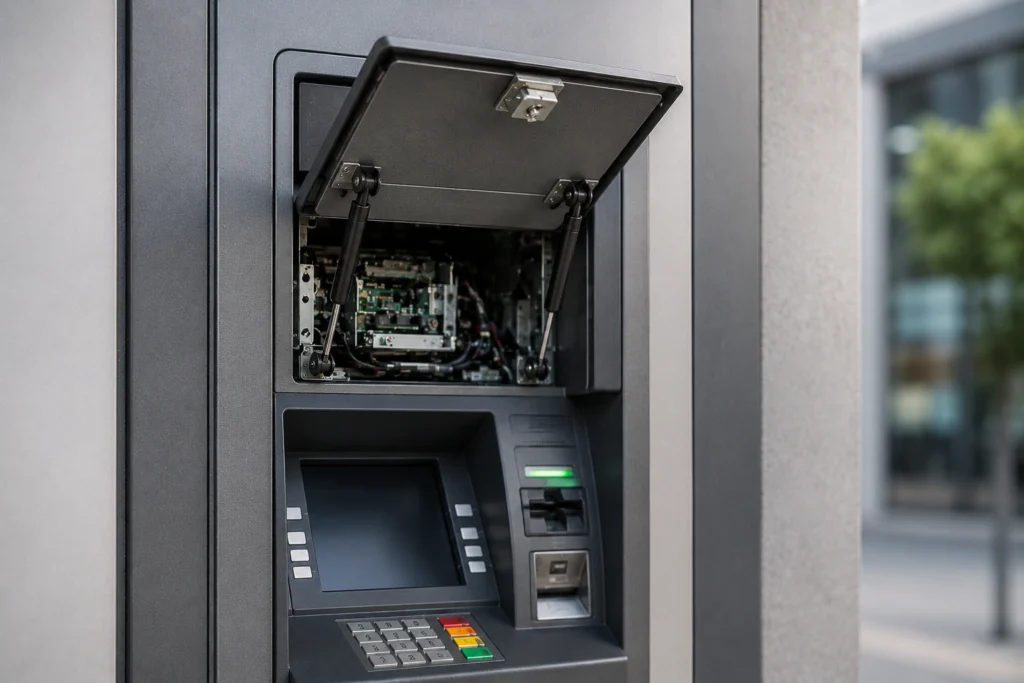
ATM Service Panels
Hold-open and controlled-motion support for the rear and top service doors on ATMs and cash machines — built for technician safety, daily service, and outdoor exposure.
- 1 The Panel That Has to Stay Open Over a Technician’s Head
- 2 The Service Panels on an ATM That Need a Gas Spring
- 3 One Spring or Two on an ATM Service Panel
- 4 When to Specify Stainless Steel or Locking Gas Springs
- 5 Specification Quick-Reference by Panel Type
- 6 How to Calculate Gas Spring Force for an ATM Service Panel
- 7 Why ATM and Banking OEMs Source Service-Panel Springs from Newtone
- 8 Frequently Asked Questions
- 9 Conclusion
- 10 Get a Specification or Quote
The Panel That Has to Stay Open Over a Technician’s Head
Gas springs for ATM service panels have one non-negotiable job: hold a heavy steel door open and keep it there while a field technician works underneath it with both hands and a cash cassette. Picture the service call — the engineer swings open the rear panel of a through-the-wall ATM in a bank vestibule, leans in to clear a jam or swap a dispenser, and the last thing anyone wants is that panel creeping down on the back of their neck. A correctly chosen spring holds the door dead still at full open. A worn or under-sized one sags, and on a steel service door that is a safety incident, not an inconvenience.
This page is written for the people who specify that behaviour before the machine ships or gets retrofitted: ATM OEM design engineers, procurement teams sourcing replacement service-panel springs for deployed fleets, and distributors supplying the field-service companies who open these doors every week. Below: how to size the force, why outdoor units wear springs out faster, when locking stops being optional, and how to mount the spring so it survives the field.
Who this page is for: ATM and self-service banking OEM engineers specifying service-door counterbalance, procurement teams sourcing replacements for installed fleets, and distributors supplying field-service technicians who need a panel that holds open safely and survives the weather the machine sits in.
The Service Panels on an ATM That Need a Gas Spring
An ATM is not one door. The cash handling, the electronics, and the maintenance access are usually behind separate panels, and each one has its own weight, swing, and security level. The spring follows the panel, not the machine.
Rear Service / Maintenance Doors
The main access for clearing jams and swapping modules. Heavy steel, opened from behind on through-the-wall units, and the panel a technician spends the most time under. This is the primary locking candidate on the whole machine.
Top Hood / Upper Service Lids
Top-hinged covers over the display and card-reader assembly that lift up for service. Top-hinged geometry means the spring fights the most torque near full open, so the moment arm drives the force more than the raw weight does.
Cash / Vault Compartment Panels
Secured inner doors over the cassette and safe area. Often weighty for security, opened on every cash replenishment, so cycle life and a controlled, no-slam motion matter as much as the hold.
Drive-Up & Through-Wall Enclosures
Same panels, outdoor exposure. Sun, rain, and a wide daily temperature swing turn material choice and temperature-correct sizing from optional into required.
One Spring or Two on an ATM Service Panel
Most ATM service panels run two springs, and on a security door that is as much about control as balance. A heavy steel panel on a single spring tends to lead on one side and twist against its hinges, and a twisted security door is one that does not seat or seal cleanly. Two matched springs keep it square and share the load so neither is overworked. The single-spring case is the small stuff — a light upper lid or a narrow inner panel that the hinge helps carry.
⬤ Single Spring Setup
- Light upper lids and narrow inner panels
- Hinge mechanism shares the load
- Rigid panel, centred load, no twist
- Lower part count and cost
⬤ Paired Spring Setup
- Heavy steel rear service doors
- Security panels that must seat and seal square
- Wide panels prone to twisting
- Springs force-matched to ±5% from one batch
When to Specify Stainless Steel or Locking Gas Springs
Indoor lobby ATMs are fine on a standard configuration: a black nitrided rod (900–1000 HV, 20–30 µm) with HNBR seals handles ordinary indoor conditions and a long service-cycle life. Outdoor, drive-up, and through-the-wall machines are the high-humidity case where a stainless steel gas spring pays for itself, because the corrosion and surface pitting that attack a standard rod are exactly what eventually let a seal leak and the panel sag.
Locking is where ATM service panels differ from most doors. The whole point of the panel is hands-free, safe access for a technician working over live cash-handling hardware, so a locking gas spring that holds firmly at full open until deliberately released is often the correct default, not an upgrade. It removes the risk of a heavy steel door drifting down during service. The right release type depends on panel weight and how the technician works, so confirm it at the design stage.
Specification Quick-Reference by Panel Type
| Panel Type | Typical Weight | Recommended Force | Spring Count | Notes |
|---|---|---|---|---|
| Rear service / maintenance door | 10–18 kg (22–40 lb) | 150–350 N each (34–79 lbf) | 2 | Locking recommended |
| Top hood / upper service lid | 6–12 kg (13–26 lb) | 120–250 N each (27–56 lbf) | 1–2 | Top-hinged — moment arm drives force |
| Cash / vault compartment panel | 8–16 kg (18–35 lb) | 140–300 N each (31–67 lbf) | 2 | High-cycle; controlled no-slam motion |
| Outdoor / drive-up enclosure | Any of the above | Per type + temp margin | 2 | Stainless + temperature calc |
| Light inner / electronics panel | 3–6 kg (7–13 lb) | 60–120 N (13–27 lbf) | 1 | Single spring plus hinge |
How to Calculate Gas Spring Force for an ATM Service Panel
Pick the formula that matches how the panel moves. Many ATM service doors lift more or less straight up on a parallel linkage rather than swinging on a simple hinge, and for a straight vertical lift the springs carry the weight directly — there’s no long lever multiplying it. The baseline check is simple:
Feach ≥ (W × SF) ÷ n
Feach = force per spring · W = panel weight (N) · SF = safety factor (1.1–1.3) · n = number of springs
Worked example — 12 kg (26 lb) straight-lift service panel, two springs:
W = 12 kg × 9.81 = 117.7 N (26 lbf) · SF = 1.2 · n = 2
Feach = (117.7 × 1.2) ÷ 2 = 141.2 ÷ 2 = 71 N (16 lbf) per spring
For a top-hinged hood the physics changes: there the weight acts through a lever, so use a moment balance about the hinge — F = (W × Lg) ÷ (n × r) — and the force can be several times higher than the straight-lift number for the same weight, because the centre of gravity sits well out from the pivot. Either way, finish with the temperature correction for an outdoor unit, since force moves about 0.3% per °C (FT ≈ F20 × [1 + 0.003 × (T − 20)]). Where the panel weight, travel, or linkage geometry isn’t fixed yet, that’s a number to confirm with our engineering team rather than guess.
Mounting is what makes the calculated force last. Fit the spring rod-down in the closed position so the oil keeps the seals wetted and the motion stays quiet — and on a damped service door, rod-down is also what lets the end-of-stroke damping actually work. Use ball-socket or eyelet end fittings that allow a little angular play, so the rod sees pure axial load; side-load is the quiet killer of cycle life on a panel opened daily. Keep both pivots in the same plane, and remember the lower pivot’s position relative to the hinge changes the effective moment arm more than re-rating the force does. If a top hood feels heavy to start, move the mount before ordering a stronger spring.
Why ATM and Banking OEMs Source Service-Panel Springs from Newtone
We manufacture in our own plant in Turkey, so the force tolerance, rod material, and lead time are ours to control — which is what a security panel that has to hold the same way on every machine in a fleet actually needs.
Frequently Asked Questions
Start from the panel weight and how it moves. For a straight upward-lifting panel, each of two springs carries at least half the weight plus a safety margin — a 12 kg (26 lb) panel needs about 71 N (16 lbf) each at a 1.2 factor. For a top-hinged hood, use a moment balance about the hinge, which gives a higher figure. Then correct for temperature outdoors. Send Newtone the weight and travel for an exact value.
Yes, for through-the-wall and drive-up ATMs that face weather. Rain, washdown, and condensation pit a standard rod over time and let the seals fail, so a stainless steel rod and body is the right call outdoors. For indoor lobby ATMs, a black nitrided rod with HNBR seals is sufficient at lower cost.
Often yes. A technician services the cash dispenser or vault area with both hands and tools, and the panel must stay open and not drift down onto them. A locking gas spring holds mechanically at full open until released, which makes it a safety feature rather than just a convenience on heavier service panels.
Mount it rod-down in the closed position so oil keeps the seals lubricated and the motion stays quiet and even. Use ball-socket or eyelet fittings that allow slight angular play so the rod is not side-loaded, and keep both pivots in the same plane of motion. Lateral load is the main cause of early failure in a service panel that gets opened daily.
Gas spring force changes about 0.3% per °C. An outdoor ATM panel sized at 20°C reads noticeably softer below freezing, so a panel that held fine in testing can drift down on a cold morning. Sizing at the real service temperature, not the bench, prevents this.
Conclusion
An ATM service panel spring is judged in one moment: a technician leaning into live hardware with both hands, trusting a steel door to stay where it was left. The ways it goes wrong are well understood — a force sized in a warm shop instead of a cold street, a standard rod left to corrode on an outdoor unit, a single spring twisting a security panel out of square, or no locking on a door heavy enough to hurt someone if it drifts.
Newtone builds these springs to the way they’re actually used: matched pairs to ±5% so panels seat square, stainless where the machine faces weather, locking where a technician’s safety depends on the hold, and force sized at the real service temperature. Engineering support is available to set force, stroke, and fittings for a specific panel before it goes into production or out to the field.
Send us the panel type, weight, travel, and whether the machine is indoor or outdoor. We’ll come back with a force recommendation, a datasheet, and a quote — usually within 5 business hours.
Get a Specification or Quote
Tell us your panel type, weight, how it moves, and the machine’s location. Our engineering team handles the rest — force calculation, material choice, locking selection, and a configuration that fits.