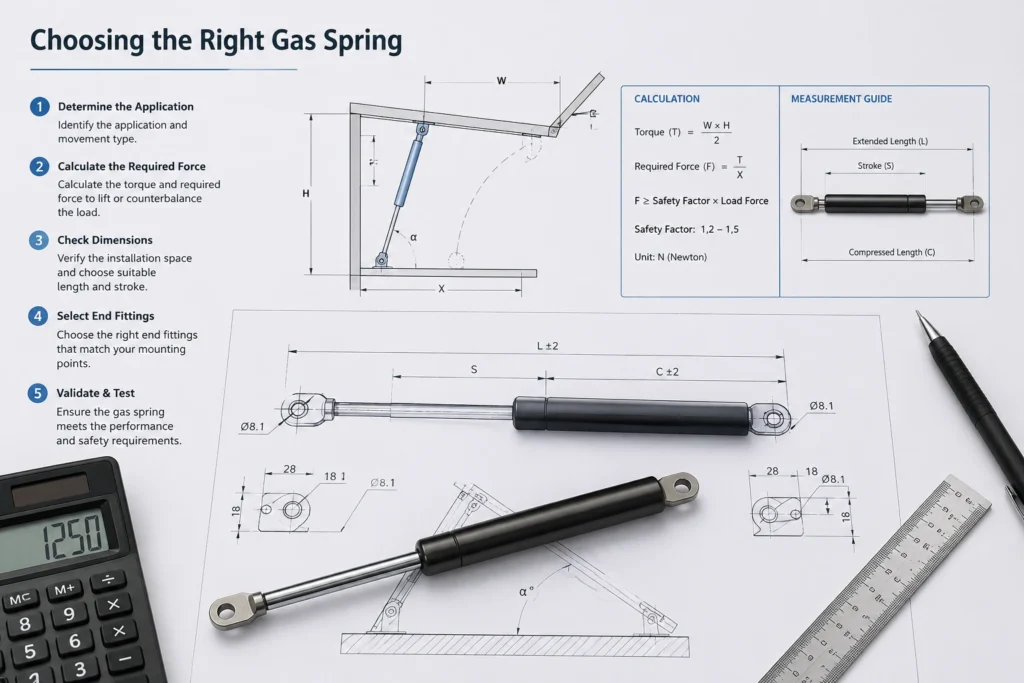
Choosing the Right Gas Spring
Cycle-rated lift and hold support for self-service kiosk doors, service panels, and touchscreen housings — engineered for machines that get opened thousands of times a year.
- 1 Reliability Is the Whole Specification in a Kiosk
- 2 The Kiosk Panels Where Cycle Life Decides the Spring
- 3 One Spring or Two on a Kiosk Panel
- 4 When to Specify Stainless Steel or Locking Gas Springs
- 5 Specification Quick-Reference by Kiosk Panel
- 6 Sizing for Service Life: Cycles, Force, and the Worked Numbers
- 7 Why Kiosk OEMs Source High-Cycle Springs from Newtone
- 8 Frequently Asked Questions
- 9 Conclusion
- 10 Get a Specification or Quote
Reliability Is the Whole Specification in a Kiosk
Gas springs for high-use kiosks live or die on one number that has nothing to do with how strong they are: how many times they can open before the seals give up. A self-checkout lane, a ticketing machine, a parcel locker, an airport check-in unit — these get opened for restocking, jam-clearing, and cash collection many times every single day, in front of customers, by staff who do not want to fight a panel. The spring that felt fine on the bench is irrelevant. The one that still holds the panel dead-level after its eighty-thousandth open is the one that mattered.
This page is for the people choosing that spring before the kiosk goes into a fleet: OEM design engineers building self-service hardware, procurement teams sourcing replacements for machines already in the field, and distributors supplying operators who measure success in uptime. The focus here is reliability — cycle life, the failure modes that actually show up, and how sizing and mounting decide whether a spring lasts three years or six months.
Who this page is for: kiosk and self-service OEM engineers specifying door and panel counterbalance, procurement teams sourcing high-cycle replacements for deployed fleets, and distributors supplying operators who need a spring that survives daily use without becoming a recurring service ticket.
The Kiosk Panels Where Cycle Life Decides the Spring
Not every panel on a kiosk is opened at the same rate, and the duty cycle should drive the spec more than the weight does. A panel opened twice a day and one opened a hundred times a day are different engineering problems even at identical weight.
Restocking & Product Doors
Vending-style or locker doors opened for refills and order pickup. Highest cycle count on the machine, so this is where the cycle rating, not the force, is the headline number. Under-rate it and you are back on site replacing springs within a season.
Cash / Coin Collection Panels
Secured panels opened on every cash pickup. Heavier for security, moderate cycle count, and a controlled, no-slam close matters because the panel sits in a public space and a banging door reads as broken.
Touchscreen & Display Housings
Top or front covers over the screen and card reader, opened for tech support. Lower cycle count but tight packaging, so stroke and compressed length drive the choice as much as force.
Outdoor & Drive-Up Kiosks
EV charging, parking, and parcel units exposed to weather. High cycles plus rain and temperature swing, which is the combination that makes both stainless material and a real cycle rating non-negotiable.
One Spring or Two on a Kiosk Panel
For a high-use kiosk, two springs are often the more reliable choice even when one could carry the weight — because splitting the load halves what each spring works against on every cycle, and a spring run at half its rated load lasts longer than one run near its limit. The classic reason for pairing still applies too: a wide panel on a single spring leads on one side and twists, and a twisted panel that gets opened a hundred times a day wears its hinges fast.
⬤ Single Spring Setup
- Narrow, light panels and display lids
- Hinge mechanism shares the load
- Lower-cycle access covers
- Lower part count and cost
⬤ Paired Spring Setup
- Highest-cycle restocking and locker doors
- Wide panels that would otherwise twist
- Load split to extend service life
- Springs force-matched to ±5% from one batch
When to Specify Stainless Steel or Locking Gas Springs
Indoor kiosks in malls, lobbies, and terminals are well served by a standard spring: a black nitrided rod (900–1000 HV, 20–30 µm) with HNBR seals handles indoor humidity and a high cycle count without paying for more. Outdoor and semi-outdoor units are the case for a stainless steel gas spring, because rain and condensation pit a standard rod, and on a high-cycle door that pitting reaches the seals faster than it would on a panel opened occasionally.
Locking has a narrower but real place here. Where staff restock or service with both hands and the panel must stay put — or where a heavier security panel could drift down in a public space — a locking gas spring holds firmly at full open until released. For most light, frequently-opened kiosk doors, a correctly sized standard spring that holds at any angle is enough, and a simpler part with fewer wear points is the more reliable choice for sheer cycle count.
Specification Quick-Reference by Kiosk Panel
| Panel Type | Typical Weight | Recommended Force | Spring Count | Notes |
|---|---|---|---|---|
| Restocking / locker door | 5–12 kg (11–26 lb) | 100–250 N each (22–56 lbf) | 1–2 | Highest cycle — specify rating first |
| Cash / coin panel | 6–14 kg (13–31 lb) | 120–280 N each (27–63 lbf) | 2 | Controlled no-slam close |
| Touchscreen / display housing | 3–7 kg (7–15 lb) | 80–160 N (18–36 lbf) | 1–2 | Tight packaging — check stroke |
| Outdoor / drive-up kiosk | Any of the above | Per type + temp margin | 2 | Stainless + high-cycle rating |
| Light service / access cover | 2–5 kg (4–11 lb) | 50–110 N (11–25 lbf) | 1 | Single spring plus hinge |
Sizing for Service Life: Cycles, Force, and the Worked Numbers
Reliability sizing starts with the duty cycle, not the force. Translate how often the panel is opened into a yearly cycle count, then match it to a rated life so you know how long the spring lasts before seal wear sets the limit:
Service years ≈ Rated cycles ÷ (cycles per day × 365)
Rated cycles = spring’s rated life · cycles per day = real opens per day · result = expected years before seal wear governs
Worked example — restocking door, 80 opens/day, 100,000-cycle spring:
Cycles per year = 80 × 365 = 29,200 · Service years ≈ 100,000 ÷ 29,200 = ~3.4 years
For a 150-opens/day unit the same spring lasts ~1.8 years — so specify a higher cycle rating up front.
Force still has to be right, and for a hinged kiosk lid that is a moment balance about the hinge: F = (W × Lg × cos φ) ÷ (n × r). For a 6 kg (13 lb) top-hinged lid (W = 58.9 N / 13 lbf) with Lg = 150 mm (5.9 in), held at the open position on a single spring with r = 55 mm (2.2 in): F = (58.9 × 0.15) ÷ (1 × 0.055) ≈ 161 N (36 lbf). Add a safety factor around 1.15 and, for outdoor units, a temperature correction of roughly 0.3% per °C. But here is the reliability point: do not pad that 161 N up to “200 N to be safe.” The right-sized spring lasts longer than the over-sized one. Where the panel weight or geometry isn’t fixed, confirm it with our engineering team rather than guess.
Mounting is where cycle life is won or lost. Fit the spring rod-down in the closed position so oil keeps the seals wetted and the damping stays even across tens of thousands of opens. Use ball-socket or eyelet end fittings that allow a little angular play, so the rod sees pure axial load — on a high-use panel, side-load is the single biggest cause of a spring failing years early, because every one of those cycles bends a slightly misaligned rod a little more. Keep both pivots in the same plane, and start the moving pivot about a third of the panel length out from the hinge, then refine.
Why Kiosk OEMs Source High-Cycle Springs from Newtone
We manufacture in our own plant in Turkey, so the seal material, force tolerance, and cycle rating are ours to control — which is what reliability over a fleet of high-traffic machines actually comes down to.
Frequently Asked Questions
Size from the real duty cycle. A panel opened 80 times a day runs about 29,000 cycles a year, so a 100,000-cycle spring gives roughly three to four years before seal wear governs. For heavier traffic, specify a higher cycle rating up front rather than replacing springs in the field. Newtone rates a minimum of 100,000 cycles and builds higher on request.
Two causes dominate. An over-sized spring sits under constant static load and wears its seals faster, and side-load from a misaligned mount bends the rod over thousands of cycles. Both are avoidable: size to the actual panel weight rather than over-spec, and mount both pivots in the same plane so the rod takes pure axial load.
Take a moment balance about the panel hinge: weight in newtons × hinge-to-centre-of-gravity distance × cos of the open angle, divided by the number of springs × the spring’s perpendicular moment arm. A 6 kg (13 lb) top-hinged lid on one spring at a 55 mm (2.2 in) arm needs about 161 N (36 lbf). Add a safety factor and, outdoors, a temperature correction. Send Newtone the geometry for an exact figure.
Mount it rod-down in the closed position so oil keeps the seals lubricated and the motion stays consistent. Use ball-socket or eyelet fittings that allow slight angular play so the rod is never side-loaded, and keep both pivots in one plane. On a high-cycle panel, mounting discipline matters more for service life than the force rating does.
Yes. Outdoor and semi-outdoor kiosks face rain, washdown, and condensation that pit a standard rod and shorten seal life, so a stainless steel rod and body is the right choice. Indoor kiosks in malls or lobbies are well served by a black nitrided rod with HNBR seals at lower cost.
Conclusion
In a high-use kiosk the spring is judged on one thing: does it still hold the panel level after years of daily opening, or does it become a service ticket. The failures are predictable and mostly self-inflicted — an over-sized spring worn out by standing pressure, a side-loaded rod bent a little more on every cycle, a standard rod left to corrode outdoors, or a cycle rating chosen for the showroom instead of the route. Name them and they are easy to design out.
Newtone builds kiosk springs for the duty they actually see: rated for a minimum of 100,000 cycles and higher on request, right-sized to avoid standing-pressure wear, matched to ±5% so paired panels stay level, and offered in stainless for the machines that live outside. Engineering support is available to set force, stroke, cycle rating, and fittings for a specific panel before it ships.
Send us the panel type, weight, how often it’s opened, and where the kiosk stands. We’ll come back with a force-and-cycle recommendation, a datasheet, and a quote — usually within 5 business hours.
Get a Specification or Quote
Tell us your panel weight, daily open count, mounting geometry, and whether the kiosk is indoor or outdoor. Our engineering team handles the rest — force and cycle-life calculation, material choice, and a configuration built to last.