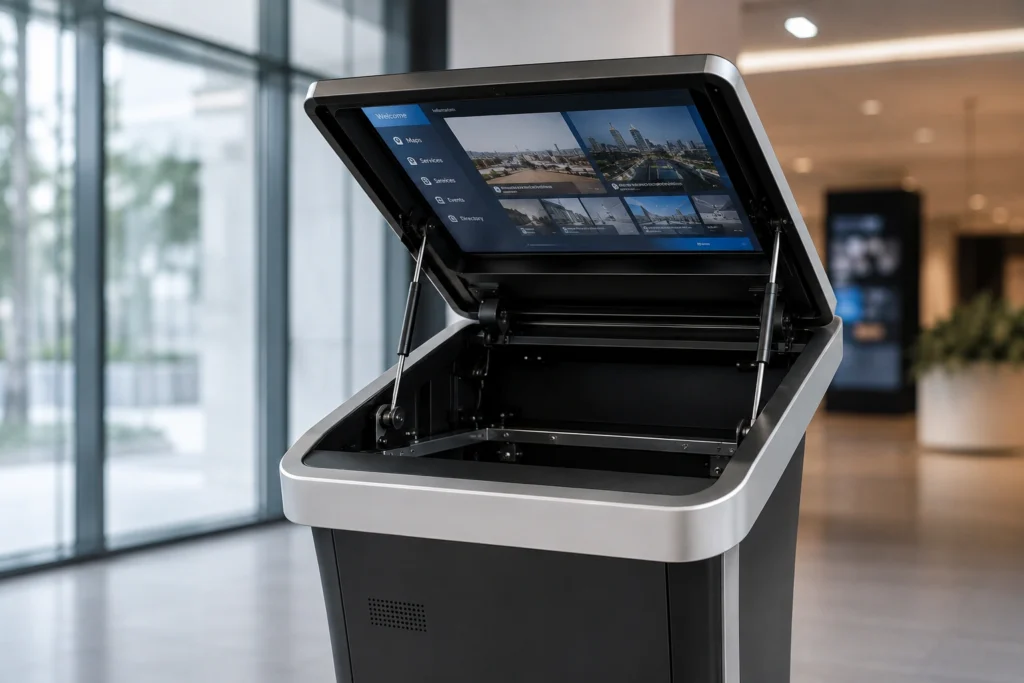
Interactive Display & Touchscreen Kiosks
Compact lift, controlled hold, and soft-close support for touchscreen housings and display service panels — sized to fit tight enclosures and protect the electronics behind them.
- 1 The Panel That Opens Onto a Screen, Not Empty Space
- 2 Where Gas Springs Go on Interactive and Touchscreen Kiosks
- 3 One Spring or Two on a Display Panel
- 4 When to Specify Stainless Steel or Locking Gas Springs
- 5 Specification Quick-Reference by Panel Type
- 6 Sizing Gas Springs for Touchscreen Kiosks: Stroke, Fit, and Force
- 7 Why Kiosk OEMs Source Display-Panel Springs from Newtone
- 8 Frequently Asked Questions
- 9 Conclusion
- 10 Get a Specification or Quote
The Panel That Opens Onto a Screen, Not Empty Space
Gas springs for touchscreen kiosks have a constraint most door springs never see: there is a display and a stack of boards right behind the panel they hold, and the spring has to fit in the gap without touching any of it. Open the front housing of a wayfinding kiosk or a self-order terminal and you are looking at a thin cavity, a bonded touchscreen, and a media player crammed in tight. The technician needs that panel to lift, stay open while they swap a board, and close back down without the panel cracking onto the glass. A spring chosen for force alone, without checking that it fits and eases shut, is the one that leaves a hairline across a display.
This page is for the engineers and buyers who design and maintain that hardware: OEM teams building interactive kiosks and digital signage, procurement teams sourcing replacement panel springs for deployed terminals, and distributors supplying the people who service them. The emphasis here is geometry and control — fitting the spring in a shallow housing, and bringing the panel down soft enough to protect what is behind it.
Who this page is for: interactive kiosk and digital-signage OEM engineers specifying display-panel support, procurement teams sourcing compact replacement springs for deployed terminals, and distributors supplying technicians who service screens in tight enclosures.
Where Gas Springs Go on Interactive and Touchscreen Kiosks
The moving parts on an interactive kiosk are mostly access panels onto sensitive hardware, and each one is a packaging problem before it is a force problem. The cavity is shallow, so stroke and closed length usually decide the spring before the weight does.
Front Touchscreen Housings
The hinged or lift-up bezel that gives access to the back of the display. Shallow depth and a fragile screen behind it make this the tightest packaging case and the clearest reason to want a soft, damped close.
Media Player & Electronics Bays
Rear or side covers over the player, power supply, and cabling. Light panels, but opened for support, so a clean controlled motion and a spring that does not foul the wiring loom matter more than raw force.
Card Reader & Peripheral Doors
Small covers over payment modules, printers, and scanners. Low force, very tight envelope, moderate cycle count — the case where a compact body diameter and short closed length are the whole spec.
Outdoor Interactive Terminals
Wayfinding, EV, and transit kiosks exposed to weather. Same packaging constraint plus rain and temperature swing, which adds stainless material and a temperature check to the geometry work.
One Spring or Two on a Display Panel
Most touchscreen housings run a single spring, because the panels are light and the cavity rarely has room for two. The deciding factor is width and twist, not weight. A narrow bezel on one centred spring lifts straight and true; a wide display panel on a single off-centre spring racks, and on a bonded screen a panel that flexes as it lifts is a panel that can crack. When the display is wide, pair the springs and keep the lift square.
⬤ Single Spring Setup
- Narrow bezels and small peripheral doors
- Light panels, centred load
- Shallow cavity with room for one spring only
- Lower part count and cost
⬤ Paired Spring Setup
- Wide display housings prone to racking
- Bonded screens that must lift without flex
- Even lift to protect the glass
- Springs force-matched to ±5% from one batch
When to Specify Stainless Steel or Locking Gas Springs
For indoor interactive kiosks — retail, hospitality, transit halls — a standard configuration is right: a black nitrided rod (900–1000 HV, 20–30 µm) with HNBR seals handles indoor conditions and a long service life. Outdoor and semi-outdoor terminals are the case for a stainless steel gas spring, since rain and condensation pit a standard rod and let the seals fail sooner.
Locking is worth it where a technician needs the display panel to stay firmly open and hands-free while they work over live electronics, especially on a heavier housing that could drift down onto a screen. A locking gas spring holds at full open until released. For the protect-the-glass problem on the way down, though, the more relevant tool is damping rather than locking — a hydraulic damper or a damped gas spring controls the closing speed so the panel eases shut instead of dropping onto the display.
Specification Quick-Reference by Panel Type
| Panel Type | Typical Weight | Recommended Force | Spring Count | Notes |
|---|---|---|---|---|
| Front touchscreen housing | 4–9 kg (9–20 lb) | 100–220 N (22–49 lbf) | 1–2 | Tight cavity — solve stroke first; damped close |
| Wide display panel | 8–15 kg (18–33 lb) | 150–300 N each (34–67 lbf) | 2 | Pair to stop the screen flexing |
| Media / electronics bay | 3–7 kg (7–15 lb) | 80–160 N (18–36 lbf) | 1 | Clear the wiring loom through travel |
| Card reader / peripheral door | 1–4 kg (2–9 lb) | 40–90 N (9–20 lbf) | 1 | Compact body, short closed length |
| Outdoor interactive terminal | Any of the above | Per type + temp margin | 1–2 | Stainless + temperature check |
Sizing Gas Springs for Touchscreen Kiosks: Stroke, Fit, and Force
Start with the geometry, because in a shallow housing that is the binding constraint. The stroke has to cover the panel’s travel, and the spring’s closed length has to fit the cavity while still housing that stroke plus the seals and guide:
Stroke = Lextended − Lcompressed | Lcompressed ≥ Stroke + body/guide allowance
Stroke = travel the panel needs · Lcompressed = closed length (must fit the cavity) · allowance = seals + guide + fittings
Worked example — front housing needing 180 mm (7.1 in) of panel travel:
Stroke required = 180 mm (7.1 in) · typical closed length ≈ stroke + ~10% body allowance
Lcompressed ≥ 180 + ~20 = ~200 mm (7.9 in) minimum closed length — if the cavity is shorter than this, reduce stroke with pivot geometry or split into two shorter springs.
Only once the spring fits do you set the force, with a moment balance about the hinge: F = (W × Lg × cos φ) ÷ (n × r). For a 5 kg (11 lb) top-hinged screen housing (W = 49.1 N / 11 lbf), Lg = 135 mm (5.3 in), held open on a single spring with r = 50 mm (2 in): F = (49.1 × 0.135) ÷ (1 × 0.05) ≈ 133 N (30 lbf). Add a safety factor near 1.15, and for outdoor units a temperature correction of about 0.3% per °C (FT ≈ F20 × [1 + 0.003 × (T − 20)]). Where the cavity depth, panel weight, or hinge position isn’t fixed, send the geometry to our engineering team rather than guess.
Mounting decides both the soft close and the fit. Mount the spring rod-down in the closed position: it keeps the seals lubricated, and on a damped spring it is the only orientation in which the end-of-stroke damping actually slows the panel before it reaches the screen. Use ball-socket or eyelet fittings that allow a little angular play so the rod takes pure axial load, never side-load, and verify the spring clears the display and boards through its entire travel before you commit the pivot points. The lower pivot’s position relative to the hinge shifts the effective moment arm more than re-rating the force does, which is useful when the cavity leaves you little room to move.
Why Kiosk OEMs Source Display-Panel Springs from Newtone
We manufacture in our own plant in Turkey, so stroke, closed length, body diameter, and damping are ours to tune to a specific housing — which is exactly what a screen crammed into a shallow cavity needs.
Frequently Asked Questions
Work the geometry before the force. Stroke equals extended length minus compressed length, and the compressed length must still house the full stroke plus seals and fittings. A panel needing 200 mm (8 in) of travel needs a spring whose closed length is roughly 220 mm (8.7 in) or more. Confirm the exact closed length with Newtone for the body diameter you choose.
Use a gas spring with end-of-stroke damping and mount it rod-down. Near full extension the spring meters its oil to slow the panel over the last part of travel, so it eases onto its stop instead of hitting the display and boards. Damping only works with the rod pointing down, so rod orientation is part of the soft-close design, not just an install detail.
Take a moment balance about the panel hinge: weight in newtons × hinge-to-centre-of-gravity distance × cos of the open angle, divided by the number of springs × the spring’s perpendicular moment arm. A 5 kg (11 lb) top-hinged screen housing on one spring at a 50 mm (2 in) arm needs about 132 N (30 lbf). Send Newtone the geometry for an exact figure.
Mount it rod-down in the closed position so the oil keeps the seals lubricated and any end-of-stroke damping works. Use ball-socket or eyelet fittings that allow slight angular play so the rod is not side-loaded, and keep both pivots in the same plane. In a tight housing, check that the spring clears the screen and boards through its whole travel before fixing the mount points.
Usually not. Indoor kiosks in malls, lobbies, and retail are well served by a black nitrided rod with HNBR seals. Stainless steel is the right choice for outdoor and semi-outdoor interactive kiosks exposed to rain, washdown, or heavy condensation, where a standard rod would pit and shorten seal life.
Conclusion
An interactive kiosk spring is judged by what it does not damage. The panel opens onto a screen and a stack of boards, so the spring has to fit a shallow cavity, lift the panel without flexing it, and come back down soft enough to leave the glass intact. The mistakes are specific to this job — sizing the force before checking the closed length, running a single spring under a wide display that then racks, or skipping damping and letting the panel drop onto the screen.
Newtone builds these springs to the housing, not to a catalog: custom stroke and closed length to fit a thin cavity, compact body diameters for peripheral doors, soft-close damping to protect the display, and matched pairs to ±5% so wide panels lift level. Engineering support is available to work the stroke, force, and damping for a specific enclosure before it goes into production.
Send us the cavity depth, panel weight, travel, and whether the kiosk is indoor or outdoor. We’ll come back with a stroke-and-force recommendation, a datasheet, and a quote — usually within 5 business hours.
Get a Specification or Quote
Tell us your housing depth, panel weight, required travel, and whether the kiosk is indoor or outdoor. Our engineering team handles the rest — stroke and force calculation, damping, material choice, and a configuration that fits the cavity.