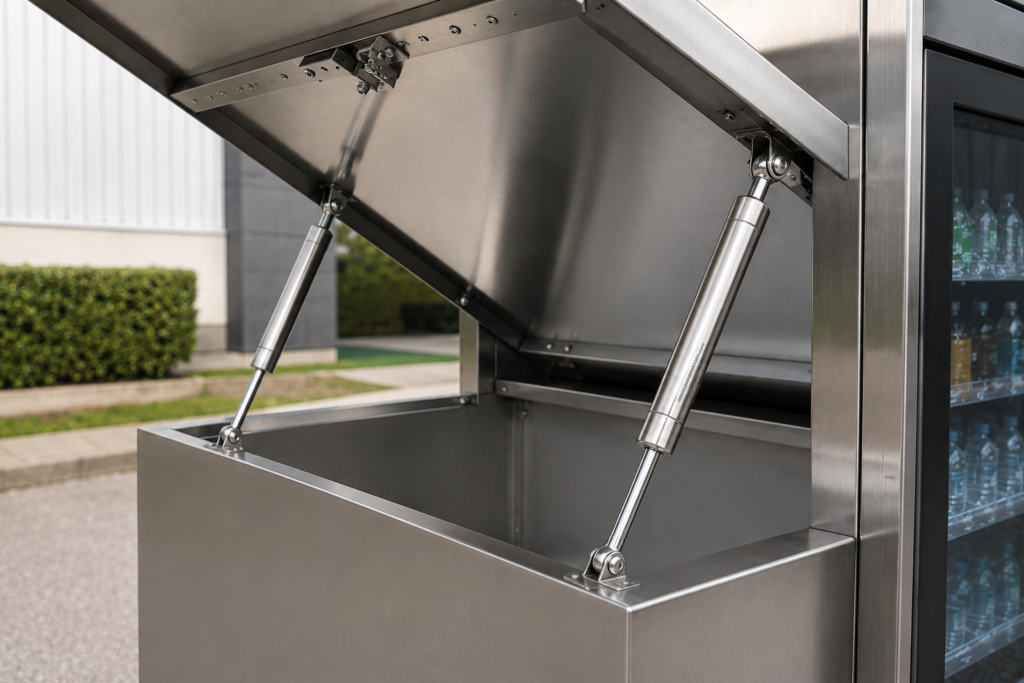
Outdoor Vending Units
Corrosion-resistant door and panel support for vending machines that live outdoors — engineered to survive rain, washdown, salt, and a wide temperature swing without losing force.
- 1 The Spring That Has to Outlast the Weather
- 2 Where Stainless Steel Gas Springs for Outdoor Vending Earn Their Cost
- 3 One Spring or Two on an Outdoor Vending Door
- 4 Choosing the Right Stainless Grade and When Locking Helps
- 5 Specification Quick-Reference by Outdoor Vending Door
- 6 Sizing for Service Life: Cycles, Corrosion, and Force
- 7 Why Outdoor Vending OEMs Source Stainless Springs from Newtone
- 8 Frequently Asked Questions
- 9 Conclusion
- 10 Get a Specification or Quote
The Spring That Has to Outlast the Weather
Stainless steel gas springs for outdoor vending exist because of what a parking-lot machine goes through that a lobby one never does. A vending unit standing outside a gas station or a transit platform takes rain, gets hosed down on cleaning rounds, catches road salt spray in winter, and goes through a daily condensation cycle as the temperature drops at night and climbs at dawn. The door still has to open for restocking and hold while an operator loads it — but the quiet failure here is not the force, it is the rod. A standard hard-chrome rod pits in that environment, and a pitted rod chews up the seals it runs through until the spring leaks and sags. Stainless is how you stop that.
This page is for the people specifying machines that will not live indoors: vending OEM engineers designing outdoor and semi-outdoor cabinets, procurement teams replacing corroded door springs across an exposed fleet, and distributors supplying operators in coastal, wet, or de-iced locations. The focus is corrosion and service life — why stainless, which grade, and how long it buys you.
Who this page is for: vending and self-service OEM engineers designing outdoor cabinets, procurement teams sourcing corrosion-resistant replacements for exposed fleets, and distributors supplying operators in coastal, high-humidity, or road-salt environments.
Where Stainless Steel Gas Springs for Outdoor Vending Earn Their Cost
Not every vending machine needs stainless, but the outdoor ones almost always do, and some sites push the case harder than others. The rule is simple: the more chloride and moisture, the stronger the argument for a higher stainless grade.
Coastal & Marine-Adjacent Sites
Salt air carries chlorides that pit ordinary steel fast and even attack lower stainless grades. These are the clearest 316-grade cases, where the spring would otherwise be the first thing on the machine to fail.
Road-Salt & De-Iced Locations
Forecourts, transit stops, and roadside machines hit by winter de-icing spray. Salt plus the freeze-thaw temperature swing is a tough combination for both corrosion and force stability.
Washdown & Food-Service Areas
Machines cleaned with pressure washers or near food-prep washdown. Frequent direct water on the rod and seals makes stainless and good rod-down mounting essential, not optional.
Semi-Outdoor & Covered Sites
Under canopies, in car parks, and in open lobbies that still see humidity and condensation. Less aggressive than coastal, but enough that a standard rod gives a shorter life than the cabinet deserves.
One Spring or Two on an Outdoor Vending Door
Most full-height outdoor vending doors use two springs, and outdoors there is a corrosion reason on top of the usual one. Two matched springs share the load so each runs gently and the tall door lifts square — but they also let each spring be a smaller unit working below its limit, and a spring run below its limit through a wet, cold life holds up better than one run near maximum. A single spring is for small countertop or kiosk-style outdoor units only.
⬤ Single Spring Setup
- Small outdoor or countertop machines
- Light control and coin panels
- Narrow door, rigid frame
- Lower part count and cost
⬤ Paired Spring Setup
- Full-height outdoor service doors
- Tall, glass-fronted or electronics-laden panels
- Even lift and shared load for long outdoor life
- Springs force-matched to ±5% from one batch
Choosing the Right Stainless Grade and When Locking Helps
Stainless steel is the default rod and body for outdoor vending, and the grade should follow the site. For general outdoor exposure a standard stainless build is enough; for coastal, marine-adjacent, or heavily de-iced locations, a 316-grade body and rod resists chloride pitting far better than 304. Pair that with HNBR seals, which add UV and ozone resistance for a door that sits in sun and weather. Newtone’s stainless steel gas springs are built for exactly this, and the grade is worth confirming against the environment rather than defaulting.
Locking is the same recommendation as for any vending door, with the outdoor twist that wind makes it more valuable. An operator restocks an outdoor machine with both hands while gusts pull at a tall open door, so a locking gas spring that holds the door firmly open until released turns a convenience into a safety feature outdoors. Specify the locking version in the same stainless build so the lock mechanism resists corrosion too.
Specification Quick-Reference by Outdoor Vending Door
| Door / Panel Type | Typical Weight | Recommended Force | Spring Count | Notes |
|---|---|---|---|---|
| Full-height outdoor service door | 12–20 kg (26–44 lb) | 200–400 N each (45–90 lbf) | 2 | Stainless + wind margin |
| Coastal / marine-adjacent unit | 12–20 kg (26–44 lb) | 200–400 N each (45–90 lbf) | 2 | 316-grade for chlorides |
| Outdoor combo / coffee machine lid | 4–9 kg (9–20 lb) | 100–200 N (22–45 lbf) | 1–2 | Warm, wet interior — stainless + seals |
| Coin / cash compartment | 3–6 kg (7–13 lb) | 60–120 N (13–27 lbf) | 1 | High-cycle; corrosion-resistant fittings |
| Small countertop outdoor unit | 3–7 kg (7–15 lb) | 80–150 N (18–34 lbf) | 1 | Single spring plus hinge |
Sizing for Service Life: Cycles, Corrosion, and Force
For outdoor vending the service-life question has two halves — how many cycles, and how long before corrosion ends it — and stainless is what stops the second half cutting the first one short. Start with the cycle life:
Service years ≈ Rated cycles ÷ (cycles per day × 365)
Rated cycles = spring’s rated life · cycles per day = real door opens per day · result = years before cycle wear governs
Worked example — outdoor door, 60 opens/day, 100,000-cycle stainless spring:
Cycles per year = 60 × 365 = 21,900 · Service years ≈ 100,000 ÷ 21,900 = ~4.6 years on cycles
With stainless, corrosion does not cut that short; a standard rod in the same outdoor spot can fail well before the cycle limit once pitting reaches the seals.
Force still has to be sized for an outdoor door. Use a moment balance about the hinge — F = (W × Lg) ÷ (n × r) — for, say, a 16 kg (35 lb) door (W = 157 N / 35 lbf), Lg = 280 mm (11 in), two springs on r = 70 mm (2.8 in): F = (157 × 0.28) ÷ (2 × 0.07) ≈ 314 N (71 lbf) per spring. Then apply a wind safety factor near 1.3 — about 408 N (92 lbf) — and correct for the cold end at roughly 0.3% per °C, since a spring set at 20°C reads near 11% weaker at −15°C. Where the door weight, hinge offset, or site corrosivity isn’t pinned down, confirm both the force and the stainless grade with our engineering team rather than guess.
Mounting matters more outdoors, not less. Fit the spring rod-down in the closed position so the oil keeps the seals lubricated and, just as important outside, so water does not sit at the seal. Use corrosion-resistant ball-socket or eyelet end fittings that allow a little angular play so the rod takes pure axial load — outdoors, side-load plus moisture is the fast path to early failure. Keep both pivots in the same plane, match the pair from one batch, and pair the spring with corrosion-resistant mounting brackets so the bracket is not the part that rusts first.
Why Outdoor Vending OEMs Source Stainless Springs from Newtone
We manufacture in our own plant in Turkey, so the stainless grade, seal, force, and matched-pair production are ours to control — which is what a door that lives outdoors for years actually needs.
Frequently Asked Questions
Because an outdoor vending door is exposed to rain, washdown, road salt, and daily condensation, and a standard hard-chrome rod pits under that. Once the rod pits, the seals start to leak and the spring loses force. A stainless steel rod and body resist that corrosion, so the spring lasts the life of the machine instead of failing a season or two in.
Service life is set by cycles and corrosion together. A door opened 60 times a day runs about 22,000 cycles a year, so a 100,000-cycle spring gives roughly four to five years on cycles, and stainless keeps corrosion from cutting that short outdoors. A standard rod in the same spot can fail far sooner once pitting reaches the seals.
Take a moment balance about the door hinge, then add a wind margin and a cold-temperature correction because the machine is outside. A 16 kg (35 lb) door on two springs at a 70 mm (2.8 in) arm needs about 314 N (71 lbf) each before margins. Apply a safety factor near 1.3 for wind and size at the coldest service temperature. Send Newtone the door geometry for an exact figure.
For genuinely corrosive outdoor exposure, especially coastal or de-iced sites, a 316-grade stainless gives better resistance to chloride pitting than 304. The right grade depends on the site, so confirm the environment with the supplier rather than defaulting. Newtone builds stainless gas springs and can advise on the grade for the location.
Mount it rod-down in the closed position so oil keeps the seals lubricated and water does not pool at the seal. Use stainless or corrosion-resistant end fittings that allow slight angular play so the rod is not side-loaded, and keep both pivots in the same plane. Outdoors, side-load plus moisture is what ends a spring early, so axial-only loading matters even more than indoors.
Conclusion
An outdoor vending door spring is judged by what the weather does to it over years, not by how it feels on day one. The failures are corrosion-led: a standard rod pitted by salt and condensation, a stainless body let down by a non-stainless rod, or the wrong grade for a coastal site — and on top of that, an outdoor door still needs a wind margin and cold-temperature sizing that a warm-bench spec misses.
Newtone builds these springs for the outdoor reality: stainless rod and body with 316-grade options for chloride sites, HNBR seals for sun and UV, matched pairs to ±5% so tall doors lift square, force sized for wind and cold, and locking in the same corrosion-resistant build. Engineering support is available to set the grade, force, and locking for a specific machine and site.
Send us the door type, weight, and where the machine will stand — coastal, roadside, washdown, or covered. We’ll come back with a grade-and-force recommendation, a datasheet, and a quote — usually within 5 business hours.
Get a Specification or Quote
Tell us your door size, weight, mounting geometry, and the site environment. Our engineering team handles the rest — stainless grade, force calculation with wind and cold margins, locking selection, and corrosion-resistant fittings.