Materials
What gas springs are actually made of — cylinder, rod, surface treatment, seals and oil — and how each material choice changes corrosion life, friction and temperature range. Plus the full material and product range a manufacturer can build.
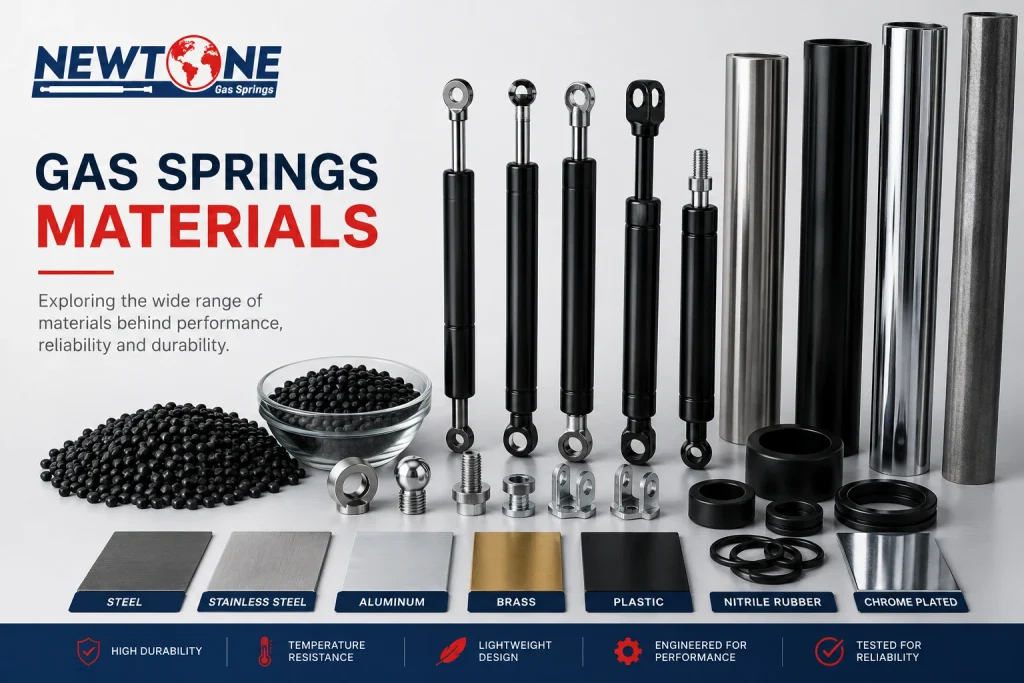
Gas spring materials come down to a short, deliberate list: a steel or stainless cylinder and piston rod, a chrome-plated or black-nitrided rod surface, a polymer or elastomer seal and guide package, a metal or polymer piston, and an inert nitrogen charge with a measured amount of oil. None of it is arbitrary. The cylinder and rod carry the pressure, the rod surface resists wear and corrosion, the seals hold the gas in for years, and the oil lubricates and damps the motion. Get the material combination right and the spring lasts a decade unnoticed; get it wrong and it pits, leaks, or drags.
This guide covers each material and what it does, then maps the choices to the environments they suit. It’s written from a manufacturer’s side of the bench, because these material decisions are exactly what separate a spring that survives a salt-air winter from one that’s weeping oil by spring. At the end, the practical part for buyers: the full span of materials and types that can be built when the supplier isn’t limited to a single catalogue line.
The short version: rod surface and body alloy decide corrosion life; seal compound and oil decide temperature range and friction; rod diameter and gas charge decide force. Match those four to the job and the rest is geometry.
- 1 How Each Gas Spring Material Choice Changes Performance
- 2 The Gas Spring Materials, Part by Part
- 3 Why Seal Material Shows Up in the Force Number
- 4 Choosing Gas Spring Materials by Environment
- 5 The Full Material and Product Range Behind a Gas Spring
- 6 Why Material Range Matters When You Source
- 7 Frequently Asked Questions
- 8 Conclusion
- 9 Specify the Right Materials for Your Application
How Each Gas Spring Material Choice Changes Performance
Material selection isn’t a parts list — each choice moves a specific performance lever. This is the map most catalogue pages leave out.
| Material decision | What it controls | Choose when |
|---|---|---|
| Body alloy (carbon steel / 304 / 316 stainless) | Corrosion resistance and environment rating | Stainless for marine, washdown, food; steel inland. |
| Rod surface (chrome plate / black nitride) | Wear, corrosion, and how kind the surface is to the seal | Nitride as a hard default; chrome for specific corrosion or finish. |
| Seal compound (HNBR and others) | Temperature range, UV/ozone resistance, friction | HNBR for outdoor and hot work; specialised compounds for extremes. |
| Oil (food / standard / high-temp / low-temp) | Damping behaviour and temperature limits | Match the oil to the operating temperature and industry. |
| Rod diameter & gas charge | Gross force output | Size from the load and geometry, within 20–7500 N (4–1686 lbf). |
The Gas Spring Materials, Part by Part
Five material groups make up almost every gas spring. Here’s what each is and why it’s chosen.
Cylinder & rod
Carbon steel for strength and value, or 304 / 316 stainless where corrosion is the threat. The bore is honed smooth so the piston and seal slide with minimal friction. The rod must stay straight and unmarked — any damage to it ends the seal’s life.
Rod surface treatment
The rod is the one part that slides through the seal on every cycle, so its surface matters most. Hard chrome plating gives a smooth corrosion-resistant layer; black nitriding diffuses hardness into the steel itself — 900–1000 HV at 20–30 µm — for wear resistance and a seal-friendly finish.
Seals & guides
The sealing package contains the nitrogen and guides the rod. Compound choice sets the temperature range and friction — HNBR resists UV, ozone and heat far better than plain NBR, which is why it’s the sensible default for any exterior or hot application.
Piston, nitrogen & oil
The piston meters gas flow and sets the speed character; nitrogen provides the force because it’s inert and stable; and a small oil charge lubricates the seal and damps the end of stroke. The oil grade — food, standard, high or low temperature — is matched to the environment.
Why Seal Material Shows Up in the Force Number
The force a gas spring delivers isn’t only about pressure and rod size — the seal and guide materials take a cut of it as friction. That’s why two springs with identical gas charges can feel different.
A = π × 8² ÷ 4 = 50.3 mm² → gross P × A = 402 N (90 lbf)
Seal + guide friction at ~8%: −32 N (7 lbf)
F_eff ≈ 370 N (83 lbf) of usable force
Lower-friction seal and guide compounds keep more of that gross force usable and reduce hysteresis — the gap between how hard the spring pushes opening versus closing. On precision or automated motion that gap matters, and it’s a material choice, not a pressure one. Temperature stacks on top: force also shifts about 0.3% per °C, so the seal and oil that hold up at your operating temperature are part of getting the force right, not an afterthought.
Choosing Gas Spring Materials by Environment
The environment usually picks the materials for you. For dry, inland and interior work, a steel body with a black-nitrided rod and HNBR seals is the cost-effective standard. Move outdoors or into heat and the seal compound and oil grade start to matter. Near salt water, in washdown, or in food and pharmaceutical lines, the body and rod themselves need to change — to 304 or 316 stainless steel — because a coated steel rod will eventually lose to corrosion.
We saw this plainly with a customer operating equipment close to the sea. Their chrome-rod springs kept developing rod pitting and then seal leaks within a couple of seasons, and they assumed it was a quality problem. It wasn’t — it was a material mismatch: the salt air was attacking a surface never meant for it. Moving to 316 stainless bodies and rods, with seals and oil suited to the exposure, ended the warranty returns. Corrosion failures are almost always a materials-selection decision made too early, not a manufacturing defect.
The Full Material and Product Range Behind a Gas Spring
What a buyer can actually get depends entirely on how broad the manufacturer’s range is — and this is where being a manufacturer rather than a reseller shows. A single catalogue line forces your application to fit the product; a full material and product range lets the product fit your application. For reference, the span Newtone builds to looks like this:
Spring & damper types
Compression and standard gas springs, side-valve and end-valve adjustable types, force-adjustable springs, traction (pull) and traction-locking springs, locking gas springs, double-stroke springs, double-action cylinders, friction springs, multiforce springs, hydraulic dampers, and non-gas mechanical springs — more than a dozen distinct families.
Body, rod & seal materials
Carbon steel, 304 stainless and 316 stainless bodies and rods; chrome-plated or black-nitrided (900–1000 HV) rod surfaces; HNBR seals as standard. The right combination is specified per application rather than forced from stock.
Oils for every temperature
Food-grade oil for food and packaging equipment, standard oil for general use, high-temperature oil for hot machinery, and low-temperature oil for cold-store and outdoor cold-soak — across the full −40°C to +100°C (−40°F to +212°F) range.
Fittings & brackets
More than 50 end-fitting types, over 100 metal connectors, and over 100 mounting bracket variants — the difference between a spring that bolts straight into your design and one you have to engineer around.
That breadth is the practical point of this whole page. Materials only help if the manufacturer can actually supply the combination your application needs, matched to ±5% on force and cycle-tested past 100,000 operations. Range plus tolerance is what turns a materials list into a part that fits.
Why Material Range Matters When You Source
We’re a manufacturer, not a distributor — so body alloy, rod finish, seal compound, oil grade, force, stroke and fittings are all specified per order, not picked from whatever’s on a shelf.
Frequently Asked Questions
A gas spring is built from a steel or stainless cylinder and piston rod, a surface-treated rod (chrome-plated or black-nitrided), a polymer or elastomer seal and guide package, a piston, and an inert nitrogen charge with a small amount of oil. Each material is chosen for a reason: the cylinder and rod handle pressure, the rod surface resists wear and corrosion, the seals contain the gas, and the oil lubricates and damps. The combination decides corrosion life, friction, and temperature range.
Both protect the rod and the seal that rides on it, but in different ways. Hard chrome plating gives a very smooth, hard, corrosion-resistant surface. Black nitriding diffuses hardness into the rod itself — Newtone nitrided rods reach 900–1000 HV at 20–30 µm — for excellent wear resistance and a surface that’s kinder to seals. For most applications nitriding is an excellent default; for specific corrosion or cosmetic needs, chrome or stainless may be specified instead.
Specify stainless — 304 for general corrosion resistance, 316 for marine, coastal, food and washdown environments — when moisture, salt or chemicals would pit a standard steel body and rod over time. The pitting that follows corrosion eventually ruins the seal and lets the gas leak. For dry, inland or interior use, a black-nitrided rod with a steel body and HNBR seals is usually enough at lower cost.
The seal compound and the oil are what set a gas spring’s temperature range. HNBR seals resist UV, ozone and heat far better than standard NBR, which is why Newtone uses them as standard. The oil is then matched to the environment — food-grade oil for food and packaging equipment, high-temperature oil for hot machinery, and low-temperature oil for cold-store and outdoor cold-soak. Newtone springs operate across −40°C to +100°C (−40°F to +212°F).
Yes, in two ways. The force itself comes from nitrogen pressure acting on the rod’s cross-section, so rod diameter sets the gross force. The seal and guide materials then determine how much of that force is lost to internal friction — typically 3–20% — and how smooth the motion feels. Low-friction seal and guide compounds deliver more usable force and less difference between the extend and retract directions.
Conclusion
Gas spring materials are a small set of decisions that carry most of the outcome. Body alloy and rod finish set corrosion life; seal compound and oil set temperature range and friction; rod diameter and gas charge set force. Specify those together with the geometry, not after it, and the spring does its job quietly for years.
The other half is range. Materials only matter if the manufacturer can build the exact combination your application needs — the right alloy, finish, seal, oil, force and fitting — and match it to a tight tolerance. Tell us the environment, the load and the geometry, and we’ll specify the materials and supply the part, typically within 5 business hours.
Specify the Right Materials for Your Application
Send the environment, load, temperature range and mounting details. We’ll recommend the body alloy, rod finish, seal and oil — and build it to your force, stroke and fittings.