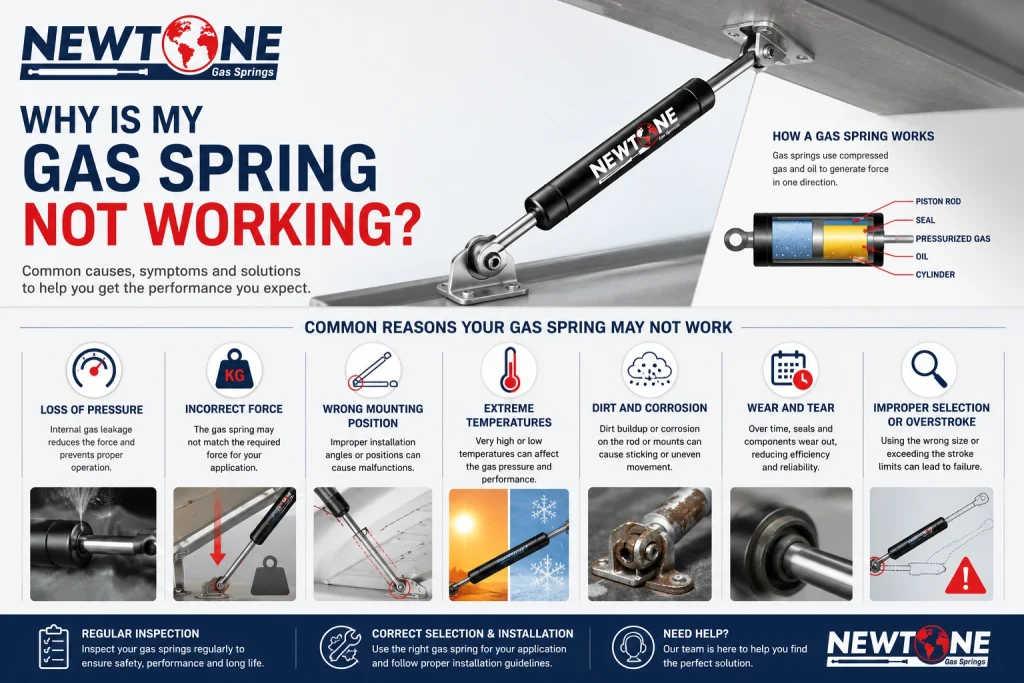
Not Working?
A field-tested diagnostic for OEM engineers, fleet maintenance and procurement teams — how to tell lost pressure from a mounting error, when the spring is actually fine, and what to do about each.
Why is my gas spring not working the way it used to? Most of the time the cause is one of three things: lost gas pressure from a worn seal, a mounting error, or a force that was never matched to the geometry. And in a fair number of cases the spring itself is fine and the installation is the real problem — the point most guides skip, and the one that saves you ordering a replacement you don’t need.
The classic scenes: a new strut won’t compress by hand, so you assume it’s faulty; a tailgate that held all summer sags on a cold morning; one of a pair quietly gives up and the lid lifts crooked. None of these necessarily means a dead spring — each has a specific, diagnosable cause. This page walks through them the way our engineers do when a customer sends a batch back, so you can find the real fault fast.
First principle: a gas spring rated for 100,000 cycles, opened ten times a day, lasts about 27 years on cycle count alone (100,000 ÷ 10 ÷ 365). Genuine wear-out from cycling is rare. When one “stops working” early, it’s almost always a seal/pressure issue, a temperature effect, or a mounting and force mismatch — not end of life.
Why Is My Gas Spring Not Working? The 60-Second Diagnostic
Start by matching your symptom to its most likely cause, then run the quick check before you decide to replace anything. The right-hand column is deliberately honest about the cases where the spring is fine and the fix is free.
| Symptom | Most likely cause | Quick check | Fix |
|---|---|---|---|
| Won’t hold open; drifts shut | Gas pressure loss (worn seal) | Compress by hand — very little resistance means lost charge | Replace; a sealed spring can’t be refilled |
| Held in summer, weak in cold | Temperature derating (~0.3%/°C) | Compare hold warm vs cold | Size for the coldest temp — don’t just add force |
| New strut won’t compress / too strong | Over-spec for geometry, or wrong mount | Check force rating against a moment calc; check mount angle | Recalculate force or move the pivot — often no replacement needed |
| Sticky, grabbing, short life | Mounted rod-up (seals running dry) | Confirm rod points down when closed | Remount rod-down free fix |
| Rust, pitting, oil weeping on rod | Corrosion / seal damage (humid, coastal) | Inspect the rod surface for pitting | Replace; specify stainless or nitrided rod for the environment |
| One side sags (paired) | Mismatched pair / different batches | Swap-test the two struts | Fit a batch-matched ±5% pair |
| Rod visibly bent | Side-load or impact | Check rod straightness | Replace, then correct the mounting alignment |
In short, the first and fifth rows are genuine spring failures; the rest are install, spec, or environment problems a new spring alone won’t solve.
Has It Really Lost Pressure — or Is It the Install?
A true pressure loss is easy to confirm: with the spring off the application, push the rod in by hand. A healthy gas spring resists firmly and pushes back; one that has leaked its charge compresses with almost no effort and doesn’t return. If it’s soft, the seal has gone and the unit needs replacing — a sealed gas spring isn’t designed to be refilled, and opening a pressurised one is genuinely hazardous.
But before you condemn it, rule out the most common false alarm: orientation. A gas spring should sit rod-down in its closed position, so the small oil charge inside keeps the seals wetted and the damping smooth. Mounted rod-up, the oil drains to the wrong end, the seals run dry, and the rod sticks — behaviour identical to a failed spring. Side-load does the same: these units take axial load only, so if the two pivots aren’t in the same plane the rod binds and wears fast. Correct geometry and the right mounting brackets fix a surprising share of “dead” springs at no cost.
The Cold-Weather Case: Why a Good Spring Looks Dead in Winter
If a gas spring works in warm weather and weakens in the cold, it probably hasn’t failed — it’s following physics. Force tracks temperature, because it comes from pressurised gas, and pressure falls as the gas cools. The change is about 0.3% per °C, and it’s enough to matter.
F_T = 250 × [1 + 0.003 × (−15 − 20)]
= 250 × [1 + 0.003 × (−35)] = 250 × 0.895
= 223.8 N (50 lbf) — about 10% weaker
Drop to −20°C (−4°F) and it’s roughly 12% down — the difference between a panel that holds and one that sags. The wrong response is a stronger spring, because then it slams and over-stresses the hinge in summer. The right response is to size for the coldest operating temperature from the start. For outdoor and unheated service we specify HNBR seals as standard for their UV and ozone resistance, and a black-nitrided rod (900–1000 HV) to keep the sealing surface intact across the full −40°C to +100°C (−40°F to +212°F) range.
“Too Strong,” “Won’t Stay Shut,” “Lid Flies Open” — That’s Geometry
When a correctly-made spring still misbehaves, the mounting geometry is usually the culprit. The moment balance, F = (W × Lg × cos φ) ÷ (n × r), shows why: where you attach the strut changes the required force by a factor of two or more. Mount the lower pivot so the strut’s line of action passes almost through the hinge when closed, and it has almost no moment arm there — the panel won’t stay shut, then the spring takes over as it opens and flings the lid up. Move that pivot a few centimetres and the same spring behaves perfectly. Force isn’t the lever here; position is.
A few years ago a fleet customer flagged a batch of springs as failing — panels sticking, units that felt seized within weeks of fitting. We bench-tested the returns and every one held force to spec. Nothing was wrong with the springs. They’d been installed rod-up, the oil had drained away from the seals, and the dry seals were grabbing the rod. Re-orienting them rod-down in the closed position cured the entire batch. The lesson stuck with us: before a spring is called dead, check how it’s mounted — orientation is part of the product’s working health, not an afterthought.
When It Really Is the End of the Line
Sometimes the spring genuinely is finished, and the signs are specific: a soft, non-returning rod on the hand test (lost charge), oil weeping at the rod seal, or visible rod pitting from corrosion. Those are replace-it conditions — and because the unit is sealed and pressurised, replacement is the only safe route. When you replace, match force, stroke and end fittings to the original so the new unit behaves identically; our standard gas springs cover the common configurations, and for coastal or washdown environments a stainless steel gas spring resists the pitting that kills a chrome rod. What you should almost never do is keep swapping in stronger springs to chase a symptom that’s really geometry or temperature.
Why Engineers Bring the Diagnosis to Newtone
We’re a manufacturer, not a distributor — every spring is built in our own facility in Turkey, so when something comes back, we can tell you whether it’s the spring or the application.
Frequently Asked Questions
Most of the time it’s one of three things: lost gas pressure through a worn seal, a mounting error such as fitting it upside down, or a force that was never matched to the geometry. Often the spring is fine and the installation is the real problem, so diagnose before you replace.
Often, yes. A new gas spring is built to be compressed by the leverage of its mounted position, not by hand, so a 300 N (67 lbf) strut can feel impossible to push in on the bench. Mount it first, then test — if it still won’t move once fitted, the force is likely too high for your geometry.
Gas spring force falls with temperature at roughly 0.3% per °C, because the pressurised gas loses pressure as it cools. A spring sized at 20°C can give 10–12% less force at −15°C to −20°C, so a panel that holds in summer can sag on a cold morning. Size for the coldest temperature rather than adding force.
Generally no. A gas spring is sealed and pressurised, so once the seals or charge are gone it’s replaced, not refilled — and opening one is dangerous. First confirm the spring is the problem: a unit that tests to force but fails in service is usually a mounting or orientation issue.
Yes. A gas spring should sit rod-down when closed so the internal oil keeps the seals lubricated. Mounted rod-up, the oil drains away, the seals run dry, and the rod sticks — which looks like a failed spring even though the unit is sound. Re-orienting it rod-down usually restores normal operation.
Conclusion
Working out why is my gas spring not working comes down to reading a small, legible set of signals. A soft rod on the hand test or a weeping seal means the unit is spent and should be replaced. Weakness only in the cold means it’s behaving exactly as temperature dictates. A new strut that won’t compress, or a lid that won’t stay shut, almost always points back to mounting geometry or orientation — and to a spring that’s perfectly healthy.
The commercial point is simple: chasing the wrong diagnosis costs money and rarely fixes anything. Stronger springs won’t cure a geometry problem, and refitting a “dead” batch that was only mounted upside down wastes a good order. If you’re not sure which case you’re in, send us the symptom plus the panel weight, mounting points and operating temperature. We’ll tell you whether it’s the spring or the setup, and recommend the fix — typically within 5 business hours.
Get a Straight Diagnosis
Describe the symptom and your mounting setup. Our engineers will tell you whether to replace, re-mount, or re-spec — and supply the right part if you need one.