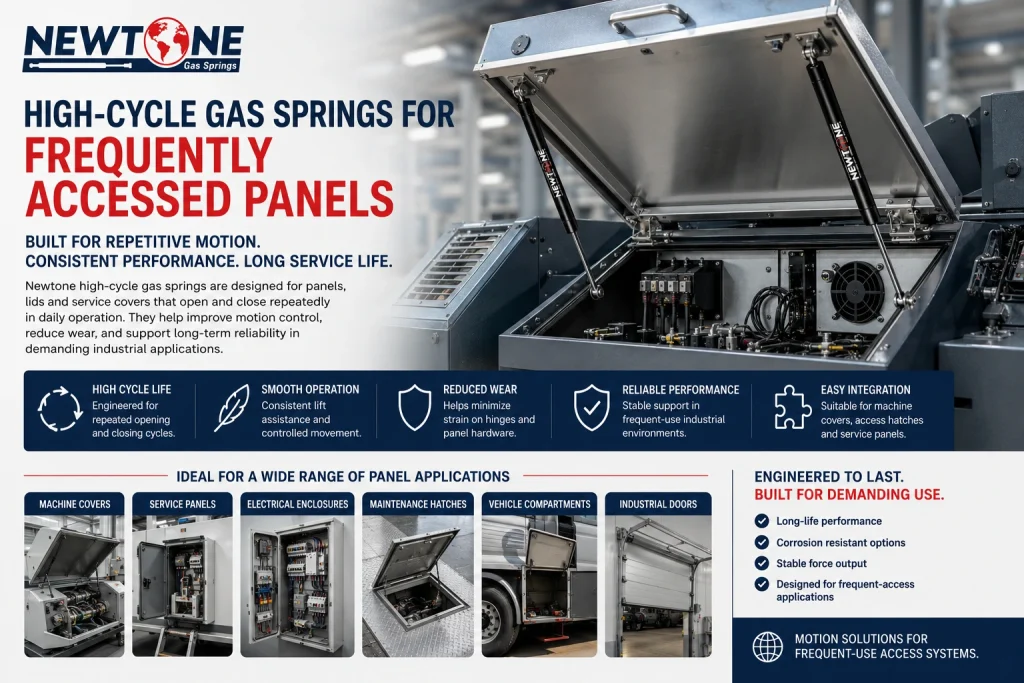
Application Guide — High-Cycle & Heavy-Use
Gas Springs for
Frequently Accessed Panels
Cycle-life engineering for access doors, kiosk enclosures, vending panels and test-equipment hatches — for OEM engineers and procurement teams who need the spring to outlast the warranty.
- 1 Sizing Gas Springs for Frequently Accessed Panels Starts with Cycles, Not Force
- 2 How Long Does a High-Cycle Gas Spring Actually Last?
- 3 The Cycle-Life Triangle: Rate, Alignment, and Static Load
- 4 Mounting Gas Springs for Frequently Accessed Panels to Last
- 5 Specifying a Gas Spring for High Cycle Life
- 6 Cycle-Life Quick-Reference by Use Intensity
- 7 Why Manufacturers Source High-Cycle Springs from Newtone
- 8 Frequently Asked Questions
- 9 Conclusion
- 10 Get a Cycle-Life Spec or Quote
Sizing Gas Springs for Frequently Accessed Panels Starts with Cycles, Not Force
Gas springs for frequently accessed panels live or die on three numbers, not one: cycles per day, alignment, and static load. A unit rated at 100,000 cycles opening 30 times a day lasts roughly nine years. The same spring side-loaded by a misaligned bracket, or held under too much pressure when the panel is closed, can fail in months. The cycle rating is the headline figure, but the duty and the geometry are what actually decide how long the spring survives. Think of a self-service kiosk in a transit hub, a refrigerated vending door, or the access hatch on a piece of test equipment a technician opens a hundred times a shift. These panels get worked harder in a month than a car tailgate sees in a year. Spec the spring the way you’d spec a tailgate strut — by force alone — and you’ve bought yourself a warranty problem. The job here isn’t to hold a lid open; it’s to keep doing it, smoothly, tens of thousands of times.
Who this page is for: OEM engineers designing access panels that cycle dozens to hundreds of times a day, procurement managers sourcing replacements that keep failing early, and distributors supporting equipment where downtime from a dead strut costs more than the strut.
100,000+
Minimum Cycle Rating — Extended-Life on Request
100–400 N
Typical Panel Force (22–90 lbf) — mfg. range 20–7500 N / 4–1686 lbf
−40° to +100°C
Operating Temp Range
±5%
Force Tolerance
How Long Does a High-Cycle Gas Spring Actually Last?
Take the cycle rating, divide by how many times the panel is opened per day, then by 365. That single calculation tells you more than any catalogue adjective, and it’s the one most suppliers won’t put in writing.Service-life framing
Service years ≈ Rated cycles ÷ cycles-per-day ÷ 365
One cycle = one open plus one close. Use the real opening frequency for the panel, not a nominal one.
The Cycle-Life Triangle: Rate, Alignment, and Static Load
Most “high-cycle” failures aren’t the rod running out of fatigue life — they come from one of three things the cycle rating doesn’t capture: how fast the panel is cycled, how well the spring is aligned, and how much force sits on the seals when the panel is shut. Get those right and a standard spring reaches its rating. Get any one wrong and the rating becomes fiction. Rate matters because published cycle figures are measured at a moderate pace, often no more than about three cycles per minute at room temperature. A machine-paced or rapidly hand-cycled panel doesn’t let the spring settle thermally between strokes, and a warm body accelerates seal wear. Alignment matters most of all. Gas springs are built for axial load only; if the two pivots aren’t in the same plane of motion, every single cycle drags the rod sideways through the seal. We once worked with a US kiosk-enclosure manufacturer whose access-door struts kept failing well short of their rating. The cycle count wasn’t the problem — the units were dying young from a closed-position force set too high, which kept the seals under heavy static load, compounded by a few degrees of bracket misalignment that side-loaded the rod on every open. Dropping the force and squaring up the mounting brought the life back to where the rating said it should be. Neither fix cost anything in production; both would have been invisible on a force-only spec sheet.Mounting Gas Springs for Frequently Accessed Panels to Last
On a high-cycle panel, the mounting geometry protects the spring more than the cycle rating does. Keep both pivots in the same plane of motion so the load stays axial — lateral load is the single fastest way to shorten life. Use ball-socket or eyelet end fittings that allow slight angular misalignment, so normal build tolerance doesn’t translate into a side-load. Mount the rod pointing down in the panel’s at-rest position, which keeps the seals sitting in oil for consistent lubrication and quieter, more even motion. And remember that shifting the lower mount point changes the effective moment arm more than changing the force does, so dial in the geometry before reaching for a different force. Repeatable mounting brackets are what make that alignment hold across a production run instead of drifting unit to unit.⚠ The most common high-cycle spec mistake: chasing force instead of cycles. A spring sized at the very top of the force window sits under heavy static seal load whenever the panel is closed, and that static pressure — not the opening and closing — is often what wears it out early. Pair that with a misaligned bracket and you get exactly the warranty pattern that looks like a “bad batch” but is really a specification and geometry issue. Size with a small force margin and square the mounting.
Specifying a Gas Spring for High Cycle Life
Once the duty is known, the cycle-life spec comes down to a handful of choices a manufacturer controls. A hard, smooth rod surface is what the seal rides against thousands of times, so a black nitrided rod at 900–1000 HV and 20–30 µm gives the seal a durable running surface. HNBR seals hold up to UV, ozone and temperature cycling far better than commodity NBR, which matters on any panel that sees daylight or heat. Damping oil keeps the seal lubricated across the stroke. Above all, size below the maximum tolerable force so the seal isn’t permanently overloaded when the panel is shut. For genuinely heavy or continuous duty, an extended-life build raises the cycle target beyond the standard floor, but the right number depends on your real rate and temperature rather than a catalogue label — so it’s set with engineering, not guessed. If the panel lives in a humid or wash-down enclosure, a 316L stainless body and rod prevents the surface pitting that would otherwise destroy the seal long before the cycles run out. For most dry indoor panels, the nitrided rod is enough.Cycle-Life Quick-Reference by Use Intensity
| Use Intensity | Opens per Day | Suggested Cycle Target | Priorities |
|---|---|---|---|
| Light | Up to ~10 | 100,000 (standard) | Standard build is ample; basic alignment |
| Medium | ~10–40 | 100,000+ | Check alignment; small force margin |
| Heavy | ~40–150 | Extended-life build | Tight alignment, force margin, seal/oil spec |
| Continuous / machine-paced | 150+ or automated | Engineered to duty | Review rate & temperature with engineering |
Why Manufacturers Source High-Cycle Springs from Newtone
We’re a manufacturer, not a distributor. Every spring is built in our own facility in Turkey, so rod finish, seal compound and tolerance are ours to control — the three things that decide cycle life. You can review our gas springs range.100,000+ Cycle Floor
Standard minimum, with extended-life builds configured to your real duty.
Nitrided Rod, 900–1000 HV
A hard, smooth 20–30 µm running surface for the seal to ride on, cycle after cycle.
HNBR Seals as Standard
UV, ozone and temperature-cycling resistance for panels that see heat or daylight.
±5% Force Tolerance
Consistent force unit to unit, so a service replacement behaves like the original.
Custom & Engineering Support
Cycle target, force margin and seal spec reviewed against your duty — support available.
OEM & Aftermarket
Same platform for new builds and exact-match replacements, exported to 60+ countries.
Frequently Asked Questions
How long does a gas spring last on a frequently used panel?
Divide the cycle rating by how many times the panel is opened per day, then by 365. A 100,000-cycle spring opened 30 times a day lasts about nine years; the same spring on a panel opened 150 times a day lasts under two. That figure assumes clean alignment and a sensible force margin. Side-load or an over-high closed force can cut it to a fraction regardless of the rating.
What counts as a high-cycle gas spring?
There is no single industry threshold, but in practice anything specified above the common 50,000-cycle baseline is treated as high-cycle, and frequently accessed panels usually start at a 100,000-cycle floor. The number that matters is whether the rating comfortably exceeds your real cycles-per-day over the service life you need, not the headline figure on its own.
Why did my gas spring fail before its cycle rating?
Almost always alignment or force, not the gas itself. If the two pivots are not in the same plane of motion, every cycle side-loads the rod and scores the seal, so a unit rated for 100,000 cycles can fail in a few thousand. An over-high force that holds the seals under heavy static pressure when the panel is closed does the same thing more slowly. Cycle ratings are measured under clean axial loading.
Does cycling a gas spring quickly reduce its life?
Yes. Published cycle ratings assume a moderate rate, commonly no more than about three cycles per minute at room temperature. Faster repeated cycling and a warm enclosure heat the seals and shift the force, so the real-world life on a fast-paced panel is shorter than the bench figure suggests. If the panel is machine-paced or runs hot, the rate and temperature need to be part of the specification.
Can Newtone supply higher-cycle gas springs for OEM panels?
Yes. Newtone’s standard floor is 100,000+ cycles, and extended-life builds are configured with our engineering team around your rate, temperature, and force. We supply both the OEM build and exact-match aftermarket replacements from the same platform, so a service-network spring behaves like the original.
Conclusion
A frequently accessed panel doesn’t need the strongest spring; it needs the one that keeps working after the hundred-thousandth open. That comes down to matching the cycle rating to your real cycles-per-day, keeping the mounting square so the load stays axial, and sizing the force with enough margin that the seals aren’t overloaded sitting closed. Miss those and you get early failures that look random but aren’t. Newtone has been building this kind of spring for OEMs and distributors for over two decades, with the rod finish, seal compound and tolerance held in-house because that’s where cycle life is won. Whether you’re designing a new access panel, chasing down a recurring early-failure pattern, or sourcing a longer-life replacement, send us the duty and we’ll spec to it. Tell us your opens-per-day, panel weight and geometry, and operating temperature. We’ll come back with a cycle target, a force, and a quote — typically within five business hours.Get a Cycle-Life Spec or Quote
Share how often the panel is opened, its weight and mounting, and the operating temperature. Our engineering team turns that into a cycle target and a matched force — no charge for the calculation.Email: [email protected]
Response: Within 5 business hours
Supply: OEM & Aftermarket — Global Export