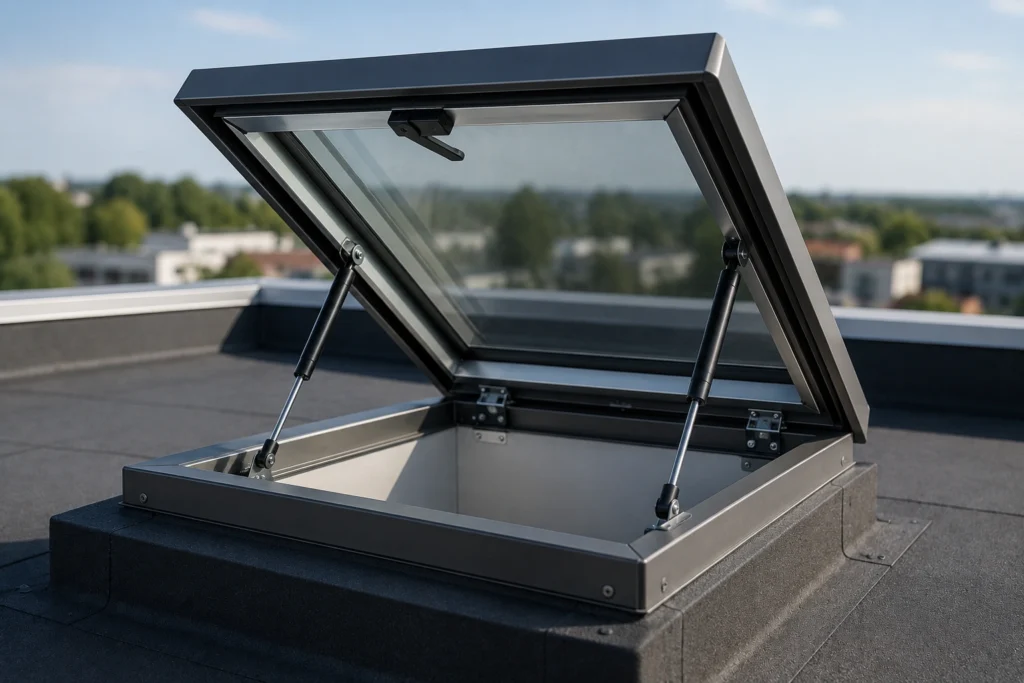
Skylights & Roof Access Hatches
Weather-rated lift and hold support for roof hatches, smoke vents, and skylights — built to hold a heavy panel open in wind and survive years of outdoor exposure.
The Hatch a Worker Has to Trust at Roof Height
Gas springs for roof access hatches carry a panel that someone climbs out underneath, on a roof, often in wind — which is a very different job from a cabinet lid indoors. Picture a maintenance tech pushing up a roof hatch to reach a rooftop unit: the panel is heavy steel or insulated aluminium, it opens flat to near-vertical, and once it is up it has to stay up while they climb through with tools. A gust catches an open hatch like a sail. If the spring is under-sized, or has corroded through a winter, the hatch drops or slams, and at roof height that is a serious incident. The spring’s job is to make the panel light to lift, dead-steady when open, and controlled on the way down.
This page is for the people who specify that hardware: OEM engineers building roof hatches, smoke vents, and skylights, procurement teams sourcing weather-rated replacement springs for installed units, and distributors supplying building-maintenance contractors. The focus is the outdoor reality of the job — wind and snow loading, corrosion, and the temperature swing a rooftop sees across a year.
Who this page is for: architectural and building-hardware OEM engineers specifying roof hatch, vent, and skylight counterbalance; procurement teams sourcing weather-rated replacements for installed units; and distributors supplying building-maintenance and roofing contractors.
Where Gas Springs for Roof Access Hatches Are Used
Roof openings come in a few forms, and they differ in weight, opening angle, and how often they move. The spring follows the opening, and an outdoor location is the common thread that drives material and safety margin for all of them.
Roof Access Hatches
Heavy walk-through hatches for rooftop maintenance access. Opened from below to near-vertical, infrequent but high-consequence, and the clearest case for a locking spring so the panel cannot drop on someone climbing out.
Smoke & Heat Vents
Roof vents that open for smoke extraction and daily ventilation. These sit outdoors permanently and must open reliably after long periods closed, so corrosion resistance and a force that holds after years of standstill matter most.
Opening Skylights & Roof Windows
Glazed panels that lift for light and ventilation, often heavier than they look once the glass and frame are counted. Smooth, controlled motion and a soft close protect the glazing and the seal.
Rooftop Equipment & Plant Covers
Hinged covers over rooftop HVAC, plant, and service equipment. Wide, exposed panels that catch wind, usually paired springs, and a strong candidate for a generous wind-load safety factor.
One Spring or Two on a Roof Hatch
Most roof hatches and wide vents use two springs, and outdoors that is about wind as much as weight. A wide panel on a single spring twists, and a twisted hatch does not seal against weather — which on a roof means leaks. Two matched springs keep the panel square so it closes flat onto its weather seal, and they share the load so each runs below its limit through a long outdoor life. Narrow skylights and small vents can run on one.
⬤ Single Spring Setup
- Narrow skylights and small vents
- Light panels, centred load
- Hinge mechanism shares the load
- Lower part count and cost
⬤ Paired Spring Setup
- Walk-through roof hatches and wide vents
- Panels that must seal flat against weather
- Wide covers that catch wind
- Springs force-matched to ±5% from one batch
When to Specify Stainless Steel or Locking Gas Springs
For roof hatches, stainless steel is usually the correct default rather than an upgrade, because the spring lives fully outdoors. Rain, UV, and condensation pit a standard hard-chrome rod over time, and once the surface is pitted the seals start to leak and the force fades. A stainless steel gas spring with a 316-grade body and rod resists that, which is why this application is the textbook high-humidity case the material exists for. HNBR seals add UV and ozone resistance on top.
Locking is the other strong recommendation here, and for a direct safety reason. A worker passes through an open roof hatch, and a free hatch can be slammed shut by wind onto someone half-through it. A locking gas spring holds the hatch mechanically at full open until it is deliberately released, removing that risk. The right release type depends on hatch weight and how the user operates it from the ladder, so confirm it at the design stage rather than retrofitting.
Specification Quick-Reference by Opening Type
| Opening Type | Typical Weight | Recommended Force | Spring Count | Notes |
|---|---|---|---|---|
| Walk-through roof hatch | 15–35 kg (33–77 lb) | 250–600 N each (56–135 lbf) | 2 | Locking + stainless |
| Smoke / heat vent | 10–25 kg (22–55 lb) | 180–450 N each (40–101 lbf) | 2 | Must open reliably after long closure |
| Opening skylight / roof window | 8–20 kg (18–44 lb) | 150–350 N each (34–79 lbf) | 1–2 | Count the glass; soft close protects glazing |
| Rooftop equipment cover | 12–30 kg (26–66 lb) | 200–550 N each (45–124 lbf) | 2 | High wind-load safety factor |
| Small access / hatch lid | 5–12 kg (11–26 lb) | 100–250 N (22–56 lbf) | 1 | Single spring plus hinge |
How to Calculate Gas Spring Force for a Roof Hatch
A roof hatch is a top-hinged panel that opens up from a flat, horizontal closed position. The spring works hardest right at the start, where the full weight acts on the longest lever — cos φ = 1 at horizontal — so size for that worst case with a moment balance about the hinge:
F = (W × Lg × cos φ) ÷ (n × r)
F = force per spring · W = hatch weight (N) · Lg = hinge-to-CoG distance · φ = angle above horizontal (0° = worst case) · n = number of springs · r = perpendicular moment arm
Worked example — 20 kg (44 lb) roof hatch, two springs, horizontal:
W = 20 × 9.81 = 196.2 N (44 lbf) · Lg = 300 mm (11.8 in) = 0.30 m · cos 0° = 1 · n = 2 · r = 90 mm (3.5 in) = 0.09 m
F = (196.2 × 0.30 × 1) ÷ (2 × 0.09) = 58.86 ÷ 0.18 = 327 N (74 lbf) per spring
That is the still-air balance, and outdoors you don’t stop there. Apply a safety factor at the high end for wind and snow — 327 N × 1.3 ≈ 425 N (96 lbf) — then size at the coldest service temperature, since force falls about 0.3% per °C (FT ≈ F20 × [1 + 0.003 × (T − 20)]); a hatch that must still hold at −20°C needs roughly 12% more nominal force than the 20°C figure suggests. Keep the strut’s line of action off the hinge pivot so the open hatch doesn’t trap over-centre. Where the hatch weight, hinge offset, and local wind and snow loads aren’t pinned down, that is a number to confirm with our engineering team rather than guess.
Mounting on a roof hatch carries an extra weather duty. Fit the spring rod-down in the closed position so the oil keeps the seals lubricated and any end-of-stroke damping works — and on an outdoor unit, rod-down also keeps water from pooling at the seal. Use ball-socket or eyelet end fittings that allow a little angular play so the rod takes pure axial load; side-load plus weather is what ends an outdoor spring early. Pair the springs from one batch, keep both pivots in the same plane so the hatch closes square onto its weather seal, and remember the lower pivot position relative to the hinge shifts the effective moment arm more than re-rating the force does.
Why Building-Hardware OEMs Source Roof Hatch Springs from Newtone
We manufacture in our own plant in Turkey, so material grade, force tolerance, and lead time are ours to control — which is what a safety-critical panel exposed to weather for years actually needs.
Frequently Asked Questions
Treat the hatch as a top-hinged panel opening from horizontal, where the spring fights the most torque. Moment balance about the hinge: hatch weight in newtons × hinge-to-centre-of-gravity distance, divided by the number of springs × the spring’s perpendicular moment arm. A 20 kg (44 lb) hatch on two springs at a 90 mm (3.5 in) arm needs about 327 N (74 lbf) each before the safety factor. Add a wind and snow margin and send Newtone the geometry.
Yes. A roof hatch sits fully outdoors in rain, UV, and condensation, which pits a standard rod and lets the seals fail, so a stainless steel rod and body is the right call. This is one of the clearest cases for stainless, unlike many indoor applications where a black nitrided rod with HNBR seals is enough.
Often yes. A worker climbs out onto a roof through the hatch and the panel must stay open and not blow shut on them in a gust. A locking gas spring holds the hatch firmly at full open until released, which makes it a safety feature rather than a convenience. Size it with a wind-load safety factor and confirm the release type for the hatch weight.
Mount it rod-down in the closed position so oil keeps the seals lubricated and the motion stays even, and so water doesn’t pool at the seal. Use ball-socket or eyelet fittings that allow slight angular play so the rod is not side-loaded, and keep both pivots in the same plane. Also keep the strut’s line of action off the hinge pivot so the panel doesn’t trap over-centre.
Weather plus the wrong margin. Outdoor UV and moisture attack a standard rod and seals, and force changes about 0.3% per °C, so a hatch sized in a warm shop can be too weak to hold in winter and strained by wind in a storm. Stainless material, HNBR seals, and a wind-load safety factor address all three.
Conclusion
A roof hatch spring is judged at the worst moment: a worker half-through the opening, a gust pulling at the panel, on a cold day years after the spring was installed. The ways it fails are specific to being outdoors — sized like an indoor lid with no wind margin, a standard rod corroded by rain and UV, a single spring twisting a panel until it no longer seals, or force chosen for a warm shop instead of a winter roof. Each one is straightforward to design out.
Newtone builds these springs for the roof, not the bench: stainless for full outdoor exposure, locking where a hatch must hold open safely over someone climbing through, matched pairs to ±5% so panels seal square, and force sized at the cold-end temperature with a wind-load margin. Engineering support is available to set force, stroke, material, and locking for a specific opening before it ships.
Send us the hatch type, weight, opening angle, and the local wind and temperature conditions. We’ll come back with a force recommendation, a datasheet, and a quote — usually within 5 business hours.
Get a Specification or Quote
Tell us your hatch or skylight type, weight, opening geometry, and the climate it will face. Our engineering team handles the rest — force calculation with a wind and snow margin, material choice, and locking selection.