Safety Guide — Gas Springs & Struts
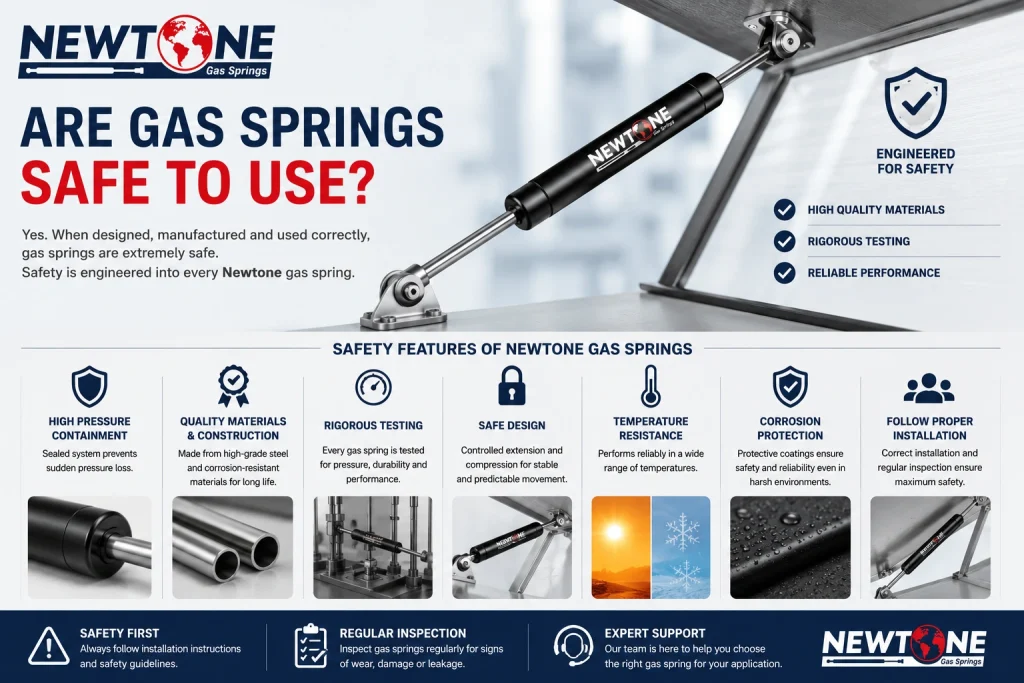
Are Gas Springs
Safe to Use?
A straight answer for OEM engineers, maintenance teams and procurement — where gas springs are completely safe, where the real hazards actually live, and how to handle, lock and dispose of them correctly.
The short version: safe in use, careful in handling. A standard gas spring is engineered to a controlled force, sealed, and cycle-tested to 100,000+ operations. It becomes hazardous only if its casing is breached, it’s exposed to fire, or a damaged unit is forced or removed without care.
100,000+
Rated Cycles (Safe Service Life)
≤250 bar
Typical Internal Pressure (≤3600 psi)
±5%
Newtone Force Tolerance
−40 / +100°C
Operating Temperature Range
- 1 The Two Ways a Gas Spring Fails — and Which One Is Dangerous
- 2 Are Gas Springs Safe in Normal Use? Why a Good One Is
- 3 How Much Energy Is Actually Inside? The Physics
- 4 Are Gas Springs Safe to Cut, Drill, or Dispose Of?
- 5 When Safety Means a Locking Gas Spring
- 6 Standard Gas Springs vs High-Energy Nitrogen Cylinders
- 7 Why Buyers Trust Newtone on Safety
- 8 Frequently Asked Questions
- 9 Conclusion
- 10 Specify a Safe Gas Spring
The Two Ways a Gas Spring Fails — and Which One Is Dangerous
A gas spring fails in one of two ways, and they are not equally serious. Knowing which is which is the core of using them safely.1. Gradual pressure loss (common, low-risk)
A seal wears and the gas slowly bleeds off. The panel starts to creep down or needs more effort to hold. There’s no bang and nothing flies — it’s a cue to replace the spring, not a safety emergency. The vast majority of “failed” springs fail this gentle way.2. Sudden ejection (rare, hazardous)
If the casing is internally damaged, over-extended, or breached, the restraining structure can give way and release the stored energy at once — ejecting the rod or fragments. This is the failure to design against, and it’s almost never something that happens while a healthy spring is just being used.Are Gas Springs Safe in Normal Use? Why a Good One Is
In everyday operation, a quality gas spring is safe because everything hazardous about it is contained and controlled. The force is set to a tested value within a tight tolerance, the nitrogen and oil are fully sealed behind seals chosen for the environment, and the unit is cycle-rated so it won’t quietly degrade for years. A spring rated for 100,000 cycles and used a dozen times a day lasts decades on cycle count alone — well over 27 years before cycling alone wears it out (100,000 ÷ 12 ÷ 365 ≈ 22–28 years). Premature trouble is almost always a specification or installation issue, not the spring being inherently unsafe. Sound installation is part of that safety. Mount the spring rod-down in the closed position so the oil keeps the seals lubricated; keep both pivots in the same plane so the rod isn’t side-loaded, since lateral load shortens life; fit the right mounting brackets with a little angular freedom; make sure end fittings are fully screwed home; and design in mechanical stops so the spring is never forced past its rated extension or compression. None of these are exotic — they’re the standard practice that keeps a safe part safe.How Much Energy Is Actually Inside? The Physics
The force a gas spring holds comes from pressure acting on the cross-section of the rod — that’s the whole mechanism, and it’s why the body is a pressure vessel you don’t breach casually.Force from internal pressure
F = ΔP × A with A = π × d² ÷ 4
ΔP = internal pressure (N/mm²) • A = rod cross-sectional area • d = rod diameter
A typical 400 N (90 lbf) strut with an 8 mm (0.31 in) rod:
A = π × 8² ÷ 4 = 50.3 mm² (0.078 in²)
ΔP = F ÷ A = 400 ÷ 50.3 = ≈ 8 N/mm² (about 80 bar / 1160 psi)
So ~80 bar pushes on a 50 mm² rod to give 400 N (90 lbf) of hold.
Are Gas Springs Safe to Cut, Drill, or Dispose Of?
Not while charged — and this is where most real incidents happen. A pressurised gas spring should never be pierced, cut, machined, welded near, heated, or thrown into a fire. Each of those can breach the cylinder and release the energy uncontrolled. A few specific don’ts worth stating plainly:- Don’t pierce, cut, or grind a charged unit. The body is a sealed pressure vessel; opening it releases oil and gas, and can launch the rod.
- Don’t heat it or expose it to fire. Heat raises the internal pressure and can cause it to burst — which is why struts must be kept clear of welding and burning vehicles.
- Don’t grip, scratch, paint, or solvent-clean the rod. Any damage to the rod surface ruins the seal and starts a leak.
- Don’t try to refill a spent strut. Recharging under pressure with worn seals or a weakened casing is genuinely dangerous; replacement is cheaper and safe.
- Don’t bin or incinerate old units. They must be depressurised by the correct procedure before scrapping, then the metal recycled.
When Safety Means a Locking Gas Spring
Whenever a person can be underneath a held load, a standard spring isn’t the right safety choice — a locking gas spring is. A locking or safety-shroud unit holds mechanically at full extension and won’t let the panel creep down or drop if the spring loses pressure or someone knocks it. Service hatches, equipment covers, and maintenance access panels are the classic cases. For a lid that nobody ever works beneath, a standard spring is fine; the locking version is specifically for hands-free, hold-open safety where a falling panel would hurt someone. We saw exactly why this matters with a customer whose machinery access hatch occasionally drifted down onto technicians’ hands during servicing — the spring was sound, but a hatch held only by gas pressure will always come down eventually if it’s nudged or the charge dips. We moved them to a locking gas spring that holds positively at full open until the operator releases it. The maintenance complaints stopped immediately. Where people put their hands under a load, mechanical hold beats trust in pressure every time.Standard Gas Springs vs High-Energy Nitrogen Cylinders
One honest clarification, because it drives a lot of the fear online: the dramatic “rod ejected across the factory” warnings generally refer to high-energy nitrogen gas cylinders used in press tools and dies, which store far more energy than the gas springs that lift a hood, hatch, or cabinet. A standard lift-support gas spring operates at a few hundred Newtons; a press-tool nitrogen cylinder is a different class of component at much higher pressure and force. Both deserve correct handling, but conflating them makes ordinary lid struts sound more dangerous than they are. If you’re specifying for lift support, you’re in the safer, lower-energy category — handled correctly, entirely routine. Please review our gas spring range.Why Buyers Trust Newtone on Safety
We’re a manufacturer, not a distributor — every spring is built and tested in our own facility in Turkey, so the force, seal and rod quality that safe performance depends on are things we control directly.±5% Force Tolerance
Tested, repeatable force — no surprise units that are wildly over or under spec.
Locking Springs Available
Safety-hold units for any application where a person works beneath the load.
Robust Seals & Rod
HNBR seals and a black-nitrided rod (900–1000 HV) for a long, leak-free life.
100,000+ Cycle Rating
Cycle-tested so the spring stays predictable for years, not months.
Engineering Support Available
Force, stroke and safe-handling guidance, including correct disposal for your model.
OEM & Aftermarket — 60+ Countries
Consistent, traceable supply with a reply within 5 business hours.
Frequently Asked Questions
Are gas springs safe to use?
Yes. A correctly specified, correctly installed gas spring is safe in normal use — it’s a sealed, factory-tested pressure device with no user maintenance. The risk isn’t in opening and closing a panel; it’s in tampering. Cutting, drilling, heating, burning, forcing, or removing a charged strut can release its stored energy suddenly, so those are the moments that call for care.
Can a gas spring explode?
A gas spring won’t explode on its own during normal use, but it can fail violently if its casing is breached or weakened. Cutting or drilling a charged strut, exposing it to fire, or over-extending a damaged one can eject the rod or fragments at high speed. That’s why the body should never be pierced, heated, or cut until the pressure has been released by the correct procedure.
Is it safe to cut or drill a gas spring?
Not while it’s charged. A gas spring is a pressure vessel, and cutting or drilling into the body of a pressurised unit can spray high-pressure oil and metal or launch the rod. If a unit must be dismantled or scrapped, it has to be depressurised first by the manufacturer’s specified method, with eye and ear protection, or handed to a proper recycling scheme. Never put one in a fire.
When do I need a locking gas spring for safety?
Use a locking or safety-shroud gas spring whenever a person can be underneath the held load — service hatches, equipment covers and maintenance access panels are the common cases. A locking spring holds mechanically at full extension, so the panel can’t creep down or drop if the spring loses pressure or someone bumps it. For an open lid that nobody works under, a standard spring is usually enough.
Why does a gas spring slowly stop holding its load?
Gradual pressure loss through a worn seal is the most common failure, and it’s the gentle one — the panel simply starts to creep down or needs more effort to hold. It isn’t dangerous in the way a sudden ejection is, but it is a signal to replace the spring before it stops supporting the load entirely. Specifying good seals and the correct force keeps that day a long way off.
Conclusion
Gas springs are safe to use — that’s the honest answer, with one condition: respect what’s inside them. In ordinary service they’re sealed, tested, and undramatic, holding a panel for years without incident. The energy they store only becomes a hazard when the cylinder is breached or a damaged unit is removed or scrapped carelessly. So the rule of thumb is short: use them freely; don’t cut, drill, heat, or burn them; remove them deliberately and clear of the rod’s path; choose a locking spring wherever someone works under the load; and depressurise correctly before disposal. If you want help choosing the right spring — including a locking version for a safety-critical hold, or the correct way to retire old units — send us the application. We’ll advise, and recommend the right part, typically within 5 business hours.Specify a Safe Gas Spring
Tell us the application and where people stand relative to the load. We’ll recommend a standard or locking spring, with safe-handling and disposal guidance for your exact model.Email: [email protected]
Response: Within 5 business hours
Supply: OEM & Aftermarket — Global Export