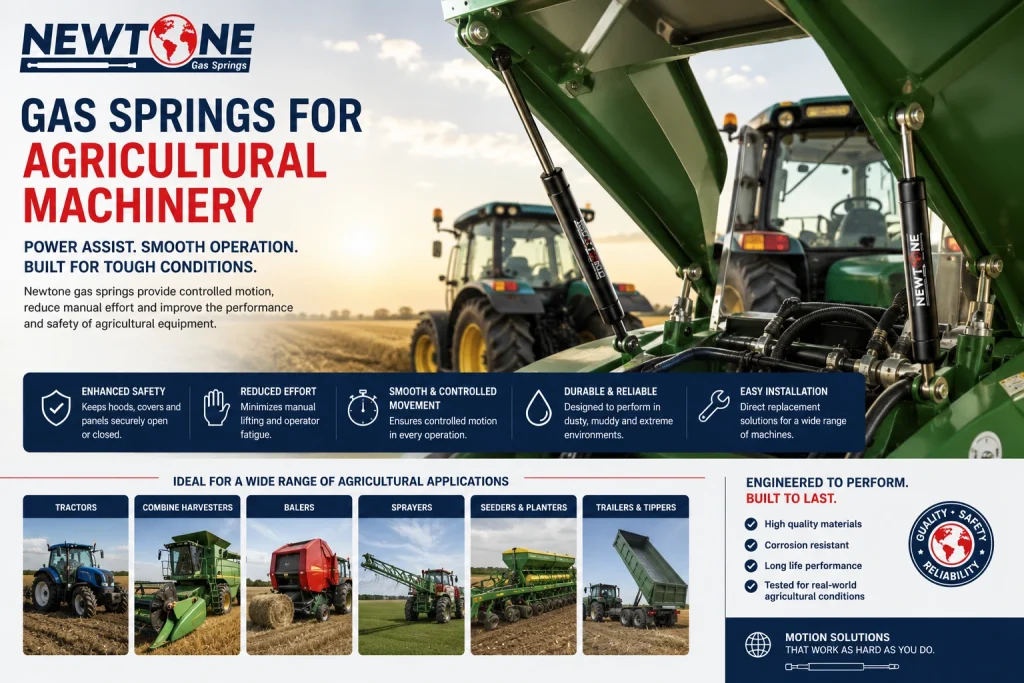
Agricultural Machinery
Lift support engineered for tractor engine hoods, cab doors, harvester access panels, and sprayer covers — for OEM equipment manufacturers, dealers, and aftermarket distributors.
- 1 Gas Springs for Agricultural Machinery: Start With the Force Number
- 2 Where Gas Springs Go on Agricultural Machinery
- 3 Working the Force: A Tractor Hood Moment Balance
- 4 Why Agricultural Duty Is Harder on a Gas Spring Than Automotive
- 5 When to Specify Stainless Steel or Locking Gas Springs
- 6 Specifying Gas Springs for Agricultural Machinery, by Component
- 7 Why Equipment Makers Source from Newtone
- 8 Frequently Asked Questions
- 9 Conclusion
- 10 Get a Specification or Quote
Gas Springs for Agricultural Machinery: Start With the Force Number
Choosing gas springs for agricultural machinery comes down to a moment balance about the panel’s hinge — the hood or door weight times its hinge-to-centre-of-gravity distance, divided by the number of springs and their moment arm — then derated for the cold starts and constant vibration a field machine actually sees. Get that number right and the panel lifts with one hand and stays put. Get it wrong and the hinge pays for it, or the operator ends up propping a tractor hood with a length of timber.
That timber-prop scene is more common than it should be. Owners describe hoods that quietly lose their hold over a season or two, then drop the full weight of sheet metal toward whoever is leaning over the engine. The part that prevents it is unglamorous and easy to under-specify. At Newtone Gas Springs we manufacture lift supports for agricultural OEMs and distributors, and most of the trouble we are asked to fix traces back to three things: a force value chosen by guess, seals that were never rated for field conditions, and mounting that lets vibration side-load a spring built for axial duty only.
Who this page is for: OEM engineers specifying springs for a new tractor, harvester, or implement platform; procurement managers sourcing replacement parts for a dealer network; and distributors looking for a manufacturing partner that can supply both original and aftermarket from one product line.
Where Gas Springs Go on Agricultural Machinery
Each location on a farm machine loads the spring differently, and the environment shifts from one panel to the next — an engine hood sees heat and vibration, a sprayer cover sees agrochemicals. Specify per location, not per machine.
Tractor Engine Hoods
The heaviest, most-cycled panel on the machine. Top-hinged, lifted dozens of times a week for service, and parked directly above a hot engine. Almost always paired springs — and the application where an incorrect force is felt first.
Cab Doors & Rear Windows
Need a controlled hold against wind gusts in the open field, plus seals that survive constant UV. Door hinges are unforgiving of side-load, so axial mounting matters more here than the raw force figure.
Harvester & Combine Access Panels
Wide side covers and engine shrouds opened for daily cleaning and inspection. Their width usually calls for paired, force-matched springs to keep the panel from racking and wearing one hinge faster than the other.
Sprayer & Chemical-Handling Covers
Tank lids and pump-bay access exposed to fertiliser and agrochemicals. This is the clearest case on the machine for 316L stainless rather than a coated steel rod.
Working the Force: A Tractor Hood Moment Balance
A hinged hood is a lever. The spring has to overcome the torque the hood’s own weight makes about the hinge. The governing relationship is the moment balance:
Take a one-piece hood of 14 kg (31 lb), so W = 14 × 9.81 = 137 N (31 lbf). At the near-horizontal position where it needs the most support, the weight acts on a horizontal arm of 500 mm (20 in), giving a load torque of 137 × 0.50 = 68.5 N·m. Split across two struts, each carries 34.3 N·m. With the strut mounted to give a perpendicular moment arm of 90 mm (3.5 in):
Now add a safety-factor surcharge for outdoor and vibration loading — Fdesign = F × SF, with SF ≈ 1.2 here — which lifts the target to about 457 N (103 lbf) per strut. One more correction the catalogue pages skip: temperature. Gas spring force changes roughly 0.3% per °C (FT ≈ F20 × [1 + 0.003 × (T − 20)]). A strut delivering 457 N at 20°C gives only about 409 N (92 lbf) at −15°C — close to a 10% loss, which is exactly why a hood that balances fine in July feels heavy at a frosty dawn.
Mounting decides whether that calculated force behaves. Fit the spring rod pointing down in the closed position so oil keeps the seals lubricated and damping stays quiet. Use ball-socket or eyelet end fittings that allow slight angular misalignment, and keep both pivots in the same plane of motion — on a vibrating machine, a spring loaded even slightly off-axis wears its rod guide out early. Where you place the lower body pivot relative to the hinge changes the effective moment arm far more than changing the force does, so move the mount before you reach for a stronger spring. Values here are starting points; share your hood dimensions and we will run the moment balance for your geometry at no charge.
Why Agricultural Duty Is Harder on a Gas Spring Than Automotive
A car hood strut lives an easy life: smooth roads, a sealed engine bay, a few cycles a week. An agricultural spring does not. Three field realities shorten its life, and none of them appear on the generic supplier pages.
Vibration and side-load fatigue
A field machine vibrates continuously, and that vibration drives tiny repeated lateral loads into a component engineered for axial force only. Over a season those micro-side-loads chew the rod guide and seal long before the gas charge would ever have run down. The defence is mechanical, not material: articulating end fittings, both pivots co-planar, and no bracket that pinches the rod off-axis.
Dust, mud, and rod abrasion
Every extension drags the rod surface past the seal. In a dusty harvest or a muddy field, abrasive grit rides in with it and scores both. That is why we run a black nitrided rod at 900–1000 HV, 20–30 µm deep as standard — a hardened surface resists the scoring that ends a soft chrome rod’s seal life in field conditions.
The temperature swing one machine sees in a day
The same tractor can start at −15°C on a winter morning and run a hood panel against a +90°C engine bay by mid-afternoon. A spring sized only at bench temperature will be wrong at both ends. We had a tractor OEM in the Upper Midwest come to us after field crews reported hoods that felt heavy and sluggish on sub-zero mornings; the original supplier kept adding raw force, which only made the panels harder to close once the machines warmed up. Sizing at the actual cold operating point — and accepting the small force gain as the bay heats — fixed the open-and-hold behaviour without overloading the warm-weather case. Our seals and charge are rated across −40°C to +100°C (−40°F to +212°F) precisely because one machine sees that whole band.
When to Specify Stainless Steel or Locking Gas Springs
A nitrided rod with HNBR seals handles most inland field machines. Two situations justify an upgrade.
Stainless steel for chemical and coastal exposure
On sprayers, fertiliser spreaders, washdown-cleaned equipment, and any machine worked near the coast, agrochemicals and salt air pit a coated rod faster than the panel corrodes. A 316L stainless body and rod removes the pitting that eventually compromises the seal. For premium machine lines sold into those markets, stainless is worth making standard. Our stainless steel gas springs are built for exactly this exposure.
Locking gas springs for service-hold safety
Where a hood or panel must stay up while someone works beneath it, a locking gas spring adds a mechanical hold at full extension so the panel cannot drop if the machine is bumped or parked on a slope. This directly answers the recurring safety complaint behind every broomstick prop. The release method is matched to door weight and access needs, so it is worth raising at the design stage rather than retrofitting later.
Specifying Gas Springs for Agricultural Machinery, by Component
| Component | Typical Weight | Recommended Force | Spring Count | Notes |
|---|---|---|---|---|
| Tractor engine hood | 10–18 kg (22–40 lb) | 300–500 N each (67–112 lbf) | 2 | Top-hinged — run the moment balance |
| Cab door | 6–12 kg (13–26 lb) | 150–300 N (34–67 lbf) | 1–2 | Axial mounting critical for hinge life |
| Rear cab window | 4–9 kg (9–20 lb) | 120–250 N (27–56 lbf) | 1–2 | UV-exposed seal — HNBR standard |
| Harvester / combine side panel | 8–20 kg (18–44 lb) | 200–450 N each (45–101 lbf) | 2 | Wide panel — request matched batch |
| Sprayer / chemical cover | Any | Per above | Per above | 316L stainless recommended |
| Service hatch (held open) | 5–14 kg (11–31 lb) | 120–350 N (27–79 lbf) | 1–2 | Consider locking version for safety |
Force figures are starting estimates. Final values depend on hinge offset and open angle — an 8 kg (18 lb) panel can need anywhere from 80 N (18 lbf) to 220 N (49 lbf) depending on geometry — so always run the moment balance or send us the dimensions. For mounting hardware, our mounting brackets and standard gas springs are configured from the same platform as OEM parts.
Why Equipment Makers Source from Newtone
We are a manufacturer, not a distributor. Every spring is built in our own facility in Turkey, so we control force tolerance, rod treatment, and lead time directly — not a third party.
Frequently Asked Questions
Force comes from a moment balance about the hinge: the hood’s weight times its hinge-to-centre-of-gravity distance, divided by the number of springs and each spring’s perpendicular moment arm. A 14 kg (31 lb) top-hinged hood on two struts typically needs around 380 N (86 lbf) per strut before safety factor, but the exact value depends on your geometry. Send us your hood dimensions and we will run the calculation at no charge.
Continuous chassis vibration is the main reason. It forces tiny repeated side-loads into a spring designed for axial load only, wearing the rod guide and seal early. Dust and field debris on the rod, plus an over-specified force that keeps the spring under constant static load, make it worse. A nitrided rod, HNBR seals, axial ball-socket mounting and the correct force rating together solve it.
Gas spring force drops about 0.3% per degree Celsius as temperature falls. A strut that holds the hood comfortably at 20°C delivers roughly 10% less force at −15°C, which is enough to make a balanced hood feel heavy and sluggish. The fix is to size the spring at the operating temperature, not to add raw force.
Usually no. A drooping hood is more often a worn or undersized original than a case for more force, and over-specifying force keeps the spring under constant static load when closed, which accelerates seal wear and shortens life. Identify the correct force for the geometry and pair it with good seals instead of simply going stronger.
Specify 316L stainless for sprayers, chemical-handling covers, washdown equipment, and machines worked near the coast, where fertiliser, agrochemicals, and salt air pit a chrome or nitrided rod. For general inland field use, a black nitrided rod with HNBR seals gives sufficient corrosion protection at lower cost.
Conclusion
A correctly specified gas spring on a farm machine disappears into the work — the hood lifts, holds, and closes, season after season, through frost and dust and engine heat. A poorly specified one becomes a warranty line and a safety risk. The gap between them is rarely complicated: the right force from an honest moment balance, seals and a rod surface rated for field conditions, mounting that keeps the spring axial under vibration, and a tolerance tight enough to matter when panels are paired.
Newtone supplies agricultural OEMs and distributors with both original-fit and aftermarket springs from one product platform, so a replacement matches the part that left the factory. If you are specifying for a new machine, replacing a failed strut across a dealer network, or evaluating suppliers for production volume, send us the panel weight and mounting geometry. We will return a force recommendation, a datasheet, and a quote — usually within five business hours.
For related reading, see our guide to gas springs for RV baggage doors, which covers the paired-spring matching principles in more depth.
Get a Specification or Quote
Tell us your component, panel weight, and mounting geometry. Our engineering team handles the rest — force calculation, sample datasheet, and competitive pricing.