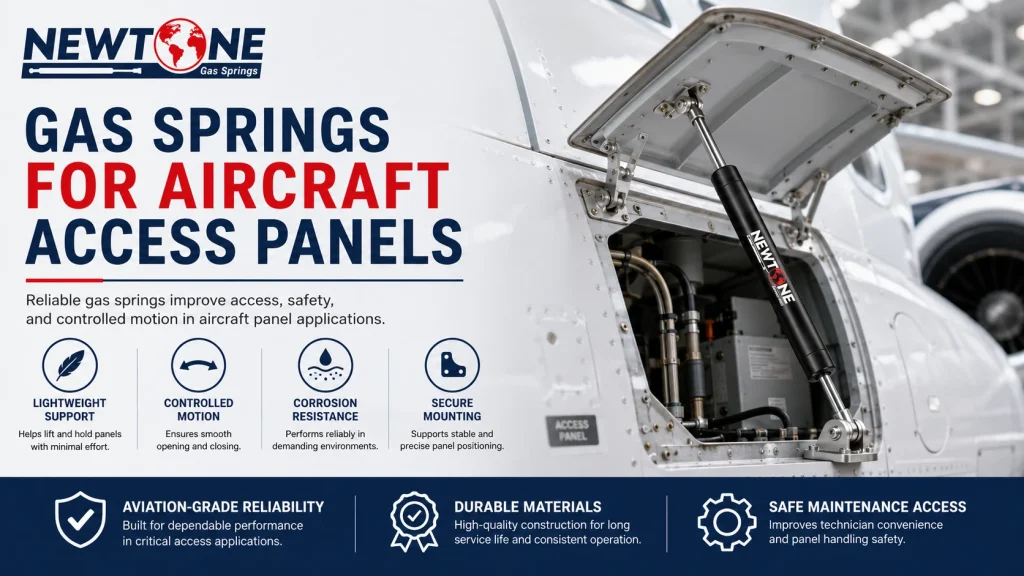
Aircraft Access Panels
Lift support for access panels, cargo and baggage doors, and canopies — for cabin interiors, experimental and light-sport aircraft, and ground-support equipment. Honest about where a commercial spring fits and where it doesn’t.
Gas springs for aircraft access panels and cargo doors are the right choice on non-flight-critical, experimental, and ground-support applications — cabin interiors, kit and light-sport aircraft, GSE and hangar equipment — provided they’re sized for the cold and mounted correctly. What they are not is a substitute for certified flight hardware: a flight-critical door on a type-certificated aircraft needs airframe-qualified, certified actuation, not a commercial gas spring. Knowing which side of that line your panel sits on is the first and most important decision.
We’ll be straight about this throughout, because the aviation world has good reason to be careful. Newtone is a gas spring manufacturer, not an AS9100 flight-hardware house, and we’d rather tell you where our springs genuinely belong than oversell them onto a door that needs a certified part. Where they do belong — interior panels, experimental canopies and baggage doors, servicing and ground equipment, UAV access hatches — they perform very well, and this page covers how to specify them properly.
Who this is for: OEM and interiors engineers on non-flight-critical assemblies, experimental and light-sport (E-AB, LSA) builders, kit-aircraft owners, and procurement teams sourcing for ground-support and MRO equipment. If your application is a certified flight-critical door, talk to us about scope before anything else.
- 1 Where Gas Springs for Aircraft Access Panels Belong
- 2 The Aircraft Applications We Actually Supply
- 3 Sizing Gas Springs for Aircraft Access Panels
- 4 When to Specify Stainless or Locking on Aircraft Work
- 5 Why Source Aircraft-Application Springs from Newtone
- 6 Frequently Asked Questions
- 7 Conclusion
- 8 Specify Your Aircraft Panel or Door Spring
Where Gas Springs for Aircraft Access Panels Belong
The honest map matters more here than anywhere else, so start with it. A quality commercial gas spring is appropriate for some aircraft jobs and explicitly wrong for others.
| Application | Commercial gas spring? | Why |
|---|---|---|
| Cabin interior, non-flight-critical panels | Suitable | Galley, lavatory, stowage and trim access — not part of the airframe’s structural or flight function. |
| Experimental / light-sport canopy & doors | Suitable | On E-AB and LSA aircraft the owner-builder is the certifying authority for the install. |
| Ground-support, MRO, hangar equipment | Suitable | Servicing carts, work platforms, tooling covers — equipment, not flight hardware. |
| UAV / drone access hatches | Suitable | Lightweight access and battery-bay covers, sized to the platform. |
| Flight-critical door on a certified aircraft | Needs certified hardware | Requires AS9100 / airframe-qualified actuation to the type’s approved spec — not a commercial spring. |
The Aircraft Applications We Actually Supply
Each of these has its own force, weight and environment profile — they aren’t one product with four labels.
Cabin interior access
Galley and lavatory panels, stowage lids, foldaway tables and trim access. Low forces, smooth controlled motion, and a clean rod finish that won’t mark interior surfaces.
Experimental & light-sport
Canopies, baggage and cargo doors on kit and LSA aircraft. The recurring builder problem is sourcing a correctly-specified unit at all — and getting force and orientation right so it lasts.
Ground-support & MRO
Servicing carts, ground equipment covers, tooling and work-platform panels around the hangar. Here durability and corrosion resistance matter more than absolute weight.
UAV & drone access
Battery-bay covers and payload access hatches on larger unmanned platforms, where every gram counts and the spring must be compact and consistent.
Sizing Gas Springs for Aircraft Access Panels
Force on a hinged access panel follows directly from where you mount the strut relative to the hinge. The further the strut sits from the hinge line, the less force it needs — which on a light aircraft frame is exactly how you avoid over-stressing the structure.
W = 9 × 9.81 = 88.3 N (20 lbf)
F = (88.3 × 250) ÷ 110 = 201 N (45 lbf) → with a 1.15 factor, ~231 N (52 lbf)
Move the mount out to d = 150 mm (5.9 in): F drops to 147 N (33 lbf) — same panel, far gentler on the frame.
Then correct for temperature, which on aircraft is not optional. An exterior panel that cold-soaks toward −40°C (−40°F) loses force at roughly 0.3% per °C — so that 231 N (52 lbf) design force delivers only about 189 N (43 lbf) when it’s deeply cold, an 18% drop. Size for the cold end of the envelope, or the panel that holds fine on the apron will sag at altitude. Newtone units run across the full −40°C to +100°C (−40°F to +212°F) range, but if your exterior cold-soak goes below −40°C, tell us and we’ll confirm rather than guess.
Two mounting rules carry most of the reliability. First, mount rod-down with the cylinder uppermost in the closed position, so the oil keeps the seals wetted — the wrong orientation is the most common cause of the early failures builders describe. Second, decide honestly between lift and damping: a pressurised lift-assist spring helps raise a canopy but preloads the frame, while a damper or snubber adds no preload and simply stops a slam. On a light crossmember, the snubber is often the smarter call. Keep both pivots in one plane with the right brackets so the rod is never side-loaded.
We saw this with a customer building exterior access doors for cold-climate operation. Their struts held perfectly in the workshop and went sluggish in winter, and they’d been told to simply order something stronger — which then slammed the door in milder weather. The panels weren’t the problem and neither was the brand. Once the force was specified for the −40°C cold-soak and matched as a pair, both doors behaved consistently across the temperature range. Sourcing the right spec, not a stronger spring, was the fix.
When to Specify Stainless or Locking on Aircraft Work
Material and locking are the two upgrades worth considering. A 316L stainless steel gas spring earns its place on float planes, maritime-patrol and coastal-based aircraft, and in humid hangars, where a standard chrome or nitrided rod would eventually pit and leak. For most inland and interior work, a black-nitrided rod with HNBR seals is enough. A locking gas spring makes sense on cargo and baggage doors that must stay positively open during loading or servicing, where a hands-free, can’t-drop hold is a safety benefit rather than a convenience.
Why Source Aircraft-Application Springs from Newtone
We’re a manufacturer, not a distributor — and we’ll tell you honestly where a commercial spring fits and where you need certified hardware instead. For the applications it suits, you get manufacturer control over force, materials and consistency.
Frequently Asked Questions
Newtone supplies high-quality commercial gas springs, not AS9100-certified flight hardware. They are well suited to non-flight-critical applications — cabin interiors, ground support equipment, MRO and hangar equipment — and to experimental, kit and light-sport aircraft, where the builder or owner is the certifying authority. Flight-critical doors on type-certificated aircraft require airframe-qualified, certified hardware to your program’s specification; we’ll tell you plainly when that’s the case.
Yes, this is one of the most common uses, and on an experimental or light-sport aircraft the owner-builder is responsible for the installation. The two things that matter most are not over-forcing the frame and getting the orientation right. A lift-assist spring that’s too strong can preload and stress a light canopy crossmember, so many builders prefer a damper-style snubber that simply slows the fall instead.
Gas spring force falls with temperature at about 0.3% per °C, so an exterior panel that cold-soaks toward −40°C can lose roughly 18% of the force it had at 20°C. The panel then feels heavy or won’t hold. The fix is to size the spring for the coldest operating temperature from the start, not to fit a stronger unit that slams in warm weather. Newtone springs operate across −40°C to +100°C (−40°F to +212°F).
It depends on the frame and the risk. A lift-assist (pressurised) gas spring helps raise the canopy but applies a preload the frame must carry, which can be too much for a light crossmember. A snubber or damper provides no lift but controls the speed so the canopy can’t slam down. For light frames where a slam is the main hazard, a damper is often the more elegant choice; where lift help is genuinely needed, size the force conservatively.
Rod-down in the closed position — meaning the cylinder body sits uppermost — so the internal oil keeps the seals lubricated. Mounting it the other way lets the seals run dry, which causes sticking and early failure, a frequent cause of the short strut life builders report. Keep both pivots in the same plane too, so the rod takes axial load only and isn’t side-loaded.
Conclusion
Gas springs for aircraft access panels and cargo doors are a sound, well-proven choice on the non-flight-critical, experimental, and ground-support side of aviation — and the honest place to draw the line is the certified flight-critical door, which belongs to airframe-qualified hardware. Get that distinction right and the rest is solid engineering: size for the cold-soak, use mounting geometry rather than brute force, mount rod-down, and choose lift or damping deliberately.
For builders and equipment makers, the practical value is often just being able to source a correctly-specified unit at all — built to your geometry, matched as a pair, and right the first time. Tell us the panel weight, mounting points, temperature range and whether you need lift or just controlled motion, and we’ll recommend the spec and supply it, typically within 5 business hours.
Specify Your Aircraft Panel or Door Spring
Send the panel weight, geometry, temperature range and whether the application is non-flight-critical, experimental or ground equipment. We’ll size it, advise on lift vs damping, and supply it — or tell you if you need a certified part.