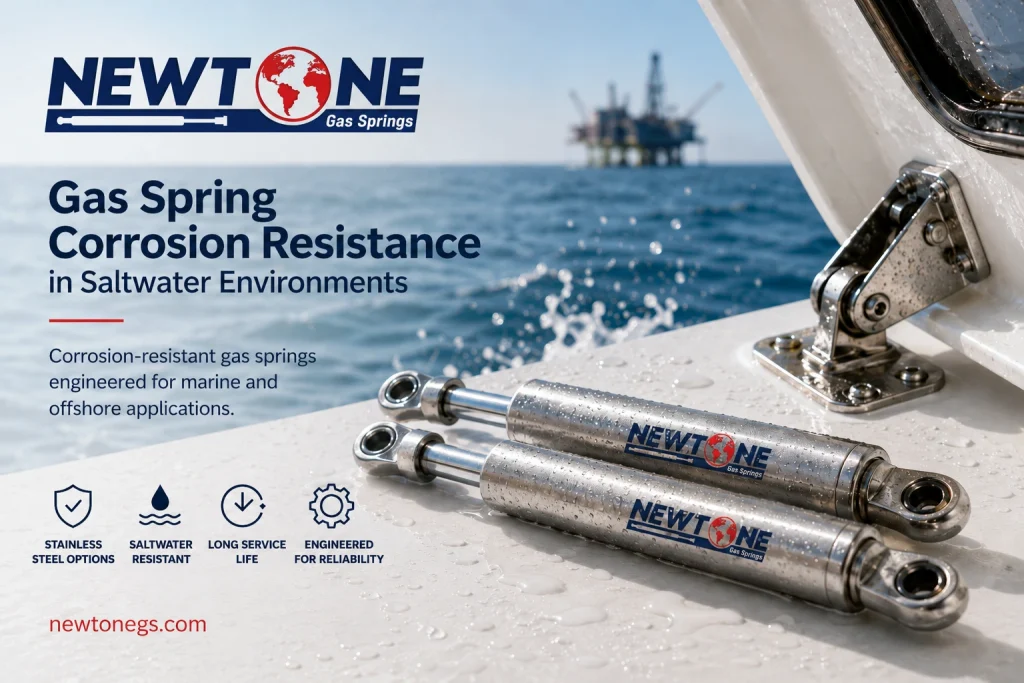
Gas spring corrosion resistance in saltwater environments depends on more than the stainless steel grade. Rod surface quality, sealing package, end fittings, brackets, fasteners, mounting alignment and how water is trapped around the spring all decide real service life.
Saltwater does not only make a gas spring look old. It can attack the rod surface, damage the seal path, increase friction, reduce effective force and eventually create oil leakage or pressure loss. That is why marine hatch, coastal equipment, outdoor access panel and washdown applications should be specified as complete corrosion-resistant systems, not just as “a stainless gas spring.”
- 1 Why Saltwater Is Hard on Gas Springs
- 2 Saltwater Corrosion Is a Seal-Life Problem Before It Is a Rust Problem
- 3 Where Saltwater Corrosion Usually Starts
- 4 Effective Force Loss from Corrosion and Seal Load
- 5 Gas Spring Corrosion Resistance in Saltwater Environments: Material Choice
- 6 Whole-System Corrosion Resistance Matters More Than One Part
- 7 Mounting Guidance for Saltwater Gas Spring Applications
- 8 How to Specify Gas Spring Corrosion Resistance in Saltwater Environments
- 9 Common Specification Mistakes in Saltwater Applications
- 10 Saltwater Exposure Specification Guide
- 11 Why Source Saltwater-Resistant Gas Springs from Newtone?
- 12 Frequently Asked Questions About Gas Spring Corrosion Resistance in Saltwater Environments
- 13 Final Engineering Takeaway
Why Saltwater Is Hard on Gas Springs
Saltwater is hard on gas springs because chloride exposure can attack the surfaces that the seal system depends on. A gas spring rod moves through the seal on every cycle. If that rod becomes pitted, contaminated or rough, the seal is no longer sliding over a controlled surface.
The first visible sign may be rust staining around brackets or hardware. The more serious sign is usually at the rod and seal interface. Once corrosion starts there, the spring can develop higher friction, inconsistent movement, weaker extension force or leakage around the rod.
Marine and coastal applications also create mixed exposure. A boat hatch may see direct spray, trapped water, salt crystals after drying, cleaning chemicals and UV exposure. A coastal machine cover may never be submerged, but humid salt air can still attack fittings and brackets for years. That difference matters. A dry inland cabinet and a deck hatch above a fish hold should not use the same corrosion logic.
Saltwater Corrosion Is a Seal-Life Problem Before It Is a Rust Problem
Saltwater corrosion is a seal-life problem before it is a rust problem because the gas spring fails when corrosion changes the working surface of the rod. Surface rust on a nearby bracket is ugly. Pitting on the rod can become functional damage.
When the rod surface is damaged, the seal lip sees more abrasion. When the seal wears, friction and leakage risk increase. The spring may still look installed correctly, but the hatch or cover starts to feel heavier, slower or less predictable. In severe cases, the user notices oil at the rod or a door that no longer stays open.
That is the point many product pages skip. Stainless steel is not only a cosmetic upgrade for marine hardware. In saltwater environments, corrosion resistance protects the sealing interface, and the sealing interface protects the force output.
Where Saltwater Corrosion Usually Starts
Saltwater corrosion usually starts at the weakest exposed part of the assembly, not necessarily at the gas spring body. The rod, ball sockets, eyelets, brackets, fasteners and hidden crevices all matter. One mismatched component can shorten the life of the complete installation.
The rod is the most sensitive component because it passes through the seal. End fittings and brackets are next because they can trap water, bind, loosen or create side-load if corrosion changes the joint geometry. Fasteners matter because a stainless gas spring mounted with unsuitable screws or brackets is not a complete marine solution.
Crevice areas deserve special attention. Saltwater trapped behind a bracket, inside a socket, under a rubber boot or around a horizontal fitting can remain active long after the surface looks dry. If water cannot drain or be rinsed away, corrosion protection becomes more difficult.
Effective Force Loss from Corrosion and Seal Load
The useful force of a gas spring is not only the theoretical gas force. In real service, friction, seal load and contamination reduce the effective force felt at the hatch or cover.
Formula:
F_eff = P × A − F_friction − F_seal
Where:
F_eff = effective output force available to support the application
P = pressure differential acting on the rod area
A = rod cross-sectional area
F_friction = mechanical friction loss
F_seal = seal drag or seal-load loss
Supporting relationship:
A = π × d² ÷ 4
Example: a compact marine gas spring has an 8 mm (0.31 in) rod. The rod area is:
A = π × 8² ÷ 4 = 50.3 mm² (0.078 in²)
If the internal pressure differential acting on that rod area gives a theoretical force of 320 N (72 lbf), and normal friction plus seal load consumes about 10%, the loss is:
F_loss = 320 × 0.10 = 32 N (7 lbf)
F_eff = 320 − 32 = 288 N (65 lbf)
Now consider the same spring after saltwater exposure has damaged the rod surface and increased seal drag. If friction and seal load rise to 18%, the loss becomes:
F_loss = 320 × 0.18 = 58 N (13 lbf)
F_eff = 320 − 58 = 262 N (59 lbf)
The gas spring did not change size. The label on the body did not change. But the effective support dropped by 26 N (6 lbf) in this example, simply because corrosion and seal drag reduced usable force. On a hatch with marginal force or poor mounting geometry, that difference can be enough for the hatch to feel weak or fail to stay open reliably.
Gas Spring Corrosion Resistance in Saltwater Environments: Material Choice
Gas spring corrosion resistance in saltwater environments usually starts with 316 or 316L stainless steel when the part is directly exposed to salt spray, deck washdown, coastal air or high humidity. For dry interior equipment or freshwater-only use, a black nitrided rod with HNBR sealing may be sufficient, but saltwater changes the risk level.
Newtone’s black nitrided rods have a typical surface hardness of 900–1000 HV and a treatment depth of 20–30 µm. That is a strong industrial rod surface. It is suitable for many outdoor and general industrial applications. But where chloride exposure is regular, stainless steel should be reviewed.
The grade decision should be honest. 304 stainless may work in less aggressive, protected or freshwater conditions. 316 or 316L is the more appropriate direction for saltwater and marine exposure because it is selected specifically for stronger chloride resistance. The point is not to make every application expensive; it is to avoid using an inland-duty spring where the environment will attack the rod and fittings.
Whole-System Corrosion Resistance Matters More Than One Part
Whole-system corrosion resistance means the gas spring, rod, end fittings, brackets, ball studs and fasteners must be compatible with the same exposure level. A stainless steel gas spring installed with weak or corroding brackets can still fail as a system.
This is a common field issue. A coastal service operator may replace the spring body with stainless, but leave the old brackets in place. The spring itself looks better than the hardware around it. Then the bracket starts rusting, the socket binds, the rod sees side-load and the installation feels rough again. The customer thinks the gas spring failed. The real failure was the system around the spring.
For marine hatch builders, boatyards and equipment OEMs, the cleaner approach is to specify the gas spring and mounting hardware together. If the application needs stainless steel, the end fittings and bracket hardware should be reviewed at the same time.
Mounting Guidance for Saltwater Gas Spring Applications
Saltwater gas spring applications should be mounted to reduce water trapping, side-load and seal wear. Where the geometry allows it, mount the gas spring with the rod pointing down in the closed or at-rest position. This helps keep oil near the seal and supports smoother damping.
Keep both pivots in the same plane of motion. Gas springs are designed for axial load, not lateral load. If a hatch twists the rod sideways, corrosion and seal wear become worse because the seal is no longer loaded evenly.
Avoid using the gas spring as the hard stop. The hatch, cover or panel should have a proper mechanical stop where needed. If the gas spring bottoms out before the panel reaches its open or closed limit, the rod, seal and brackets can see shock load.
Drainage and cleaning access also matter. Do not hide the spring in a pocket where saltwater collects and never rinses out. A location that looks tidy on the drawing can become a corrosion trap in real service.
How to Specify Gas Spring Corrosion Resistance in Saltwater Environments
To specify gas spring corrosion resistance in saltwater environments, start by classifying the exposure. The correct solution depends on whether the spring is inside a protected cabin, under a hatch, on an open deck, near a fish box, in a washdown area or on offshore equipment.
For protected interior marine locations, black nitrided steel with HNBR sealing may be acceptable. For deck-exposed hatches, fish boxes, coastal equipment and washdown zones, stainless steel gas springs should be reviewed. For direct salt spray, high humidity and offshore conditions, stainless spring bodies, rods, fittings and compatible mounting hardware should be treated as a system requirement.
Force and geometry should still be checked. Corrosion resistance does not fix an overpowered or underpowered spring. Paired gas springs should be force-matched, especially on wide hatches. Newtone controls force tolerance at ±5%, which helps paired applications behave consistently.
Common Specification Mistakes in Saltwater Applications
The first mistake is assuming “stainless gas spring” means the complete installation is corrosion-resistant. It does not. If the fittings, brackets or fasteners are not suitable for the same environment, the installation can still rust, bind or fail early.
The second mistake is using automotive-style gas struts in a marine or coastal location. They may fit by length and force, but the material system may not be built for saltwater exposure. A spring that works on a vehicle tailgate is not automatically suitable for a deck hatch or coastal machinery cover.
The third mistake is solving weak movement by increasing force without checking corrosion, seal drag or hinge condition. If friction has increased because the rod or fittings are damaged, more force may hide the issue for a while but increase load on the brackets and hinges.
The fourth mistake is ignoring maintenance access. If the spring is mounted where nobody can inspect, rinse or replace it, saltwater damage will be found late. By then, the seal may already be worn and the hatch may already feel weak.
Saltwater Exposure Specification Guide
| Environment | Recommended specification direction |
|---|---|
| Dry interior marine cabinet | Black nitrided rod with HNBR sealing may be sufficient if no saltwater reaches the spring. |
| Freshwater boat hatch | Black nitrided or stainless can be reviewed depending on humidity, washdown and service life target. |
| Coastal equipment cover | Review stainless steel gas spring options and compatible brackets due to salt air exposure. |
| Deck hatch or fish box lid | Stainless steel spring, fittings and corrosion-resistant mounting hardware should be reviewed together. |
| Direct salt spray or washdown | 316 / 316L stainless direction is preferred, with attention to drainage and crevice corrosion points. |
| Offshore platform or severe marine duty | Specify the spring, rod, fittings, brackets and safety requirements as one corrosion-resistant system. |
Why Source Saltwater-Resistant Gas Springs from Newtone?
Manufacturer, Not Distributor
Newtone manufactures gas springs in Turkey and exports to more than 60 countries for OEM and aftermarket applications.
Material Review
Stainless steel options can be reviewed for marine, coastal, washdown and high-humidity applications.
Seal-Focused Design
HNBR sealing is standard, selected for UV and ozone resistance in demanding outdoor applications.
Application Support
Engineering support is available for force, stroke, mounting points, paired springs, fittings and corrosion exposure.
Frequently Asked Questions About Gas Spring Corrosion Resistance in Saltwater Environments
What improves gas spring corrosion resistance in saltwater environments?
Gas spring corrosion resistance in saltwater environments improves when the rod, body, end fittings, brackets and fasteners are all specified for marine exposure. Stainless steel helps, but the complete assembly must be reviewed because the weakest component usually controls service life.
Are stainless steel gas springs always required near saltwater?
Not always. Protected interior or freshwater applications may use black nitrided rods with HNBR seals if exposure is limited. Direct salt spray, washdown, coastal humidity and deck-exposed marine use usually justify stainless steel review.
Why do gas springs fail faster in saltwater?
Gas springs fail faster in saltwater when corrosion damages the rod surface, end fittings or brackets. Rod pitting can increase seal wear, which can lead to higher friction, oil leakage, gas loss and reduced effective force.
Is 316L stainless steel better than 304 for saltwater gas springs?
For regular saltwater exposure, 316 or 316L is generally the better direction because it offers stronger resistance to chloride attack. 304 can be suitable in less aggressive or protected environments, but it should not be treated as the default choice for direct saltwater exposure.
Can a stainless gas spring still corrode or fail?
Yes. A stainless gas spring can still fail if the fittings, brackets or fasteners are not suitable, if saltwater is trapped around the joints, or if poor mounting creates side-load on the rod. Corrosion resistance must be designed as a complete system.
Final Engineering Takeaway
Gas spring corrosion resistance in saltwater environments is not only a stainless steel question. The real service life depends on rod surface protection, seal quality, compatible fittings, corrosion-resistant brackets, drainage, mounting alignment and exposure severity.
For protected inland applications, Newtone’s black nitrided rods and HNBR sealing can be a strong standard solution. For saltwater, coastal, washdown and offshore exposure, stainless steel options and compatible mounting hardware should be reviewed together. Newtone can support OEM and aftermarket teams with material selection, force matching and application-specific engineering review.