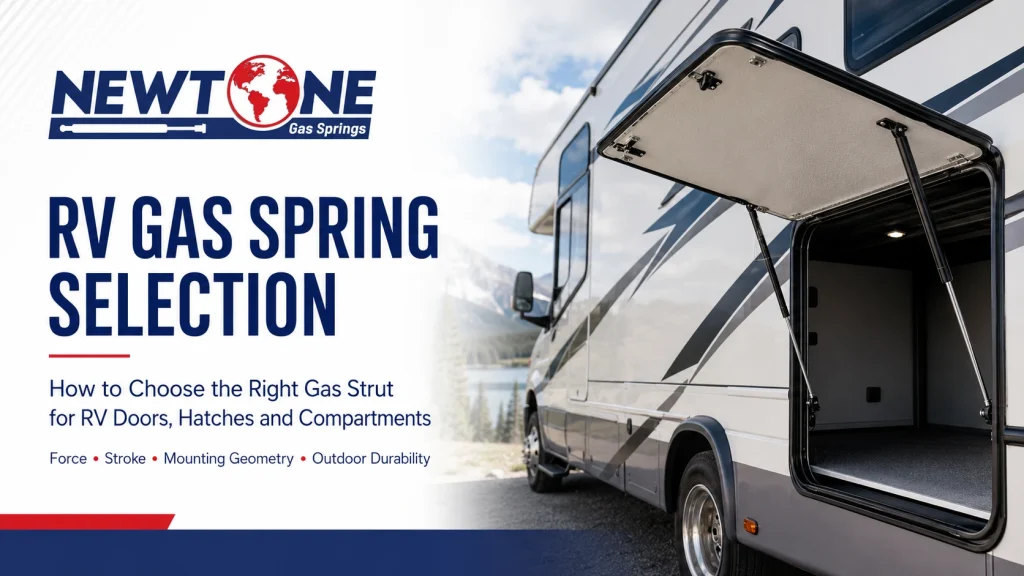
RV gas spring selection should start with the door weight, open and closed length, stroke, mounting geometry, force rating, environment and whether the door uses one or two struts. Matching only the extended length is not enough; the right gas spring must support the RV door smoothly without overloading hinges, brackets or the panel itself.
In real RV use, gas springs work on baggage doors, entrance doors, engine hatches, generator compartments, bed storage lifts, roof access panels and exterior service covers. Some are opened a few times per trip. Others are opened every day by dealers, service teams or rental-fleet operators. If the strut is too weak, the door drops. If it is too strong, the door may be hard to close or may bend hardware over time. The right choice sits between those two problems.
Why RV Gas Spring Selection Matters
RV gas spring selection matters because a recreational vehicle has many different moving panels, and each one behaves differently. A lightweight cabinet door, a side baggage compartment, a heavy engine hatch and a generator service cover should not be treated as the same application just because they all use gas struts.
A good gas spring makes the RV easier to use. It reduces lifting effort, helps the door stay open, slows movement near the end of travel and protects the user from sudden drops. For OEMs, it also helps reduce warranty issues linked to bent brackets, weak doors, mismatched replacement parts and low-grade seals failing after outdoor exposure.
For aftermarket distributors, the challenge is slightly different. A customer may bring an old gas strut with faded markings and ask for “the same one.” That usually means matching the length, stroke, force, end fittings and application type. If one of those is wrong, the new part may install correctly but behave incorrectly.
Same Length Does Not Mean Same Gas Spring
Same length does not mean same gas spring. Two RV gas struts can share the same extended length and compressed length but have different force values, rod diameters, damping behavior, end fittings, seal quality and corrosion resistance.
This is one of the most common RV replacement mistakes. A user measures the old strut, finds another one with the same length, then chooses a higher force because it sounds safer. Sometimes it works. Often it creates a new problem. The door may pop open too aggressively, become difficult to close, stress the hinges or deform a lightweight compartment panel.
The correct question is not “Can I fit it?” The correct question is “Will this force and geometry make the door behave correctly through the whole motion?” A gas spring that bolts into place is not automatically the right gas spring.
Where Gas Springs Are Used in RVs
Gas springs are used in RVs wherever a hinged or lifted panel needs controlled motion and support. The most common areas are baggage compartment doors, exterior storage doors, engine hatches, generator compartments, entry doors, under-bed storage lifts, roof access covers and interior cabinet mechanisms.
Exterior baggage doors usually need smooth opening and reliable hold-open behavior. Engine and generator hatches need stronger service-access support because a technician may need both hands free. Under-bed storage lifts often need a softer feel because the user is close to the moving panel. Entry doors may need controlled opening more than heavy lifting.
Each location has a different duty cycle. A generator compartment on a rental RV may be serviced often. A seasonal storage door may open only occasionally. The spring selection should match the real use, not just the drawing. For a more specific example, Newtone also covers gas springs for RV baggage doors as a separate application.
Formula Block: RV Gas Spring Selection for a Hatch or Compartment Door
The first useful calculation for a hinged RV hatch or baggage door is the moment balance about the hinge. Door weight alone is not enough. The force depends on where the door’s centre of gravity sits and how much effective moment arm the gas spring has.
F = (W × Lg × cos φ) ÷ (n × r)
Where F is the required force per gas spring, W is the supported weight in Newtons, Lg is the hinge-to-centre-of-gravity distance, φ is the door angle above horizontal, n is the number of gas springs, and r is the effective perpendicular moment arm of the spring.
First convert the door mass to Newtons:
W = m × g
Example: an RV baggage door weighs 12 kg (26 lb). The centre of gravity is 400 mm (15.7 in) from the hinge. The door is checked at a 50° open angle. Two gas springs are used, and each spring has an effective perpendicular moment arm of 110 mm (4.3 in).
W = 12 × 9.81 = 118 N (26 lbf)
F = (118 × 0.40 × cos50°) ÷ (2 × 0.11)
F = 30.3 ÷ 0.22 = 138 N per spring (31 lbf per spring)
With a moderate design factor of 1.15 for outdoor RV use, vibration and field variation:
F_design = 138 × 1.15 = 159 N per spring (36 lbf per spring)
This does not mean every RV baggage door needs 160 N (36 lbf). It means this specific geometry points to that range. Moving the mounting point by a small distance can change the required force more than changing the spring label by 20 N (4 lbf).
How to Measure an Existing RV Gas Spring
To replace an RV gas spring, measure the extended length, compressed length, stroke, force rating and end fittings before ordering. If the old gas spring still has a readable label, record the Newton or pound-force value. If the label is missing, the door geometry must be reviewed instead of guessing.
Extended length is measured from the centre of one end fitting to the centre of the other end fitting when the spring is fully extended. Compressed length is the same centre-to-centre measurement when fully compressed. Stroke is the difference between those two lengths.
End fittings matter. Ball sockets, eyelets, blade ends and threaded ends are not interchangeable without checking brackets and motion. Ball stud diameter should be confirmed. A spring with the right force but the wrong socket can create installation play, binding or side-load.
For older RVs, do not assume the fitted part is original. Many vehicles have been repaired over the years. The old spring may already be a poor replacement. That is why checking the door behavior is as important as reading the part number.
Single vs Paired RV Gas Springs
A single gas spring can work on narrow or lightweight RV doors, but wide doors and heavier hatches usually need paired gas springs. Paired springs spread the load, reduce twisting and help the door move evenly across the hinge line.
Force matching is important in paired applications. If one side is stronger than the other, the door may lift unevenly or stress one hinge more than the other. This becomes more noticeable on wide baggage doors, rear hatches and larger service panels.
Newtone controls force tolerance at ±5%, which helps paired springs behave consistently. For OEM supply, matched springs from the same platform are better than mixing parts that only share a nominal force value. For aftermarket distributors, replacing both sides together is often the cleaner solution when the door uses a pair.
Material and Environment Selection for RV Gas Springs
Material selection depends on how and where the RV is used. For most general RV applications, black nitrided rods with HNBR seals are a strong standard option. Stainless steel should be reviewed for coastal use, high humidity, road salt, washdown exposure or long outdoor storage in corrosive environments.
Newtone gas springs use HNBR sealing as standard, selected for UV and ozone resistance. The black nitrided rod has a typical surface hardness of 900–1000 HV with a treatment depth of 20–30 µm. That rod surface helps protect the seal interface over repeated cycles.
RVs see heat, cold, dust, rain and vibration. A gas spring that works nicely in a workshop at 20°C (68°F) can feel different in winter or in a hot storage compartment. Gas spring force changes by about 0.3% per °C, so outdoor conditions should be considered before adding force to “solve” a weak-feeling door.
When to Use Locking Gas Springs or Safety Tubes
Locking gas springs or safety tubes should be considered when the RV panel must stay open during service or when unexpected closing could cause injury or damage. A standard gas spring provides lift assistance, but it is not a mechanical safety lock.
Engine hatches, generator compartments and heavy service covers are the most common RV candidates. If a technician must work under the open panel, a locking solution deserves review. A locking gas spring may be useful when the panel needs controlled position holding. A safety tube may be useful when the main requirement is full-extension backup.
For normal baggage doors, a standard gas spring is often enough. For heavier service-access panels, the risk profile changes. The right answer depends on the door weight, access position and what happens if the panel closes unexpectedly.
Common RV Gas Spring Selection Mistakes
The most common RV gas spring selection mistake is assuming more force is always better. Too much force can make the door hard to close, increase bracket stress and cause lightweight panels to flex. It can also push the door open too aggressively when the latch is released.
Another common mistake is matching length but ignoring stroke. If the compressed length is too long, the spring may bottom out before the door closes. If the extended length is wrong, the door may not open fully or may overextend the brackets. Both problems can damage the installation.
We often see this with aftermarket matching. A dealer or service team finds a low-cost replacement with the same open and closed length, but the force is higher than the original because the customer wants a “stronger” door. The part fits, but the door starts closing harshly or loading the hinge differently. The better fix is to match force, stroke, end fittings and mounting behavior together.
Other mistakes include mixing old and new springs on the same paired door, ignoring rod-down orientation, using poor-quality seals in outdoor RV compartments and choosing end fittings that do not allow the angular movement required by the hinge geometry.
RV Gas Spring Selection Checklist
| Selection point | Why it matters |
|---|---|
| Extended length | Determines the open position and whether the door reaches the required angle. |
| Compressed length | Must fit the closed position without bottoming out. |
| Stroke | Controls the travel range between closed and open positions. |
| Force rating | Too weak drops the door; too strong can damage hardware or make closing difficult. |
| Mounting geometry | Moment arm and pivot placement often matter more than force label alone. |
| End fittings | Ball sockets, eyelets and brackets must match the existing hardware and movement. |
| Single or paired layout | Wide doors usually need matched pairs to prevent twisting. |
| Environment | Coastal, humid or road-salt conditions may require stainless steel gas springs. |
Why Source RV Gas Springs from Newtone?
Manufacturer, Not Distributor
Newtone manufactures gas springs in Turkey and exports to more than 60 countries for OEM and aftermarket applications.
OEM and Aftermarket Supply
The same platform can support production programs and replacement-part needs for RV doors, hatches and compartments.
Controlled Components
HNBR seals, black nitrided rods and ±5% force tolerance help support repeatable performance.
Application Review
Engineering support is available for force, stroke, mounting points, brackets, end fittings and material selection.
Frequently Asked Questions About RV Gas Spring Selection
How do I choose the right gas spring for an RV door?
Choose the gas spring by checking the door weight, extended length, compressed length, stroke, force rating, mounting geometry, end fittings and environment. Do not select only by length, because the same size gas spring can have a very different force and movement behavior.
Can I replace an RV gas strut with a stronger one?
You can sometimes increase force slightly, but stronger is not automatically better. Too much force can make the door hard to close, overload brackets, stress hinges or bend lightweight RV compartment doors. The force should match the door geometry and use case.
What measurements do I need for an RV gas spring replacement?
You need the extended length, compressed length, stroke, force rating, end fitting type and mounting hardware details. If the old label is missing, measure the door and mounting geometry instead of guessing from length alone.
Should RV baggage doors use one gas spring or two?
Narrow or light RV baggage doors may use one gas spring, but wide or heavier doors usually work better with two matched gas springs. Paired springs reduce twisting and help the door move evenly across the hinge line.
Do RV gas springs need stainless steel?
Not always. Black nitrided rods with HNBR seals are suitable for many RV applications. Stainless steel should be reviewed for coastal use, high humidity, road salt, washdown exposure or long-term corrosive outdoor conditions.
Final Engineering Takeaway
RV gas spring selection is not just a replacement-size exercise. A correct gas spring must match the door weight, stroke, length, force, hinge geometry, end fittings, environment and whether the door uses one or two springs.
The safest approach is to treat the RV door as a moving system. Measure the existing part, check the door behavior, review the mounting points and avoid the trap of assuming that more force is always better. Newtone can support OEM and aftermarket teams with RV gas springs, brackets, stainless options and application-specific engineering review.