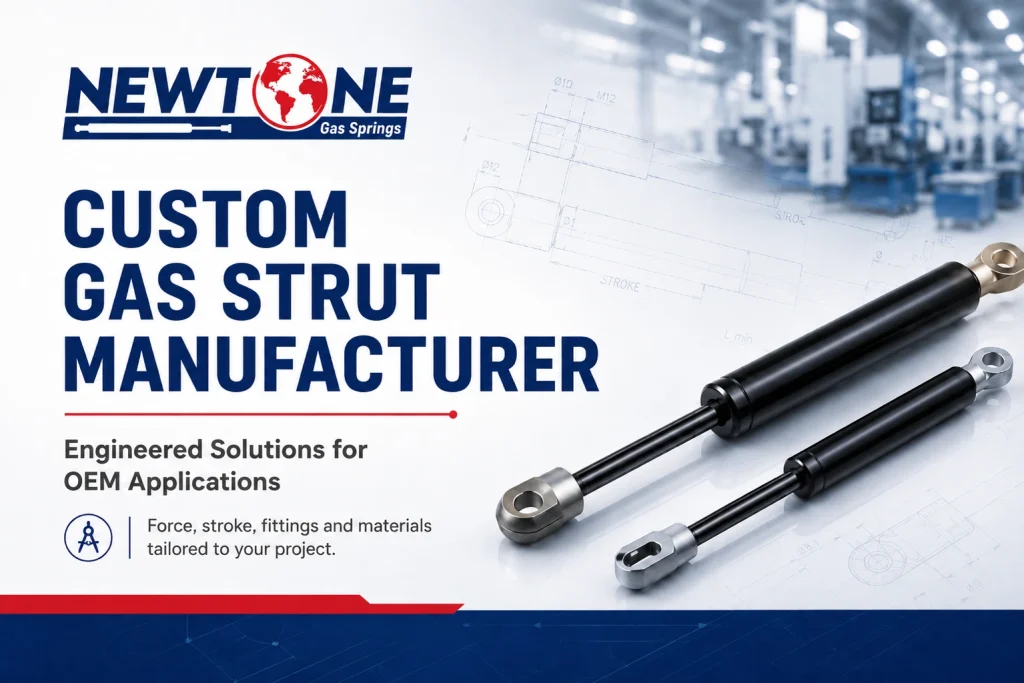
Manufacturer
Exactly how to specify a custom gas strut — the inputs a manufacturer needs, the force estimate you can do yourself, the traps that catch people, and what to send when you don’t know the force yet.
A custom gas strut manufacturer needs a short, specific list of inputs to build the right part: force — or the weight and geometry to calculate it — plus stroke, extended length, rod and body diameter, the end fittings for both ends, and the operating environment. Give those cleanly and a good manufacturer turns them into a part that fits and holds the first time. Leave one vague and you get the classic trial-and-error loop: a strut that’s too weak, then one that’s too long, then a third that finally works. (A gas strut and a gas spring are the same thing; the words are used interchangeably.)
This page is the checklist we wish every enquiry arrived with. It walks through each specification, shows you how to get a rough force figure yourself, flags the measurement traps that quietly ruin a custom order, and tells you exactly what to send when you don’t yet know the force. The difference between a smooth custom order and a frustrating one is almost always the quality of the brief.
Who this is for: OEM and design engineers speccing a strut into a new product, procurement teams sourcing a custom or replacement part, and anyone who has bought the wrong strut once and wants to get the brief right this time.
What a Custom Gas Strut Manufacturer Needs From You
Here is the full specification set, with what each input controls and what to do if you don’t have it. Treat it as a de-facto order brief — the more of it you can fill, the faster and more accurate the quote.
| Specification | What it sets | If you don’t know it |
|---|---|---|
| Force (N / lbf) | How much the strut holds or lifts | Send panel weight + geometry, or a drawing; we calculate it. |
| Stroke | How far the rod travels (open-to-closed) | Measure the travel of the moving pivot, or give the open angle. |
| Extended length | Overall length, centre-to-centre of end fittings | Measure your space; note if fittings are included. |
| Rod & body diameter | Force capacity and robustness | We recommend from the force and duty cycle. |
| End fittings (both ends) | How it mounts; side-load protection | Send bracket geometry; ball joints reduce side-load. |
| Environment & temperature | Material, seal and oil choice | Tell us indoor/outdoor, marine, hot or cold-soak. |
| Cycle life & quantity | Duty rating; matched pairs | Estimate daily cycles; state if struts are paired. |
How to Estimate the Force Before You Ask
You can get a rough force figure yourself in a minute, which makes the whole conversation faster. For a top-hinged lid, a planning-level estimate uses the weight, gravity, and a lever-arm factor for where the strut mounts.
F ≈ (15 × 9.81 × 0.6) ÷ 1 = 88 N (20 lbf)
Add a 1.2 safety factor for a cold or windy install → ~106 N (24 lbf)
Treat that as a starting point, not a final number — it’s a planning estimate. The exact value comes from the full moment balance about the hinge, which accounts for the centre-of-gravity distance and the strut’s mounting angle, and it can move the figure by a factor of two depending on geometry. Stroke is simpler: it’s the extended length minus the compressed length (for example 400 mm − 250 mm = 150 mm / 5.9 in of travel). One trap catches nearly everyone here: end fittings add to the extended length, so always measure and quote centre-to-centre of the fittings, and tell the manufacturer whether your length includes them or not.
What to Do When You Don’t Know the Force
Don’t guess by buying and re-buying — that’s the most expensive way to find the answer. If the force is unknown, there are two clean paths. The first is to send the panel weight and mounting geometry (hinge position, where the strut attaches, the open angle) or a dimensioned drawing or photo; from that the force is a calculation, not a gamble. The second is an adjustable-force strut, charged to maximum and bled down to the right force in place — ideal for prototypes where the value isn’t known yet. Once dialled in, you order fixed-force units to match for production.
The Custom-Spec Mistakes Worth Avoiding
A few errors show up again and again on custom orders. Over-specifying force is the quiet one: choosing a strut 10–20% stronger “to be safe” keeps it under constant static load when closed, which accelerates seal wear and shortens life. Side-loading is the mechanical one: gas struts take axial load only, so if the two pivots aren’t in the same plane the rod binds — ball-joint end fittings and correct brackets prevent it. And on paired installations, force-matching is the one people forget.
We saw this with a fabricator who ordered two custom struts for a single heavy lid, but at different times, so they came from different batches. The lid opened with a visible twist and one hinge started wearing early. The struts were individually fine — the problem was the mismatch between them. Supplying a matched pair from one batch, held to a ±5% tolerance, put the lift back to even and stopped the hinge wear. On anything paired, “same force” isn’t enough; it has to be the same force from the same run.
Custom, Adjustable, or Standard: Choosing Honestly
Custom isn’t always the answer, and a manufacturer worth trusting will say so. If a standard size and force fit your geometry, use a standard gas spring — cheapest and fastest. If the force is unknown or you’re prototyping, an adjustable strut saves committing early. Go custom when the force, stroke, length, material or fittings genuinely need to be exact: to hit a tight package, delete adapter plates, survive a harsh environment with stainless steel, add a hands-free hold with a locking strut, or match paired units precisely.
What a Full-Range Custom Gas Strut Manufacturer Builds
The value of a custom gas strut manufacturer is only as wide as its range — and being the manufacturer rather than a reseller is what makes real customisation possible. For reference, the span we build to:
Force, stroke & geometry
Force from 20–7500 N (4–1686 lbf), held to ±5%, with stroke, extended length, and rod and body diameter specified to your application rather than rounded to a stock size.
Types beyond the catalogue
Compression, traction (pull), locking and traction-locking, side- and end-valve adjustable, double-stroke, double-action, friction and multiforce springs, plus dampers — more than a dozen families.
Materials & oils
Carbon steel, 304 and 316 stainless; chrome-plated or black-nitrided rods; HNBR seals; and food-grade, standard, high- and low-temperature oils across −40°C to +100°C (−40°F to +212°F).
Fittings & brackets
More than 50 end-fitting types, over 100 metal connectors and over 100 mounting brackets — so the strut bolts into your design instead of forcing a redesign.
Why Specify With Newtone
We’re a manufacturer, not a distributor — so every parameter is specified per order, and the engineering team that quotes your part is the one that builds it.
Frequently Asked Questions
Six inputs cover most jobs: force (or the weight and mounting geometry to calculate it), stroke, extended length, rod and body diameter, end fittings for both ends, and the operating environment and temperature. Cycle life and quantity round it out. If you can add a drawing or a photo of the mounting points, a manufacturer can check the geometry and flag problems before anything is made.
Send the weight of the panel and the mounting geometry instead, and the force can be calculated from the moment balance. Guessing by trial — buying one strut, finding it too weak, then buying another — wastes money and rarely lands right. The other option is an adjustable-force strut, which is charged high and bled down to the correct force in place, useful for prototypes where the value isn’t known yet.
Measure the extended length from the centre of one end fitting to the centre of the other, note the stroke (the difference between extended and compressed length), and record the rod and body diameter. The force is usually printed on the cylinder. Remember that adding end fittings increases the overall extended length, so a manufacturer needs to know whether your measurement includes them.
If a standard size and force fit your geometry, use it — it’s cheapest and quickest. An adjustable strut suits prototypes or unknown forces. Go custom when the force, stroke, length, material or end fittings need to be exact — for example to avoid adapter plates, hit a tight package, survive a harsh environment, or match paired units precisely. A good manufacturer will tell you honestly which of the three you actually need.
Two struts on one panel share the load, so a force difference between them lifts the panel unevenly and wears one hinge side faster. Springs from different production batches can sit at opposite ends of their tolerance and differ by more than the panel can absorb. Ordering a matched pair from one batch, held to a tight tolerance, keeps the lift even and the hinges happy.
Conclusion
Specifying a custom gas strut comes down to a clean brief: force or the weight and geometry to derive it, stroke, extended length, diameters, end fittings, and the environment. Get a rough force figure yourself, measure centre-to-centre, and flag whether struts are paired. Do that and the custom route is fast and predictable rather than a guessing game.
And when a detail is missing, that’s fine — send the weight, the geometry, a drawing or a sample, and we’ll fill the gaps. Tell us what the panel or mechanism has to do, and we’ll return a force-checked specification, the right configuration, and a quote, typically within 5 business hours.
Get a Custom Strut Specified
Send the force or the weight and geometry, the space you have, and the environment. We’ll spec the strut, recommend fittings and material, and quote it — matched as a pair if you need two.