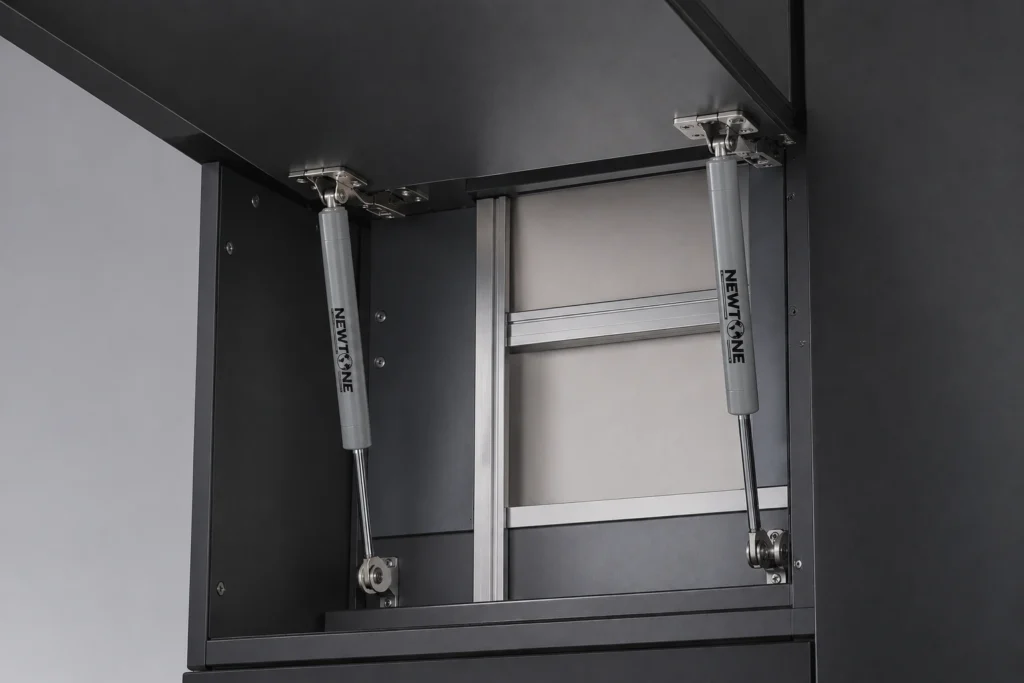
Concealed Cabinet & Panel Systems
Hidden lift, even hold, and a quiet, controlled close for concealed cabinet fronts, flap doors, and architectural panels — sized to stay put at any angle and tuck out of sight.
- 1 The Spring You Are Not Supposed to See or Hear
- 2 Where Gas Springs for Concealed Cabinets Are Used
- 3 One Spring or Two on a Concealed Panel
- 4 When to Specify Stainless Steel or Locking Gas Springs
- 5 Specification Quick-Reference by Panel Type
- 6 How to Size Gas Springs for Concealed Cabinets: Force Curve and Hold
- 7 Why Furniture & Joinery OEMs Source Concealed Springs from Newtone
- 8 Frequently Asked Questions
- 9 Conclusion
- 10 Get a Specification or Quote
The Spring You Are Not Supposed to See or Hear
Gas springs for concealed cabinets have a brief most hardware never gets: do the job and disappear. Open a wall-bed cabinet, a lift-up kitchen flap, or a flush architectural panel and the front should rise smoothly, stop wherever the hand lets go, and tuck shut without a clunk — and the spring doing all of that has to vanish inside the carcass when the panel is closed. There is no room for a strut sticking out, no tolerance for a door that creeps open on its own overnight, and in a quiet room a hiss or a clunk gets noticed immediately. The engineering is less about raw force than about a flat, quiet, well-behaved force curve hidden in a tight cavity.
This page is for the people who design and supply that joinery: furniture and cabinet OEM engineers specifying concealed lift mechanisms, procurement teams sourcing replacement struts for installed units, and distributors serving kitchen, office, and architectural-fit-out manufacturers. The focus here is the force curve and the concealed fit — what makes a panel sit at any angle and stay hidden.
Who this page is for: furniture, cabinet, and architectural-joinery OEM engineers specifying concealed lift and flap mechanisms, procurement teams sourcing replacement struts for installed units, and distributors supplying kitchen, office, and fit-out manufacturers.
Where Gas Springs for Concealed Cabinets Are Used
Concealed systems cover a range of furniture and architectural movements, and they share a requirement: the panel has to behave gracefully and the mechanism has to stay out of sight. The weight and the motion differ, and so does the force curve you want.
Lift-Up Cabinet Fronts
Upper kitchen and storage fronts that swing or parallel-lift upward and hold open above head height. The panel must stay put at any angle so it never drops on the user, with a low, even force so it lifts with one finger.
Flap & Drop-Down Doors
Desk fronts, bar-cabinet flaps, and drop-down panels that open downward. Here a controlled, damped descent matters most, so the flap eases down to horizontal instead of falling open.
Wall Beds & Concealed Furniture
Fold-away beds and hidden furniture with large travel and significant weight. Heavier loads, long stroke, and usually paired springs balanced so the panel moves true through its whole arc.
Flush Architectural Access Panels
Concealed wall and ceiling panels for services access that must sit perfectly flush when closed. The visible gap has to stay even, which puts the focus on matched force and precise concealed mounting.
One Spring or Two on a Concealed Panel
For concealed work, the decision is driven as much by appearance as by load. A narrow door on one spring is fine; a wide concealed front on a single spring lifts unevenly, and on furniture an uneven lift shows instantly as a panel that sits crooked or a shadow gap that tapers down one side. Two matched springs keep a wide panel parallel and the reveal even, and they share the load so each can be a smaller, easier-to-conceal unit.
⬤ Single Spring Setup
- Narrow doors and small flaps
- Light panels, centred load
- Soft-close hinge sharing the load
- Lower part count and cost
⬤ Paired Spring Setup
- Wide concealed fronts and wall beds
- Tall flap doors prone to lifting unevenly
- Flush panels where the reveal must stay even
- Springs force-matched to ±5% from one batch
When to Specify Stainless Steel or Locking Gas Springs
Most concealed cabinet and joinery work is indoors and dry, so a standard configuration is right: a black nitrided rod (900–1000 HV, 20–30 µm) with HNBR seals gives a long, quiet service life. The damp exceptions are the ones to watch — bathroom vanities, kitchens with heavy steam, and outdoor or marine joinery — where condensation would slowly pit a standard rod; there, a stainless steel gas spring is the right call. For the smooth, slow descent that drop-down flaps need, the relevant tool is often a hydraulic damper or a damped strut rather than more force.
Locking has a specific, useful role in concealed systems: holding a panel firmly open at a set position for safety or function, such as a lift-up front that must not drop on someone reaching into a cabinet, or a wall bed held at a service position. A locking gas spring holds at full extension until released. For most everyday concealed doors, though, a correctly tuned standard strut that genuinely stays put at any angle is what makes the product feel premium, and is enough.
Specification Quick-Reference by Panel Type
| Panel Type | Typical Weight | Recommended Force | Spring Count | Notes |
|---|---|---|---|---|
| Lift-up cabinet front | 2–6 kg (4–13 lb) | 60–150 N (13–34 lbf) | 1–2 | Low K so it stays at any angle |
| Flap / drop-down door | 3–8 kg (7–18 lb) | 80–180 N (18–40 lbf) | 1–2 | Add damping for controlled descent |
| Wall bed / concealed furniture | 20–45 kg (44–99 lb) | 300–700 N each (67–157 lbf) | 2 | Long stroke; balance through full arc |
| Flush architectural panel | 5–15 kg (11–33 lb) | 100–280 N each (22–63 lbf) | 2 | Match force so the reveal stays even |
| Damp / steam-exposed cabinet | Any of the above | Per type | Per type | Stainless recommended |
How to Size Gas Springs for Concealed Cabinets: Force Curve and Hold
For concealed panels the useful relationship is the progression ratio, because “stays at any angle” is really a statement about how flat the force curve is. Size from the held-open force first, then check K:
K = P2 ÷ P1 | ΔF = P2 − P1 = F1 × (K − 1)
K = progression ratio · P1 = extended (held-open) force · P2 = compressed (closing-end) force · ΔF = extra force gained over the stroke
Worked example — lift-up front sized for P1 = 120 N (27 lbf), K = 1.3:
P2 = P1 × K = 120 × 1.3 = 156 N (35 lbf) at the closing end
ΔF = 156 − 120 = 36 N (8 lbf) rise across the stroke — small enough that the panel sits at any angle and closes with an even feel. A K of 1.6 would give ΔF = 72 N (16 lbf), and the door would spring back near shut.
Get P1 from the panel itself: it has to equal the held-open load, which for a hinged front comes from the usual moment balance (panel weight × hinge-to-CoG distance ÷ the spring’s moment arm) divided across the springs. Then keep K low so P2 doesn’t climb into a hard closing push. Add a small safety margin and, for a wide panel, force-match the pair to ±5% so the reveal stays even. Where the weight, hinge offset, or cavity depth isn’t fixed, confirm both P1 and the closed length with our engineering team rather than guess — concealment leaves little room to correct a wrong length later.
Mounting in concealed work carries an extra constraint: the spring has to disappear. Fit it rod-down in the closed position so the oil keeps the seals lubricated and the action stays quiet — quietness is a real spec in furniture. Use compact end fittings that allow a little angular play so the rod is never side-loaded, keep both pivots in the same plane so the panel runs true, and confirm the fully compressed spring tucks entirely inside the carcass behind the closed front. The lower pivot position relative to the hinge tunes the feel and the effective arm more than re-rating the force does, which is the lever to use when the cavity is tight. Sized mounting brackets keep the install concealed and rigid.
Why Furniture & Joinery OEMs Source Concealed Springs from Newtone
We manufacture in our own plant in Turkey, so the force curve, closed length, and tolerance are ours to tune — which is what a panel that must stay put, stay quiet, and stay hidden actually needs.
Frequently Asked Questions
Size from the extended-position force (P1), the lowest force on the stroke and the one that holds the panel open. Then keep the progression ratio K — the compressed-to-extended force ratio — low, around 1.2 to 1.4. A low, flat force curve is what lets the panel sit anywhere instead of creeping open or snapping shut. Share the panel weight and geometry with Newtone for the exact P1.
Because the gas spring force rises as the rod is pushed in, set by the progression ratio K. If K is high, the panel feels light to start closing and then fights you near shut. For furniture and concealed panels, specify a spring with a low K so the closing feel stays even and the door does not spring back.
Narrow doors and light panels usually run on one spring. Wide concealed fronts and tall flap doors use two so the panel lifts level and the visible gap stays even down both sides. When two are used, match them to within ±5% from the same batch, or the uneven force shows as a panel that sits crooked.
Mount it rod-down in the closed position so oil keeps the seals lubricated and the motion stays quiet, which matters in furniture where noise is noticed. Use end fittings that allow slight angular play so the rod is not side-loaded, keep both pivots in the same plane, and confirm the compressed spring tucks fully inside the cabinet behind the panel.
Usually not. Interior furniture and joinery are fine with a black nitrided rod and HNBR seals. Specify stainless steel for cabinets in bathrooms, kitchens with heavy steam, or outdoor and marine joinery, where humidity would otherwise pit a standard rod over time.
Conclusion
A concealed cabinet spring is judged on feel and on what you cannot see. The panel should rise with one finger, stay exactly where it is left, close quietly with an even push, and hide its mechanism completely when shut. The mistakes are subtle: chasing a peak force and ignoring the progression curve, so the door springs back or creeps; running one spring under a wide front, so the reveal goes crooked; or picking a spring that will not tuck out of sight.
Newtone tunes these springs for the whole curve, not just one number: a low progression so panels stay at any angle, compact bodies that conceal fully, matched pairs to ±5% so reveals stay even, and stainless for damp installs. Engineering support is available to set P1, K, stroke, and closed length for a specific panel and cavity.
Send us the panel weight, motion, hinge geometry, and cavity depth. We’ll come back with a force-and-curve recommendation, a datasheet, and a quote — usually within 5 business hours.
Get a Specification or Quote
Tell us your panel weight, motion type, hinge geometry, and concealed cavity dimensions. Our engineering team handles the rest — held-open force, progression, stroke, material, and a configuration that disappears when closed.