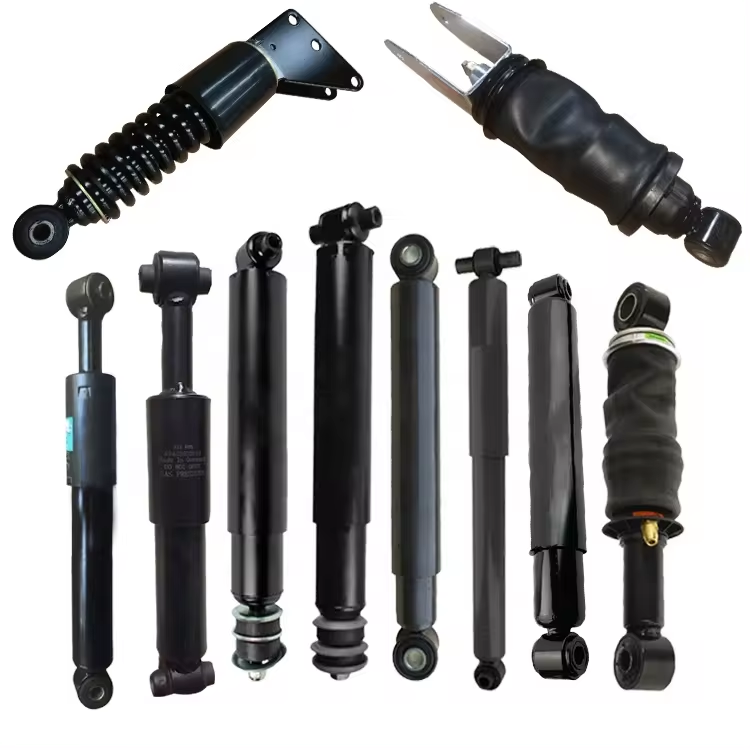
In industrial automation, movement is not only about speed and force. Just as important is how that movement stops, slows down, and behaves at the end of travel. A system may work perfectly well in terms of motion, but if it closes too hard, stops too abruptly, or creates repeated impact, the result can still be poor. That is where hydraulic
dampers become important.
Hydraulic dampers are used to control motion by absorbing energy and reducing shock. In automated systems, they help create smoother operation, protect components from impact, and improve the overall behavior of moving parts. Whether the application involves machine covers, sliding assemblies, automated doors, transfer systems, or other industrial equipment, hydraulic damping can make a noticeable difference.
For engineers and machine builders, the role of a hydraulic damper is often simple in principle but critical in practice: it helps movement end in a more controlled way.
What is a hydraulic damper?
A hydraulic damper is a motion-control component designed to slow movement and absorb kinetic energy through hydraulic resistance. Instead of providing lifting force like a gas spring or active movement like an actuator, a hydraulic damper works to control speed and reduce shock.
In practical terms, it helps prevent hard stops, sudden impact, and unstable end-of-stroke behavior.
This is especially valuable in industrial automation, where repeated motion cycles can place continuous stress on equipment if movement is not properly controlled.
Why hydraulic dampers are important in industrial automation
Automation systems often operate at high frequency, with repeated opening, closing, sliding, pressing, or positioning movements throughout the day. Without damping, these movements can create unnecessary stress on both the equipment and the user experience of the machine.
A hydraulic damper can help improve:
- motion control
- end-of-travel behavior
- equipment protection
- noise reduction
- cycle consistency
- operator comfort
- long-term component life
In many machines, damping is not added because movement is impossible without it. It is added because the system performs better with it.
What are hydraulic dampers used for?
The answer depends on the type of automation system, but in general, hydraulic dampers in industrial automation are used wherever movement needs to be slowed, softened, or controlled more precisely.
Common uses include:
- slowing sliding mechanisms
- controlling lid or cover movement
- reducing impact at the end of stroke
- soft-closing machine doors or access panels
- damping return movement in mechanical assemblies
- protecting stops, hinges, and frame structures
- improving motion quality in automated equipment
In many applications, the damper is there to manage the last part of the movement, where uncontrolled impact would otherwise happen.
Typical industrial automation applications
Hydraulic dampers are used across many kinds of automated equipment. Their function may vary slightly from one system to another, but the goal is usually the same: controlled deceleration.
Typical application areas include:
- automated machine covers
- access doors and guarding systems
- conveyor-related assemblies
- transfer units
- robotic enclosures
- packaging equipment
- industrial drawers and sliding trays
- control cabinet mechanisms
- special machinery with repeated motion cycles
In each of these, the damper helps movement feel more controlled and puts less stress on the surrounding hardware.
Hydraulic dampers and shock reduction
One of the most practical benefits of a hydraulic damper is shock reduction.
When a moving part reaches the end of its travel too quickly, the impact can transfer directly into the equipment structure. Over time, this may affect brackets, hinges, mounting points, fasteners, and other nearby components. It can also create noise and a lower-quality feel in the machine.
A properly selected hydraulic damper helps absorb part of that energy before the impact becomes a problem. This can lead to smoother machine behavior and a more durable overall assembly.
Why controlled closing matters
In industrial environments, even simple machine movements can affect safety, service life, and usability. A panel that slams shut or a sliding mechanism that stops abruptly may not seem like a major issue at first, but repeated uncontrolled movement often leads to wear and handling problems over time.
Controlled closing matters because it can help:
- reduce mechanical stress
- improve perceived product quality
- support safer machine interaction
- minimize sudden noise
- make repeated movement more consistent
That is why hydraulic dampers are often used not only for protection, but also for refinement of machine performance.
How hydraulic dampers differ from gas springs
This is a useful distinction, especially because the two products are sometimes mentioned in similar applications.
A gas spring is mainly used to support or assist movement by providing force. A hydraulic damper is used to resist motion and slow it down.
In simple terms:
- gas spring = helps move or support
- hydraulic damper = helps control or slow
In some industrial automation systems, both components may be used together. One supports the movement, while the other refines how that movement behaves.
What should be considered when selecting a hydraulic damper?
Choosing the right damper depends on the application, not only on the part itself.
Important factors include:
- moving mass
- travel speed
- available stroke
- mounting geometry
- operating direction
- cycle frequency
- environmental conditions
- required damping behavior
- installation space
A damper that is too weak may not control the movement effectively. One that is too strong may slow the system too aggressively or affect operation in an unwanted way. The right choice comes from understanding the real movement conditions of the equipment.
Hydraulic dampers for repeated industrial use
One reason hydraulic dampers are widely used in automation is that many automated systems repeat the same motion again and again. In these situations, small improvements in motion control can have a large effect over time.
A well-matched damper can help reduce wear, improve consistency, and make the machine feel more refined across thousands of cycles. In a production environment, this kind of stability matters.
It is not only about making movement softer. It is about making repeated movement more controlled and more sustainable over the life of the equipment.
Why machine builders use hydraulic dampers
For machine builders, hydraulic dampers are often a simple way to improve motion quality without redesigning the entire system. They can help solve issues related to hard stops, impact loads, and abrupt motion behavior in a compact and practical way.
In many cases, they are selected because they help the final machine feel better engineered. That may mean quieter closing, less stress on components, more stable movement, or a safer interaction for the operator.
These details often matter more than they appear on paper.
Conclusion
Hydraulic dampers are used in industrial automation to control motion, absorb energy, and reduce impact. Their role is especially important in systems where repeated movement needs to end in a more controlled and consistent way.
Whether they are used on sliding assemblies, machine covers, automated doors, or other moving parts, hydraulic dampers help improve both mechanical protection and movement quality. In many cases, they are a small component with a meaningful effect on the overall performance of the system.
Need help selecting the right hydraulic damper?
If your automation system requires smoother motion, reduced impact, or more controlled end-of-stroke behavior, our Newtone Gas Springs team can help you review the most suitable hydraulic damper solution for your application.