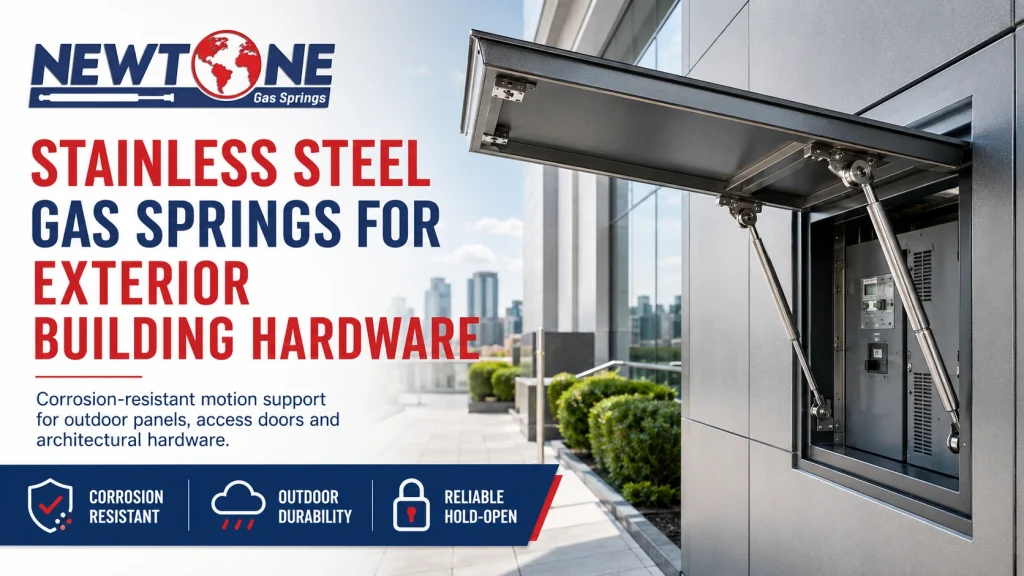
Exterior Building Hardware
Corrosion-resistant lift support for roof access hatches, smoke vents, rooftop equipment panels, and exterior louvers — for hatch and vent OEMs, procurement teams, and aftermarket distributors.
- 1 When Exterior Hardware Needs the Stainless Upgrade
- 2 Where These Springs Actually Get Used
- 3 When Cold and Snow Load Stack
- 4 Material Selection: Stainless vs. Standard for This Environment
- 5 Mounting for Rooftop and Facade Exposure
- 6 Specification Quick-Reference by Hardware Type
- 7 Why Building Hardware OEMs Source from Newtone
- 8 Frequently Asked Questions
- 9 Conclusion
- 10 Get a Specification or Quote
When Exterior Hardware Needs the Stainless Upgrade
Stainless steel gas springs for exterior building hardware are worth specifying whenever a roof hatch, smoke vent, or access panel sits directly in the weather — rooftop installations, coastal buildings, or anywhere humidity stays high year-round. For hardware mounted indoors or behind a weatherproof enclosure, a black-nitrided rod with HNBR seals holds up just as well at a lower cost. The distinction matters more than it sounds, because over-specifying stainless across an entire product line adds cost with no real benefit on units that never see rain.
A roof hatch cover doesn’t get opened often — a maintenance tech climbing up once a quarter, a fire inspector checking the smoke vent release, someone servicing a rooftop condenser. But when it does get opened, it needs to lift cleanly on the first try, in July heat and January cold alike, after months of sitting exposed to rain, salt air, or roof-deck humidity. That’s a harder environment than almost any indoor application this component sees.
Who this page is for: OEM engineers designing gas springs into roof hatches, smoke vents, or rooftop access panels, procurement managers sourcing corrosion-resistant components for a building-products line, and distributors evaluating a manufacturing partner for ongoing supply.
Where These Springs Actually Get Used
Roof Access Hatches
Single or twin-leaf hatch covers providing roof access for maintenance. Insulated aluminum covers commonly weigh 15–35 kg (33–77 lb) and are rated against code-driven snow and wind loads.
Smoke & Heat Vents
Fire-rated flaps that must open reliably within seconds of a fusible-link release, even after years of unused, weather-exposed standby.
Rooftop Equipment Access Panels
Smaller panels providing service access to HVAC units, electrical enclosures, and mechanical equipment mounted on the roof deck.
Exterior Louvers & Facade Vents
Operable louver banks and ventilation flaps on building facades, cycled more frequently than hatches and exposed to direct weather on every face.
When Cold and Snow Load Stack
Force sizing for a hinged hatch or panel starts with the same moment balance used on any pivoting lid — but exterior building hardware has a complication most applications don’t: the force naturally drops in cold weather, at the same time of year the cover is carrying its heaviest snow or ice load. Size for one and ignore the other, and a hatch that opened fine during summer commissioning can fail to lift on the coldest day of the year.
W = m × g = 8 × 9.81 = 78.5 N (17.6 lbf)
F = (78.5 × 300 × cos 15°) ÷ 50 = (78.5 × 300 × 0.966) ÷ 50 ≈ 455 N (102 lbf) at 20°C nominal
Apply a safety-factor surcharge for the code-driven live load — 1.2 is reasonable for a panel exposed to wind and occasional snow accumulation — and the design requirement becomes 455 × 1.2 ≈ 546 N (123 lbf). That’s the force the spring needs to deliver in the worst case, not at room temperature on a test bench.
That’s below the 546 N (123 lbf) the panel actually needs in a snow-loaded, worst-case-cold scenario. Specifying a 455 N spring and calling it “safety-factored” would leave the hatch under-powered exactly when it matters. Working backward — 546 N ÷ 0.88 ≈ 620 N (139 lbf) — gives the nominal 20°C spec that still clears the required force after cold derating.
That’s the correction competitors’ generic force tables miss: the safety factor and the temperature derating both act on the same number, in the same direction, at the same time of year. Sizing them independently understates the requirement.
Material Selection: Stainless vs. Standard for This Environment
A hard chrome or black-nitrided rod with HNBR seals is the right call for the large majority of hardware installed under cover or indoors — HVAC access panels inside a mechanical room, for instance. The calculation changes the moment the spring is exposed to direct weather. We worked with a hatch and access-door manufacturer supplying commercial buildings along a coastal stretch of the eastern seaboard whose chrome-rod springs were showing surface pitting and early seal failure within two to three years of installation — well short of the service life the same parts delivered inland. Switching the coastal product line to 316L stainless body and rod resolved it; the pitting that had been working its way into the seal contact surface simply stopped forming.
For an OEM building both an indoor and an outdoor variant of the same hatch or panel platform, it’s common to spec stainless as the default across the outdoor-rated SKU rather than maintaining two part numbers that differ only in rod finish.
Mounting for Rooftop and Facade Exposure
Mount with the rod pointing down whenever the hatch or panel geometry allows it — water sitting at the seal, rather than draining away from it, is what shortens seal life fastest on exposed hardware. Use ball socket end fittings rather than rigid brackets; the curb frame and the panel itself expand and contract independently across seasonal temperature swings, and the ball socket’s tolerance for angular misalignment prevents that movement from side-loading the rod. Side load on a gas spring shortens its life regardless of seal quality or material, so keeping both pivot points in the same plane of motion matters as much outdoors as anywhere else.
Specification Quick-Reference by Hardware Type
| Hardware Type | Typical Weight | Recommended Force | Material | Notes |
|---|---|---|---|---|
| Roof access hatch (single leaf) | 15–25 kg (33–55 lb) | 250–400 N each (56–90 lbf) | 316L for coastal/exposed sites | Often twin-spring; check snow-load derating |
| Smoke / heat vent flap | 10–20 kg (22–44 lb) | 150–300 N each (34–67 lbf) | 316L recommended | Must open reliably after long unused standby |
| Rooftop equipment access panel | 5–10 kg (11–22 lb) | 100–250 N (22–56 lbf) | Standard or stainless by exposure | Smaller panel, single spring typical |
| Exterior louver / facade vent | 3–8 kg (7–18 lb) | 60–150 N (13–34 lbf) | 316L for direct-weather faces | Higher cycle frequency than hatches |
| Coastal / high-humidity placement | Any of the above | Per hardware type | Stainless steel recommended | Applies regardless of hardware category |
These figures are starting points for early sourcing conversations. Panel weight, hinge geometry, and worst-case design temperature vary enough between platforms that we’d rather run the moment-balance-and-derating calculation against your actual drawings than have a customer spec from a table.
Why Building Hardware OEMs Source from Newtone
We’re a manufacturer, not a distributor. Every spring is built in our own facility in Turkey, giving us direct control over tolerances, materials, and lead times.
Frequently Asked Questions
Specify stainless (316L) whenever the hatch, vent, or access panel is exposed to the weather directly — rooftop installations, coastal buildings, or high-humidity sites. For hardware mounted indoors or under a weatherproof enclosure, a black-nitrided rod with HNBR seals performs just as well at a lower cost.
Force drops roughly 0.3% per degree Celsius below the 20°C reference point. At -20°C, a spring rated at 455 N (102 lbf) delivers only about 400 N (90 lbf) — a 12% reduction. That drop happens in exactly the season when rooftop hardware is also carrying its heaviest snow or ice load, so both effects need to be sized for together, not separately.
Calculate the base force from the moment balance, apply a safety-factor surcharge for the code-driven live load (typically 1.1-1.3), then divide that result by the cold-weather derating factor at your lowest design temperature — not the other way around. Specifying force at room temperature and adding a safety factor afterward can still leave the spring under-powered on the coldest day of the year.
Mount with the rod pointing down whenever the hatch geometry allows it, so water doesn’t sit at the seal and the seal stays lubricated. Use ball socket end fittings that tolerate the small angular misalignment caused by thermal expansion and contraction of the curb frame across seasonal temperature swings.
Yes. We supply new-production gas springs for hatch, vent, and access-panel OEMs, and can match force, stroke, and end fittings for aftermarket replacement so a manufacturer’s service network gets parts that behave identically to the original.
Conclusion
Stainless steel gas springs for exterior building hardware earn their cost premium on one condition: the hardware actually lives outdoors. Where it does, the sizing has to account for two things happening at once — reduced force in cold weather and increased structural load from snow or wind — not one or the other in isolation. Get that combined calculation right, add 316L where corrosion exposure calls for it, and a roof hatch or smoke vent stops being a maintenance callback and goes back to being hardware nobody thinks about until they need it.
Newtone builds gas springs for OEM roof hatch, smoke vent, and building-hardware manufacturers, as well as aftermarket replacement for existing product lines. Share your panel dimensions and design temperature range, and we’ll return a force recommendation, a datasheet, and a quote — typically within 5 business hours.
Get a Specification or Quote
Tell us your hardware type, panel weight, and mounting geometry. Our engineering team handles the rest — free force calculation with temperature derating, sample datasheet, and competitive pricing.