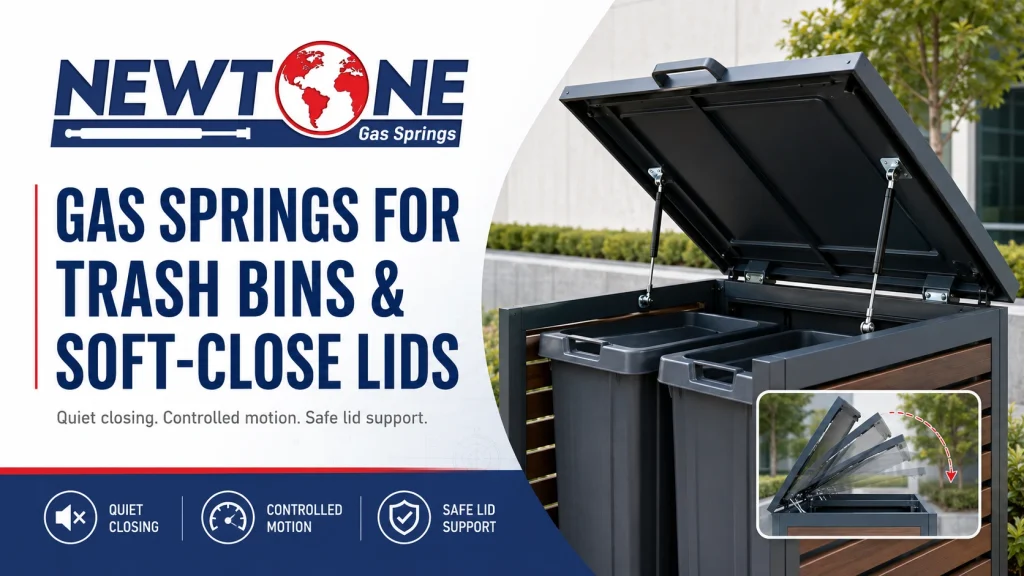
Gas springs for trash bins and soft-close lids should be selected by lid weight, hinge geometry, opening angle, required lift support, damping need and operating environment. A gas spring can help support or lift the lid, but soft-close behavior is usually a speed-control problem; the lid may also need damping so it does not slam, bounce or pinch fingers near the end of travel.
A public waste-bin lid, outdoor trash enclosure cover, recycling station flap or commercial kitchen bin lid is opened by many users with different habits. Some lift it carefully. Some drop it. Some push it with a knee, elbow or foot pedal. If the motion system is wrong, the lid becomes noisy, unsafe, hard to close or unreliable after repeated cycles. The right design separates two jobs: support the lid with the right force, then control closing speed with the right damping.
- 1 Why Gas Springs for Trash Bins and Soft-Close Lids Need Motion Control
- 2 Soft-Close Is a Speed Problem, Not Just a Force Problem
- 3 Gas Spring vs Damper: Which One Does the Lid Need?
- 4 Damping Force for Soft-Close Lid Speed
- 5 Force Selection for Trash Bin Lid Support
- 6 Mounting Guidance for Soft-Close Trash Bin Lids
- 7 Outdoor, Hygiene and Cleaning Environment
- 8 Single, Paired and Dual-Side Lid Support
- 9 Common Specification Mistakes
- 10 Trash Bin and Soft-Close Lid Specification Checklist
- 11 Why Source Trash Bin Lid Gas Springs from Newtone?
- 12 Frequently Asked Questions About Gas Springs for Trash Bins and Soft-Close Lids
- 13 Final Engineering Takeaway
Why Gas Springs for Trash Bins and Soft-Close Lids Need Motion Control
Gas springs for trash bins and soft-close lids need motion control because the lid is not only a cover; it is a user-contact part. It may be opened dozens or hundreds of times per day in a public space, apartment block, hotel, hospital, office, recycling station or food-service area.
The lid must feel light enough to open, controlled enough to close quietly, and safe enough not to drop onto fingers or hands. A heavy lid without support can slam. A lid with too much gas spring force can become hard to close. A lid with no damping can still fall quickly even if the opening force feels acceptable.
This is why the first design question should not be “how strong should the gas spring be?” The better question is “what do we need the lid to do?” If the lid needs lift assistance, a standard gas spring may fit. If the lid needs slow closing, a damper or damped gas spring behavior should be reviewed. If the lid is wide or heavy, paired support may be needed.
Soft-Close Is a Speed Problem, Not Just a Force Problem
Soft-close is a speed problem, not just a force problem. A higher Newton rating can help hold a lid open, but it does not automatically make the lid close softly. In some layouts, a stronger spring makes the lid harder to close and creates a poor user feel.
This is the common mistake in trash bin and enclosure lid design. An OEM sees a lid dropping too fast and asks for a stronger gas spring. The spring may reduce the drop, but it may also resist closing too much. The lid then feels springy, stays half-open or needs extra force from the user.
We see this in first-article reviews for waste-bin and outdoor enclosure projects. The first request is often “make the lid stronger.” After checking the geometry, the real problem is usually closing velocity. The better solution is the right support force, the right mounting angle and, where needed, a damper characteristic that slows the last part of travel without making the lid awkward to use.
Gas Spring vs Damper: Which One Does the Lid Need?
A gas spring supports load; a damper controls speed. Trash bin and soft-close lid design can require one or both functions, depending on the lid weight, hinge position and user expectation.
A standard gas spring is useful when the lid needs help opening or needs to stay open during cleaning, bag replacement or service access. A hydraulic damper is useful when the lid already moves easily but closes too quickly. A rotary damper may be useful in compact hinge-integrated designs where linear space is limited.
For larger waste enclosure lids, a gas spring may reduce the lifting effort while a damper slows the closing motion. For smaller indoor bins, the damping function may matter more than lift force. For outdoor municipal bins, corrosion, vandal resistance, repeated cycles and cleaning exposure become part of the specification.
The wrong choice usually shows up in use. If the lid is easy to lift but slams shut, the issue is damping. If the lid is heavy to open and falls closed, the issue may be support force plus damping. If the lid is hard to close, the gas spring force may be too high or the bracket geometry may be poor.
Damping Force for Soft-Close Lid Speed
The key formula for a soft-close lid is the viscous damping relationship. It shows why soft close is about controlling velocity, not simply increasing gas spring force.
Formula:
F_damp = c × v
Where:
F_damp = damping force resisting lid motion
c = damping coefficient
v = lid or damper rod velocity
Example: an outdoor trash enclosure lid closes too quickly. In the prototype, the effective damper rod speed near closing is about 0.45 m/s (17.7 in/s). The design target is to reduce controlled closing speed to about 0.15 m/s (5.9 in/s). Suppose the selected damping layout provides an effective damping coefficient of 450 N·s/m.
At uncontrolled high speed:
F_damp = 450 × 0.45 = 203 N (46 lbf)
At target soft-close speed:
F_damp = 450 × 0.15 = 68 N (15 lbf)
The damper resists the lid more strongly when the lid moves fast and less strongly when the lid moves slowly. That is why damping feels different from simple gas spring force. A gas spring applies support force based on its internal pressure and geometry. A damper reacts to speed.
Support force still matters. For a hinged lid, the load side can be checked with a moment balance:
F = (W × Lg × cos φ) ÷ (n × r)
But that force calculation answers a different question: “Can the spring support the lid?” The damping calculation answers: “Will the lid close quietly and safely?” A good soft-close design needs both questions answered separately.
Force Selection for Trash Bin Lid Support
Force selection for trash bin lid support should start with lid weight, hinge-to-centre-of-gravity distance, open angle, spring count and effective spring moment arm. A same-size lid can need very different gas spring force depending on where the pivots are placed.
For a light indoor lid, the gas spring may only need to reduce closing impact or help the lid stay open during bag replacement. For a heavy outdoor enclosure lid, the spring may need to counterbalance a larger panel while still allowing a user to close it comfortably.
Too much force is a real problem. If the gas spring over-supports the lid, the user may need to push hard to close it. That can damage hinges, bend brackets or make the lid stay open in windy outdoor conditions. In public-use products, that poor feel becomes a maintenance complaint.
Mounting distance is often more important than the label on the spring. Moving the spring line of action farther from the hinge increases the moment arm and can reduce the force required. Moving it too close to the hinge forces the designer to use a higher Newton rating, which can make the lid less pleasant to use.
Mounting Guidance for Soft-Close Trash Bin Lids
Soft-close trash bin lids should be mounted with clean pivot geometry, enough clearance for the bag or liner, and no side-load on the rod. Gas springs and dampers are designed for axial movement, not lateral bending.
Keep both pivots in the same plane of motion. A lid that twists as it closes can side-load the rod and shorten seal life. End fittings should allow the angular movement required by the lid, especially where the hinge path is compact or the lid opens past a steep angle.
Where the geometry allows it, mount the gas spring with the rod pointing down in the at-rest or closed position. This helps keep oil near the seal and supports consistent damping. In bins and enclosures, the spring should also be placed where waste bags, liners, cleaning tools and user hands do not strike it.
The spring or damper should not become the hard stop unless the design has been reviewed for that purpose. A separate lid stop or hinge limit is often safer. Bottoming out the gas spring can create shock loads at the rod, guide and brackets.
Outdoor, Hygiene and Cleaning Environment
Trash bin lid gas springs and dampers should be specified for the environment around the bin: indoor office use, outdoor municipal use, food-service cleaning, coastal exposure, high humidity or washdown. The lid may look simple, but the environment can be harsh.
For many indoor and protected outdoor bins, Newtone’s black nitrided rod with HNBR sealing is a strong standard solution. The rod treatment provides a hard working surface, and HNBR sealing supports resistance to UV and ozone exposure.
Stainless steel gas springs should be reviewed for coastal cities, high-humidity locations, food-service washdown, chemical cleaning exposure and municipal bins that stay outdoors year-round. The brackets, pins, screws and end fittings should be reviewed with the same logic. A stainless spring mounted with unsuitable hardware is not a complete corrosion-resistant system.
Hygiene also affects layout. The gas spring should not create a dirt trap where waste residue, liquids or cleaning water collect. A beautiful soft-close mechanism that is impossible to clean will not survive real waste-bin use.
Single, Paired and Dual-Side Lid Support
Single gas springs can work on small or narrow trash bin lids, but wide enclosure lids often need paired or dual-side support. Two support points reduce twisting and help the lid close evenly across the hinge line.
Paired springs should be force-matched. If one side produces more force than the other, the lid may skew, bind or close unevenly. Newtone controls gas spring force tolerance at ±5%, which supports repeatable paired behavior in OEM lid assemblies.
For public waste enclosures, paired support can also improve perceived quality. A wide lid that drops on one corner feels cheap even if it technically closes. A matched pair creates more consistent motion and reduces one-sided hinge wear.
Common Specification Mistakes
The first mistake is confusing force with soft-close damping. A stronger gas spring can reduce lid drop, but it may also make the lid hard to close. Soft-close behavior needs speed control.
The second mistake is using cabinet hardware outdoors without reviewing corrosion, cycle life and cleaning exposure. A kitchen cabinet damper and a public trash enclosure lid may share a motion idea, but they do not share the same environment.
The third mistake is ignoring the user’s hand path. On trash bins, people interact with the lid quickly and not always gently. The spring should not pinch fingers, block the bag liner or sit where it will be hit during cleaning.
Other mistakes include placing the spring too close to the hinge, replacing only one spring on a paired lid, allowing the gas spring to bottom out as the lid stop, and choosing a spring by extended length alone without checking closing force and damping need.
Trash Bin and Soft-Close Lid Specification Checklist
| Specification point | Why it matters |
|---|---|
| Lid weight | Defines the load, but does not decide support force by itself. |
| Hinge geometry | Controls the torque and the force required from the gas spring. |
| Damping need | Determines whether soft-close behavior requires a damper or damped motion. |
| Closing feel | Too much force can make the lid difficult or annoying to close. |
| Single or paired layout | Wide lids may need matched dual support to prevent twisting. |
| Environment | Outdoor, washdown, coastal and food-service use may require stainless review. |
| Cleaning clearance | The mechanism should not trap waste, liquid or cleaning residue. |
| Cycle expectation | Public bins may see frequent use and need durable, repeatable motion. |
Why Source Trash Bin Lid Gas Springs from Newtone?
Manufacturer, Not Distributor
Newtone manufactures gas springs in Turkey and exports to more than 60 countries for OEM and aftermarket applications.
Motion Review
Engineering support is available for lid force, stroke, mounting points, damping behavior and paired-spring layouts.
Controlled Components
HNBR sealing, black nitrided rods, ±5% force tolerance and 100,000+ cycle capability support repeatable lid motion.
Environment Options
Stainless steel options can be reviewed for coastal, washdown, high-humidity and municipal outdoor bin applications.
Frequently Asked Questions About Gas Springs for Trash Bins and Soft-Close Lids
What do gas springs do in trash bins and soft-close lids?
Gas springs for trash bins and soft-close lids help support the lid, reduce lifting effort and hold the lid in a controlled position. If the main goal is slow closing, damping must also be reviewed because soft-close behavior depends on speed control.
Is a gas spring the same as a soft-close damper?
No. A gas spring provides support force, while a damper controls motion speed. Some lid designs need only one of these functions, but heavier or higher-quality soft-close lids may need both support and damping considered together.
Can a stronger gas spring make a trash bin lid close softly?
Not necessarily. A stronger gas spring may slow the lid, but it can also make the lid hard to close or leave it partially open. True soft-close design depends on damping, hinge geometry and correct support force.
Do outdoor trash bin lids need stainless steel gas springs?
Not always. Protected outdoor bins may use black nitrided rods with HNBR seals. Stainless steel should be reviewed for coastal, high-humidity, washdown, food-service or municipal outdoor applications where corrosion risk is higher.
Should wide waste enclosure lids use one gas spring or two?
Wide or heavy waste enclosure lids usually work better with two matched gas springs or dual-side support. Paired support reduces twisting, improves closing feel and helps protect hinges from one-sided loading.
Final Engineering Takeaway
Gas springs for trash bins and soft-close lids should be selected around the full motion problem: lift support, closing speed, hinge geometry, user safety, noise reduction, cleaning clearance and operating environment.
The most useful rule is simple: support force and soft-close damping are different jobs. A gas spring can make the lid easier to open and hold; a damper controls how fast it closes. Newtone can review both sides of the motion so waste-bin lids close quietly, open comfortably and survive real public, commercial or outdoor use.