
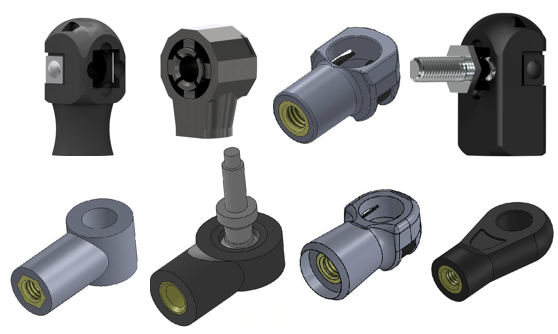
Composite End Fittings
Plastic End Fittings for Gas Springs
Precision Engineered. Rigorously Tested. Trusted Worldwide.
Plastic end fittings are essential components in gas spring systems, offering lightweight durability, corrosion resistance, and design flexibility. At Newtone Gas Springs®, we manufacture our Composite end fittings using high-precision injection molding machines and conduct 100% quality control at every step of the production process. This guarantees unmatched reliability and long-lasting performance.Uncompromised Quality Control
Our commitment to excellence includes:- 100% inspection throughout every phase of production
- Insert, climbing, and rupture tests using advanced Zwick testing machines
- Adherence to DIN tolerance standards, ensuring dimensional consistency and mechanical strength
In-House Design & Molding
We design and develop all molds internally, which gives us full control over product geometry, strength properties, and lead time. Every product is tested for tensile and rupture values before being approved for shipment.Premium Raw Materials
We use only original, high-quality materials to ensure durability and mechanical stability:- Body Material: PA66 GF30 (Glass-Fiber Reinforced Nylon)
- Available Colors: Black, Grey, White
- Clip Material: CK67, available in Zinc Black or Silver finishes
- Thread Options: Plastic or Brass
Custom Solutions Available
If you don’t see what you’re looking for in our catalog, simply reach out. We can design and produce customized plastic end fittings and create molds specifically for your project. Why Choose Our Plastic End Fittings?- Certified quality – fully compliant with industry standards
- In-house design and mold development
- Fast delivery times and responsive customer support
- Custom production for specialized applications
Are composite end fittings better than metal end fittings?
Composite end fittings are lighter and corrosion-resistant, while metal end fittings usually offer higher load capacity and strength. The best choice depends on the specific application requirements.
Can composite end fittings reduce vibration and noise?
Yes. Composite materials can absorb vibrations better than metal, helping reduce noise and improve operational smoothness in mechanical systems.
Are composite end fittings used in outdoor applications?
Yes, composite end fittings perform well in outdoor or high-humidity environments because they resist rust, corrosion, and environmental wear.
How do I choose the right composite end fitting?
When selecting a composite end fitting, consider:
- Load capacity requirements
- Thread size compatibility
- Mounting configuration
- Environmental conditions
- Type of equipment or gas spring used
