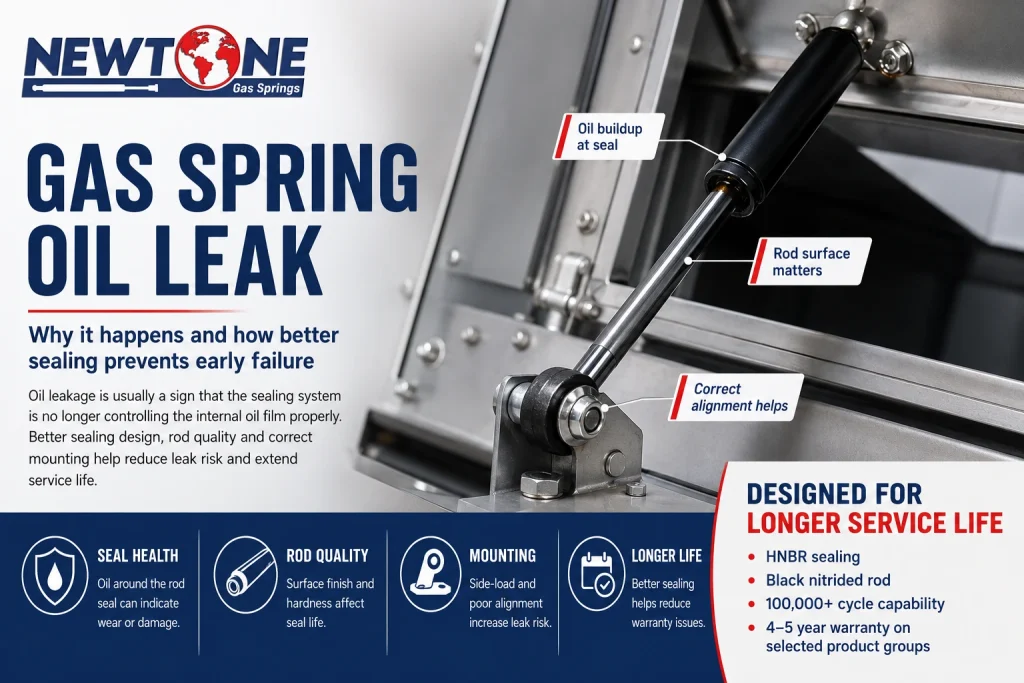
A gas spring oil leak usually means the sealing system is no longer controlling the internal oil film properly. A small trace of oil can sometimes be part of normal rod lubrication, but visible dripping, wet buildup around the rod seal, or oil collecting on the mounting area is a warning sign that the spring is losing its ability to seal, damp and hold force consistently.
For an end user, that looks like a dirty liftgate, a weak hatch or a panel that no longer opens smoothly. For an OEM or distributor, it is a bigger problem: warranty claims, early replacements and loss of confidence in the equipment. This is why Newtone treats oil leakage as a sealing-package issue, not just a cosmetic defect. The outside of two gas springs may look almost identical; the life of the product is often decided inside the guide, rod surface and seal stack.
- 1 What Does a Gas Spring Oil Leak Mean?
- 2 Why Is There Oil Inside a Gas Spring?
- 3 Main Causes Behind a Gas Spring Oil Leak
- 4 The Seal Package Is the Product
- 5 Formula Block: Service Life Behind Gas Spring Oil Leak Risk
- 6 Oil Leak vs Gas Pressure Loss
- 7 Installation Practices That Prevent Oil Leaks
- 8 How Newtone Prevents Gas Spring Oil Leak Problems
- 9 When Stainless Steel or Custom Sealing Should Be Reviewed
- 10 OEM Checklist to Reduce Gas Spring Oil Leak Risk
- 11 Why Source Long-Life Gas Springs from Newtone?
- 12 Frequently Asked Questions About Gas Spring Oil Leak
- 13 Final Engineering Takeaway
What Does a Gas Spring Oil Leak Mean?
A gas spring oil leak means the internal oil is escaping past the rod sealing area instead of staying inside the cylinder where it belongs. That oil is not decorative. It helps lubricate the rod and seal interface, supports smoother movement and, depending on the design, contributes to damping at the end of stroke.
The important distinction is between a light oil trace and a true leak. A very thin film on the rod can appear because the seal area needs lubrication. But oil that runs down the rod, collects around the end fitting, drips onto nearby parts or keeps returning after wiping is not normal. That points to a seal, rod or mounting problem.
Once the sealing system loses control of oil, gas retention may also be at risk. The spring may still move for a while, but the force curve, damping behavior and service life are no longer predictable. In industrial and OEM applications, that is usually the point where replacement and root-cause review make more sense than trying to keep the part in service.
Why Is There Oil Inside a Gas Spring?
Oil is inside a gas spring because the rod and sealing system need lubrication and controlled movement. A gas spring is not just a tube filled with nitrogen. It is a pressure device with a moving rod, guide, seal package, internal volume and, in many designs, oil used for lubrication and damping.
Oil helps reduce friction between the rod and seal. It also helps keep movement quieter and smoother. In some orientations, oil metering near the end of stroke can reduce impact when the spring approaches full extension. That is why rod orientation matters: as a default best practice, a gas spring should be mounted with the rod pointing down in the at-rest or closed position where the application allows it. This helps keep oil around the seal area.
The problem is not that oil exists inside the product. The problem is uncontrolled oil loss. Once oil escapes through the seal area, the rod may run drier, friction can change, damping can weaken and the seal can degrade faster. Get this wrong and the spring may still look acceptable from the outside while its real service life is already falling.
Main Causes Behind a Gas Spring Oil Leak
The main causes behind a gas spring oil leak are seal wear, poor seal material, rod damage, side-load, corrosion, contamination, temperature cycling and incorrect specification. In low-grade gas springs, the seal package is often the weak point. It may work at first, then fail early once the rod surface, load angle or environment becomes less forgiving.
Side-load is one of the fastest ways to damage a gas spring. The rod is designed for axial movement, not bending. If the mounting points are not in the same plane, or if the moving panel twists during travel, the seal lip is forced to work unevenly around the rod. Over time that can create a path for oil to escape.
Rod surface condition is just as important. Scratches, pitting or corrosion on the rod act like small cutting tools against the seal. This is why rod treatment matters. Newtone uses black nitrided rods with 900–1000 HV hardness and a typical treatment depth of 20–30 µm. A harder, better-controlled rod surface helps protect the sealing interface over repeated cycles.
Temperature cycling also matters. Heat can increase pressure and accelerate material stress. Cold can change force feel and oil behavior. Outdoor applications, vehicle compartments, construction equipment, agricultural machinery and marine-adjacent environments all make the sealing system work harder than a clean indoor cabinet.
The Seal Package Is the Product
The seal package is the product because it decides whether the gas spring keeps its oil, pressure and movement quality over time. Catalogue force is easy to compare. A 300 N (67 lbf) spring and another 300 N (67 lbf) spring can look identical on paper. They are not identical if the sealing package, rod finish and guide quality are different.
This is where Newtone separates its long-life gas springs from low-grade market alternatives. Newtone uses a different sealing package approach designed to reduce oil leakage risk to a very low level in correctly specified applications. That sealing package, combined with HNBR sealing and black nitrided rod treatment, is one of the main reasons Newtone gas springs can deliver significantly longer service life in many applications.
In practical terms, this is also why Newtone can offer 4–5 year warranty terms on selected product groups, depending on application, specification and operating conditions. The warranty is not built on a slogan. It is built on controlling the parts of the gas spring that usually fail first: seal behavior, rod surface, oil retention and application fit.
Formula Block: Service Life Behind Gas Spring Oil Leak Risk
Oil leak risk is not only a calendar-age issue. It is strongly connected to cycles, mounting quality and seal stress. A useful service-life framing formula is:
Service years ≈ Rated cycles ÷ cycles-per-day ÷ 365
Example: a machine access panel opens and closes 40 times per day. If the gas spring is rated for at least 100,000 cycles, the theoretical cycle-based service life is:
Service years ≈ 100,000 ÷ 40 ÷ 365 = 6.85 years
That does not mean every gas spring in that application will automatically last 6.85 years. It means the cycle count is sufficient only if the sealing package, rod surface, mounting alignment, temperature range and contamination control are also correct.
Temperature adds another layer. A practical gas spring force estimate is:
F_T ≈ F_20 × [1 + 0.003 × (T − 20°C)]
A 300 N (67 lbf) gas spring at 20°C (68°F) operating at 60°C (140°F) can be estimated as:
F_T ≈ 300 × [1 + 0.003 × (60 − 20)] = 300 × 1.12 = 336 N (76 lbf)
That extra force may be acceptable in the design, but it also reminds the engineer that seals do not live in a neutral world. Pressure, heat, friction and mounting load all meet at the rod seal.
Oil Leak vs Gas Pressure Loss
Oil leak and gas pressure loss are related, but they are not the same failure symptom. Oil leak is visible. You can see oil around the rod, seal area, bracket or nearby surface. Gas pressure loss is often invisible at first. The user notices it when the lid feels heavy, the hatch drops, or the panel no longer holds its position.
A gas spring can lose force without obvious oil on the outside. A gas spring can also show oil leakage before the user fully notices the force drop. In both cases, the root cause often sits near the sealing system. That is why a page about pressure loss should not be treated as the whole story. Oil leakage deserves its own review because it shows a physical failure path.
For OEMs, this distinction matters in warranty analysis. “The spring is weak” and “the spring is leaking oil” may both lead to replacement, but they point to different inspection questions: Was the force correct? Was the rod damaged? Was the spring side-loaded? Was the seal material suitable for the environment? Was the mounting orientation reasonable?
Installation Practices That Prevent Oil Leaks
The best sealing package can still be damaged by poor installation. Gas springs should be mounted so the rod works along its own axis. If the moving panel twists or the brackets are misaligned, the rod pushes sideways through the guide and seal. That side-load shortens life and increases the chance of oil leakage.
Rod-down orientation is the default best practice wherever the application allows it. Keeping the rod down in the at-rest or closed position helps oil stay near the seal and supports consistent damping. This is not always possible in every geometry, but when designers have a choice, rod-down is normally preferred.
End fittings and brackets should allow the angular movement required by the mechanism. Ball sockets are useful where the spring angle changes during travel. Eyelets can work well when the pivots are properly aligned. The key is not the fitting name; it is whether the spring can move without bending the rod.
Contamination also needs attention. Dust, metal chips, road dirt, salt and cleaning chemicals can attack the rod-seal interface. For outdoor, coastal, high-humidity or washdown environments, stainless steel gas springs may be the correct choice. For most indoor industrial applications, black nitrided rod treatment with HNBR seals is usually sufficient when mounting is correct.
How Newtone Prevents Gas Spring Oil Leak Problems
Newtone prevents gas spring oil leak problems by designing the spring around the seal system, not only around nominal force. The sealing package, rod treatment, guide quality and specification review all matter before the product ever reaches the customer.
Newtone gas springs use HNBR seals, selected for resistance to UV and ozone exposure. The black nitrided rod provides a hard surface, typically 900–1000 HV with 20–30 µm treatment depth. Force tolerance is controlled at ±5%, which supports repeatability in production and paired-spring applications. The operating range is −40°C to +100°C (−40°F to +212°F), but the exact specification should still be checked against the real application environment.
A few years ago, a distributor asked us why some low-cost replacements were coming back with early oil leakage while the force rating on the label looked correct. The problem was not the nominal Newton value. It was the seal package and rod quality behind that label. That is the kind of failure mode that rarely appears in a simple catalogue comparison, but it shows up quickly in warranty returns.
For selected product groups, Newtone’s sealing approach is the main reason we can support 4–5 year warranty terms when the application is correctly specified. The exact warranty always depends on the product family, environment and duty cycle, but the engineering direction is consistent: reduce oil loss at the seal, protect the rod surface and avoid early degradation.
When Stainless Steel or Custom Sealing Should Be Reviewed
Stainless steel should be reviewed when corrosion risk can threaten the rod surface and seal life. Coastal equipment, marine-adjacent applications, outdoor vending, vehicle compartments, washdown areas and high-humidity environments can all justify stainless steel gas springs. The reason is straightforward: rod pitting damages seals, and damaged seals allow oil and pressure to escape.
Custom sealing may also be needed when the application combines high cycle count, temperature cycling, contamination, unusual orientation or demanding warranty expectations. Not every application needs a special gas spring. But if the cost of failure is high, the seal package should be discussed during specification instead of after the first warranty claim.
Locking gas springs are a separate decision. They are useful when a panel must be held safely during service or maintenance. They should not be used as a casual fix for poor sealing, poor mounting or incorrect force. Safety functions need deliberate design, including mechanical stops or locks where required.
OEM Checklist to Reduce Gas Spring Oil Leak Risk
For OEM engineers and procurement teams, oil leakage prevention starts before ordering. The following checks should be part of the specification review:
| Specification point | Why it matters for oil leakage |
|---|---|
| Force value | Overspecifying force can increase stress on brackets, hinges and the seal interface. |
| Stroke and length | Bottoming out or over-travel can shock-load the internal system. |
| Rod orientation | Rod-down mounting helps keep oil near the seal where geometry allows it. |
| Side-load | Lateral force on the rod is one of the fastest routes to seal damage. |
| Environment | Humidity, salt, dust, chemicals and temperature cycling affect rod and seal life. |
| Cycle count | Frequently used panels need cycle life and sealing quality, not only the right Newton value. |
| Warranty target | Long warranty expectations should be discussed with sealing package and material selection. |
Why Source Long-Life Gas Springs from Newtone?
Manufacturer, Not Distributor
Newtone manufactures gas springs in Turkey and exports to more than 60 countries, supporting both OEM and aftermarket requirements.
Sealing Package Advantage
The sealing package is designed to reduce oil leakage risk and support longer service life in correctly specified applications.
Controlled Rod Surface
Black nitrided rods with 900–1000 HV hardness and 20–30 µm treatment depth help protect the rod-seal interface.
Engineering Review
Support is available for force, stroke, mounting orientation, side-load risk, material selection and warranty-driven applications.
Frequently Asked Questions About Gas Spring Oil Leak
What does a gas spring oil leak mean?
A gas spring oil leak usually means the sealing system is no longer controlling the internal oil film properly. A light oil trace can sometimes come from normal lubrication, but visible dripping, wet buildup or oil around the rod seal is a sign the gas spring should be inspected or replaced.
Why is there oil inside a gas spring?
Oil inside a gas spring lubricates the rod and seal area, supports smoother movement and can help provide damping near the end of stroke. The problem is not the presence of oil; the problem is uncontrolled oil loss through a damaged or weak sealing system.
Can a leaking gas spring be repaired?
In most OEM and industrial applications, a leaking gas spring should be replaced rather than repaired. Once the rod seal or sealing package has lost control of oil and gas retention, the spring can no longer be considered reliable for force, damping or service life.
What causes gas springs to leak oil?
Common causes include worn or low-grade seals, scratched rods, side-load, poor rod orientation, contamination, corrosion, temperature cycling and excessive force that keeps the seal under unnecessary stress.
How does Newtone reduce gas spring oil leak risk?
Newtone reduces gas spring oil leak risk through a stronger sealing package, HNBR sealing, black nitrided rods, controlled surface hardness, correct force specification and application review. In correctly specified applications, this design approach helps reduce oil-leak risk to a very low level.
Final Engineering Takeaway
A gas spring oil leak is usually a seal-system warning, not a harmless cosmetic detail. The spring may still move for a short time, but oil loss means the product is no longer behaving as a controlled sealed system. For OEMs, the right response is not only to replace the leaking part. It is to review why the leak happened.
Newtone’s long-life approach starts inside the gas spring: sealing package, rod surface, HNBR material, controlled force, correct mounting and application review. This is what supports longer service life, lower oil leakage risk and 4–5 year warranty terms on selected product groups where the application conditions are suitable.