- 1 Custom Gas Springs Manufacturer: What to Look for in a Reliable Production Partner
- 1.1 Why companies work with a custom gas springs manufacturer
- 1.2 Product range matters in custom manufacturing
- 1.3 Force and size flexibility in custom gas spring production
- 1.4 Different applications require different gas spring solutions
- 1.5 Material and accessory options are also part of the solution
- 1.6 Custom gas springs for prototype and serial production
- 1.7 Global supply capability
- 1.8 What to look for in a custom gas springs manufacturer
- 1.9 Conclusion
- 1.10 Need support for a custom gas spring project?
Custom Gas Springs Manufacturer: What to Look for in a Reliable Production Partner
Finding the right gas spring is not always as simple as selecting a standard part from a catalog. In many projects, the application has its own dimensional limits, force requirements, environmental conditions, and movement expectations. That is why companies often look not only for a supplier, but for a custom gas springs manufacturer that can adapt the product to the real needs of the project.
In practice, gas springs are used in a wide range of industries and products, from machine covers and industrial enclosures to medical devices, marine equipment, vehicle compartments, access panels, and many other moving systems. Each application may require a different force level, stroke, body size, mounting configuration, or material option. For that reason, customization is often part of the selection process rather than an exception.
A manufacturer with broad product capability can offer more than a standard replacement part. It can support engineers, OEMs, and purchasing teams in identifying the right configuration for the application from the beginning.
Why companies work with a custom gas springs manufacturer
Standard gas springs are suitable for many common applications, but they do not always match the exact requirements of a specific design. A lid may be heavier than expected. The opening angle may be limited. The mounting points may not allow standard dimensions. The environment may require stainless steel. In some projects, controlled locking, adjustable force, or damping characteristics may also be needed.
This is where a custom gas springs manufacturer becomes valuable. The right manufacturing partner helps align the product not only with nominal technical values, but also with the actual operating conditions of the application.
In many projects, small differences make a significant impact. Force accuracy, end fitting selection, bracket choice, material suitability, and stroke dimensions can all affect how the final product performs in use.
Product range matters in custom manufacturing
One of the most important things to look at when choosing a custom gas springs manufacturer is product range. A manufacturer with a broad portfolio is usually better equipped to respond to different technical needs across industries and applications.
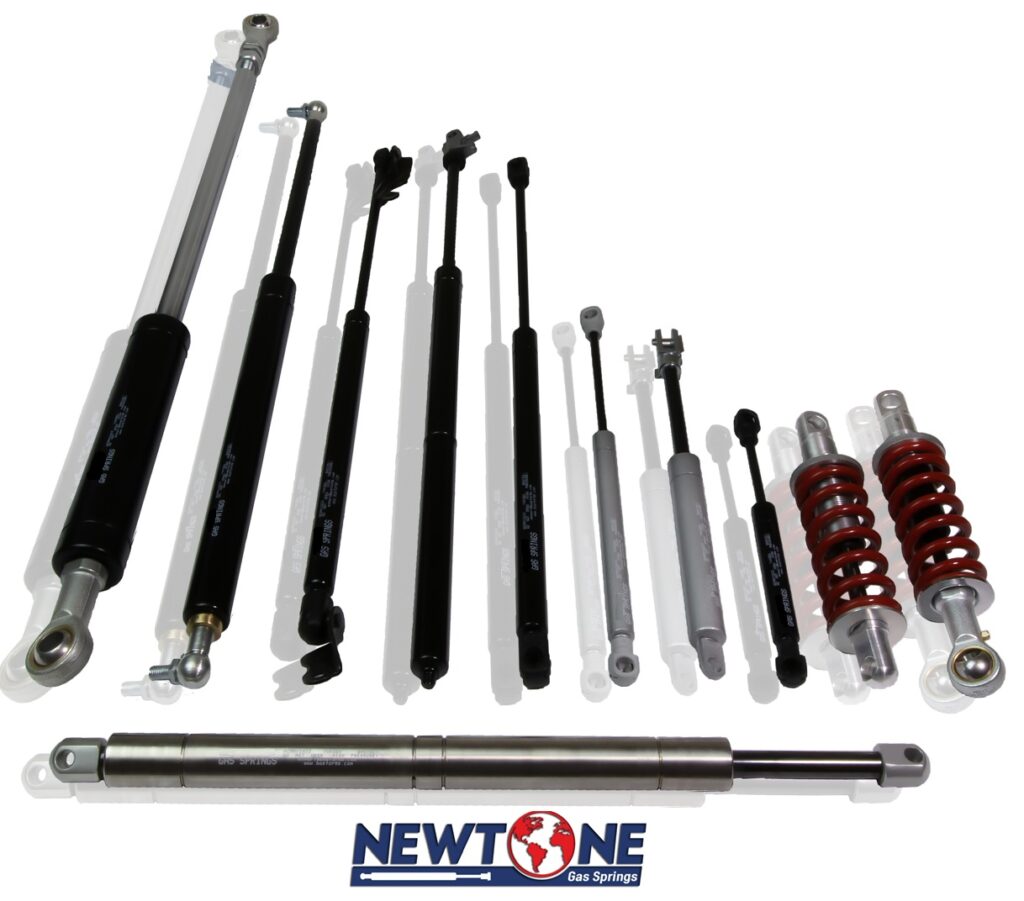
Our portfolio includes:
- Compression gas springs (standard gas springs)
- Traction gas springs (tension gas springs)
- Lockable gas springs
- Adjustable gas springs
- Fixed force gas springs
- Oil dampers
- Hydraulic dampers
- Stainless steel gas springs
- Stainless steel traction gas springs
- Lockable traction gas springs
- Non-magnetic stainless steel gas springs
- Mounting brackets
- End fittings
This range makes it possible to support projects with different movement requirements, installation geometries, and environmental conditions. Instead of trying to force one standard solution into every application, a broader manufacturing capability allows the product to be selected more accurately.
Force and size flexibility in custom gas spring production
In custom manufacturing, production range is just as important as product variety. Some applications require compact components with relatively low force values, while others demand much larger products with significantly higher output.
We can produce solutions from 20 N (4.5 lbs) up to 7500 N (1686.1 lbs), depending on the application and product type. This gives flexibility for both lightweight and heavy-duty projects.
In terms of size, we can manufacture products from 50 mm (1.97 in) up to 2.5 m (98.43 in). This allows us to support applications ranging from small technical assemblies to large industrial or specialized systems.
For OEMs and engineers, this kind of range can be critical. It means the same manufacturing partner may be able to support multiple product families, from compact units to larger custom-designed systems.
Different applications require different gas spring solutions
Not every product needs the same type of gas spring. In some applications, a standard compression gas spring is enough. In others, the project may require a traction gas spring, a locking function, corrosion-resistant materials, or controlled damping.
For example:
- Compression gas springs are widely used for lifting and supporting lids, doors, and covers.
- Traction gas springs are preferred where pulling force is required rather than pushing force.
- Lockable gas springs are useful when the moving part needs to stop and hold in a selected position.
- Adjustable gas springs help during prototype work or projects where the exact force needs to be fine-tuned.
- Oil dampers and hydraulic dampers support controlled movement and improved motion behavior.
- Stainless steel gas springs are well suited for corrosive, outdoor, marine, hygienic, or demanding environments.
- Non-magnetic stainless steel gas springs are relevant for sensitive technical applications where magnetic behavior must be considered.
This is one of the reasons product diversity matters. A custom gas springs manufacturer should understand that the right solution is not only about force, but also about how the product behaves in the actual system.
Material and accessory options are also part of the solution
A gas spring does not work alone. Installation quality and connection details matter just as much as the spring itself.
That is why mounting brackets and end fittings should be considered part of the overall solution rather than secondary accessories. The correct end fitting or bracket can make installation more secure, movement more consistent, and the overall assembly more reliable.
Material choice also plays a major role. For standard indoor environments, a conventional gas spring may be suitable. In more demanding conditions, stainless steel options may be the better choice. In some highly specific applications, non-magnetic stainless steel designs may also be required.
A reliable custom gas springs manufacturer should be able to evaluate these details together, not separately.
Custom gas springs for prototype and serial production
One of the advantages of working with a capable manufacturer is support across different stages of a project.
During development, the requirement may still be changing. Dimensions may be revised. Panel weights may shift slightly. Opening speed and movement feel may need to be confirmed on the actual product. In this stage, flexibility is especially valuable.
Once the design is finalized, the project may move into repeat production. At that point, consistency becomes just as important as customization. A good manufacturer should be able to support both prototype-based development and serial production with stable product specifications.
This is especially relevant for OEM projects, where product performance, repeatability, and fit-up quality all matter over time.
Global supply capability
For many customers, manufacturing capability alone is not enough. International supply experience also matters.
We supply our products worldwide, supporting customers in different markets and industries with application-based solutions. For companies sourcing internationally, this is an important part of the partnership. Reliable communication, the right technical understanding, and the ability to deliver products globally all contribute to a smoother sourcing process.
Whether the requirement is for a standard product, a custom-designed gas spring, a stainless steel solution, or a damping component, global supply capability helps ensure that the project can move forward efficiently.
What to look for in a custom gas springs manufacturer
Choosing the right manufacturing partner should involve more than comparing prices or checking whether a single model is available.
It is worth looking at questions such as:
- Does the manufacturer offer different gas spring types?
- Can they support both standard and custom production?
- Is the force range wide enough for different applications?
- Can they manufacture different sizes and dimensions?
- Are stainless steel and specialized options available?
- Can they also provide brackets and end fittings?
- Do they understand prototype work as well as serial production?
- Can they supply products globally?
The answers to these questions often say more about long-term suitability than a simple catalog listing.
Conclusion
A custom gas springs manufacturer should do more than produce a part with a certain force value. The real value lies in understanding the application, offering the right product type, and supporting the project with suitable dimensions, materials, accessories, and production capability.
With a portfolio that includes compression gas springs, traction gas springs, lockable gas springs, adjustable gas springs, fixed force gas springs, oil dampers, hydraulic dampers, stainless steel gas springs, stainless steel traction gas springs, lockable traction gas springs, non-magnetic stainless steel gas springs, mounting brackets, and end fittings, it becomes possible to support a wide variety of technical requirements.
When this is combined with a production range from 20 N (4.5 lbs) to 7500 N (1686.1 lbs), size capability from 50 mm (1.97 in) to 2.5 m (98.43 in), and the ability to supply products worldwide, the result is a more complete and more flexible manufacturing partnership.
Need support for a custom gas spring project?
If you are looking for a custom gas springs manufacturer for your application, our team can help you review the most suitable product type, force range, size, material, and connection options based on your project requirements.