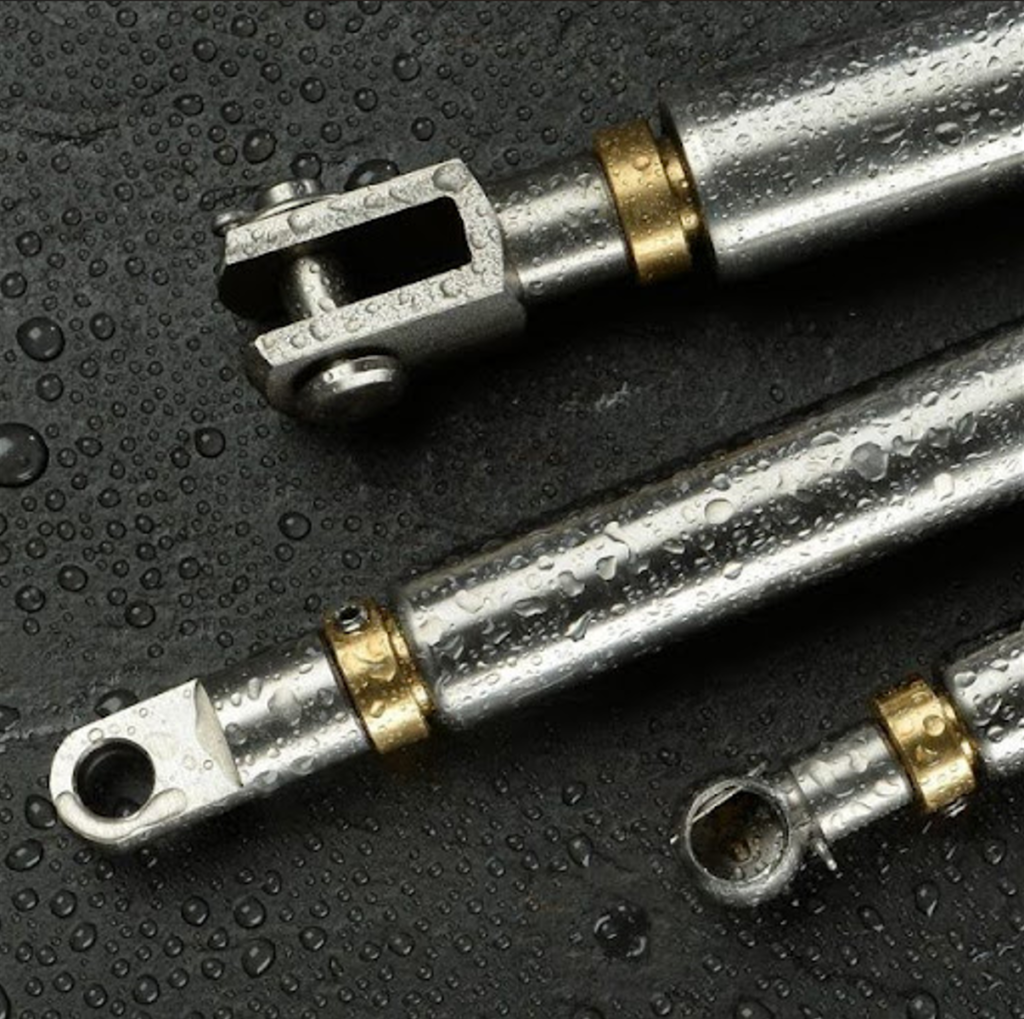
A straight answer for OEM engineers and procurement teams weighing 316L against standard — before the spec sheet is locked, not after the first corrosion complaint.
When to use stainless steel gas springs comes down to one question: will the part spend most of its service life in salt air, wash-down water, or a hygiene-controlled environment? If yes, 316L earns its higher price. If the application is dry, indoor, and cleaned occasionally, a black-nitrided rod with HNBR seals will outlast the product’s own design cycle — at a lower cost, with no performance penalty.
Picture a stainless hatch strut on a coastal patrol boat next to a black-nitrided strut on an indoor packaging machine two states inland. Both hold roughly the same 120 N (27 lbf). One will still look new in five years. The other, on the boat, would have started pitting at the rod within eighteen months if it hadn’t been spec’d correctly the first time. Same part family, same force rating — completely different material decision, and the environment is what decides it, not the load.
Who this is for: OEM engineers finalizing a material spec before tooling, procurement teams sourcing replacement parts for existing fleets or equipment lines, and distributors who need a defensible answer when a customer asks “do we really need stainless here.”
Why the Environment Decides — Not the Force Rating
Corrosion failure on a gas spring is a seal problem before it’s a rust problem. Salt air, condensation, or repeated wash-down doesn’t just discolor a black-nitrided rod — it pits the working surface the seal lip rides against. Once that surface is pitted, every stroke drags the seal lip across microscopic craters, and friction and gas leakage both climb from there. The spring can still look installed correctly while the hatch or cover it supports gets slower, heavier, or stops holding its position reliably. That’s the mechanism that actually justifies the cost of 316L — not appearance, not a generic “marine-grade” label.
Two variables matter more than most spec sheets acknowledge: how often the part contacts moisture, and whether that moisture carries chlorides (saltwater, deicing salt, some cleaning chemicals). Fresh water and general humidity are manageable for black-nitrided rod with HNBR seals. Chloride exposure is where standard material’s service life drops well below its rated cycle count.
Formula #38 — Temperature Derating
FT ≈ F20 × [1 + 0.003 × (T − 20°C)]
Material choice and temperature exposure are separate engineering decisions that get bundled together on outdoor and marine specs — and both need to be right.
Worked example: a coastal access hatch is specified at 120 N (27 lbf) bench force, measured at 20°C.
- Winter dawn at a northern marina, −10°C: FT = 120 × [1 + 0.003 × (−10 − 20)] = 120 × 0.91 = 109.2 N (24.5 lbf) — about 9% force loss.
- Engine-room heat in summer, 60°C: FT = 120 × [1 + 0.003 × (60 − 20)] = 120 × 1.12 = 134.4 N (30.2 lbf) — about 12% force gain.
Switching to 316L doesn’t change this swing by a single Newton — corrosion resistance and force-over-temperature are independent variables. A correctly-specced stainless spring can still feel wrong in January if the temperature derating wasn’t accounted for at 20°C bench conditions. Size for the coldest realistic operating temperature, then confirm the material separately.
Related: Service-life framing (#40) — Newtone’s minimum 100,000-cycle rating assumes mechanical wear, not environmental degradation. In a chloride environment, a standard-material spring can fail well before its rated cycle count purely from seal damage caused by rod pitting. Stainless resets that ceiling back to the mechanical limit.
Environments Where Stainless Steel Gas Springs Are Worth Specifying
These are the conditions where 316L consistently pays for itself over the life of the equipment.
Marine & Coastal
Boat hatches, deck storage, seat boxes, access panels on any vehicle or vessel that sees salt spray or coastal air regularly. This is the single most common reason customers ask us for stainless.
Food & Beverage Processing
Equipment subject to daily wash-down, sanitizing chemicals, or high-pressure cleaning. Standard finishes degrade faster under repeated chemical exposure than under moisture alone.
Medical & Laboratory
Covers, panels, and movable components on equipment with cleanliness requirements. Where magnetic behavior also matters — near imaging or sensitive measuring equipment — see our non-magnetic gas springs instead of assuming standard stainless is sufficient; not all stainless grades are non-magnetic by default.
Outdoor Enclosures
Weatherproof cabinets, electrical panels, roadside and agricultural equipment exposed to rain, condensation, and temperature swings year-round.
Industrial Wash-Down & Chemical Exposure
Access panels and guards on equipment cleaned with aggressive detergents or exposed to process chemicals, even indoors.
When Standard Is the Smarter, Cheaper Choice
Stainless steel gas springs are not a universal upgrade. Specifying 316L on an application that doesn’t need it adds cost without adding service life — the black-nitrided rod was never the weak point in a dry, indoor application to begin with.
Standard Is Enough
- Indoor, climate-controlled environment
- No regular chemical wash-down
- No direct or airborne saltwater contact
- Occasional cleaning, general industrial use
Our Gas Springs Manufacturer | Standart Gas Springs line — black-nitrided rod, HNBR seals — covers this reliably at a lower unit cost.
Stainless Steel Is Necessary
- Salt air, coastal, or marine exposure
- Daily wash-down or chemical cleaning
- Hygiene-controlled or food-contact-adjacent areas
- Visible components where corrosion staining is unacceptable
Our Stainless Steel Gas Springs | 316L Corrosion-Resistant Gas Struts line is manufactured for exactly this exposure profile.
The mistake nobody’s spec sheet warns about: pairing a 316L stainless rod with a standard zinc-plated or black-nitrided steel bracket in a wet environment creates a galvanic couple. The less noble metal — the bracket — corrodes faster than it would on its own, because the stainless effectively acts as the cathode in the pair. We’ve seen brackets fail within a season on an otherwise correctly-specced stainless spring, simply because the fastener and bracket weren’t upgraded along with the rod. If you’re specifying stainless for corrosion resistance, the end fittings and mounting hardware need to match — not just the cylinder and rod.
A coastal rental fleet operator running pontoon boats came to us after rod pitting and seal leaks were showing up around the eighteen-month mark on their standard chrome-rod springs — well short of the rated cycle count. The cause wasn’t cycle fatigue. Salt air had pitted the rod surface, and the seal lip was tearing on that pitting with every stroke. Moving the fleet to 316L rod and body solved it without touching the force spec at all — the geometry and load hadn’t changed, only the material needed to.
Standard vs. Stainless Steel Gas Springs
| Criteria | Standard (Black-Nitrided + HNBR) | 316L Stainless Steel |
|---|---|---|
| Best-fit environment | Indoor, dry to moderately humid | Marine, coastal, wash-down, chemical exposure |
| Corrosion resistance | Good for general industrial use | Significantly higher; resists chloride pitting |
| Force tolerance | ±5% | ±5% |
| Temperature range | −40°C to +100°C | −40°C to +100°C |
| Relative unit cost | Lower | Higher |
| Hardware matching needed | Standard brackets/fasteners fine | Stainless brackets/fasteners recommended (galvanic mismatch) |
How We Help You Decide
1. We review the exposure profile
Moisture frequency, chloride presence, cleaning chemicals, and indoor vs. outdoor duty cycle — not just “is it near water.”
2. We check the full assembly, not just the rod
End fittings and brackets are reviewed alongside the cylinder so the galvanic mismatch above doesn’t undercut the upgrade.
3. We confirm force at your real operating temperature
Not bench conditions — the coldest or hottest realistic point in service, per the derating formula above.
Frequently Asked Questions
Can 316L stainless steel gas springs still corrode in saltwater?
In flowing, oxygenated conditions, 316L resists chloride pitting far better than standard material. In stagnant, trapped saltwater — inside a bracket crevice or a sealed pocket with no water movement — even 316L can experience localized crevice corrosion over time, because the protective oxide layer needs oxygen to maintain itself. This is a mounting-design issue as much as a material one, and it’s worth reviewing with us if the installation traps water against the fitting.
Is stainless steel overkill for an indoor application?
Usually, yes. If the equipment stays indoors, sees only occasional cleaning, and has no chemical or saltwater exposure, black-nitrided rod with HNBR seals will match the corrosion resistance the application actually needs, at a lower cost.
Can a stainless steel gas spring be mounted with standard brackets?
Mechanically, yes — but in a wet or salt-exposed environment it creates a galvanic couple that accelerates corrosion on the bracket. For coastal or wash-down applications, we recommend stainless end fittings and mounting hardware to match the spring.
Does switching to stainless change the force rating?
No. Force is determined by gas pressure and rod diameter, not the alloy. A 316L spring can be manufactured to the same force, stroke, and tolerance as its standard equivalent — the material change addresses environmental durability, not load capacity.
How much longer does a stainless gas spring last in marine use compared to standard?
It depends on exposure severity, but the practical difference is usually measured in years, not months. Standard material in direct salt exposure can show rod pitting and seal wear within one to two years; 316L in the same conditions is built to reach its full rated cycle life instead of failing early from corrosion.
Conclusion
Deciding when to use stainless steel gas springs isn’t a material question first — it’s an exposure question. Chloride contact, wash-down frequency, and hygiene requirements justify 316L. A dry, indoor, occasionally-cleaned application usually doesn’t need it, and standard black-nitrided rod with HNBR seals will do the job at a lower cost. Once you’ve made that call, make sure the brackets and end fittings match the decision — a stainless rod on standard hardware solves half the problem and creates a new one.
Not sure which side of that line your application falls on? Send us the environment details and we’ll confirm the material spec.
Request a Quote View Product Range