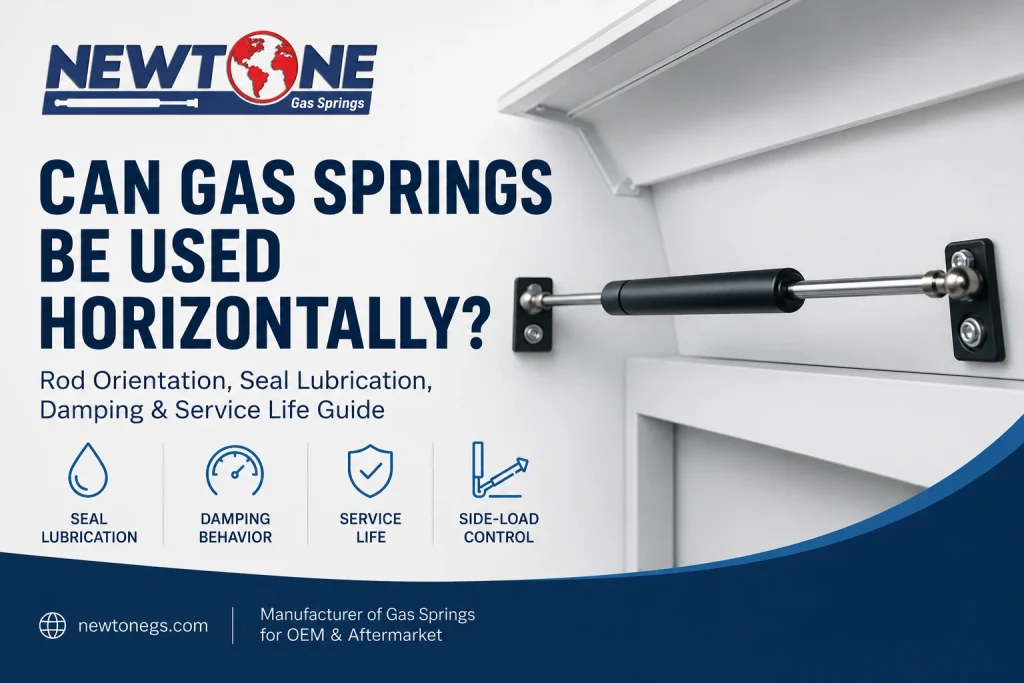
Can gas springs be used horizontally? Yes, gas springs can be used horizontally in some applications, but standard compression gas springs should be mounted rod-down where possible because the internal oil helps lubricate the seal and supports consistent damping. Horizontal mounting is not automatically forbidden, but orientation, stroke position, side-load, damping requirement and service life should be reviewed before the design is approved.
This question usually appears when a designer is working with limited space. A cabinet lid has no room for a vertical strut. A sliding cover moves almost flat. A machine panel opens in a shallow arc. The gas spring fits in CAD, so the next question is natural: can it simply work sideways? Sometimes yes. But “it fits” is not the same as “it will live well.”
- 1 Can Gas Springs Be Used Horizontally? The Quick Decision
- 2 Horizontal Is a Position; Rod-Down Is a Lubrication Strategy
- 3 What Rod-Down Mounting Actually Means
- 4 Temperature Force Change Can Be Mistaken for Orientation Trouble
- 5 Horizontal Mounting and Damping Behavior
- 6 Horizontal Mounting and Service Life
- 7 Geometry Still Matters More Than the Word “Horizontal”
- 8 Side-Load Is the Bigger Hidden Risk
- 9 When Horizontal Gas Spring Use Needs Custom Review
- 10 Horizontal Gas Spring Mounting Checklist
- 11 Why Source Horizontally Reviewed Gas Springs from Newtone?
- 12 Frequently Asked Questions About Horizontal Gas Spring Use
- 13 Final Engineering Takeaway
Can Gas Springs Be Used Horizontally? The Quick Decision
Gas springs can be used horizontally when the application has low side-load, acceptable damping behavior, clean rod movement and a duty cycle that fits the orientation. But if the design needs maximum seal life, predictable damping or high-cycle performance, rod-down mounting should be preferred where the geometry allows it.
Horizontal mounting may be acceptable when…
The gas spring is mainly providing support force, the rod is not side-loaded, the movement is clean, damping is not safety-critical, and the application has been reviewed for oil position and service life.
Rod-down mounting should be preferred when…
The application needs long seal life, smooth damping, quiet movement, frequent cycling, outdoor reliability or consistent end-of-stroke behavior. Rod-down keeps oil near the seal more reliably.
Custom review is needed when the gas spring must operate permanently horizontal, rod-up, in a dirty environment, at high cycle rates, or where damping performance is part of the safety function.
Horizontal Is a Position; Rod-Down Is a Lubrication Strategy
Horizontal is a position; rod-down is a lubrication strategy. That distinction matters. A gas spring can physically operate in more than one orientation, but the internal oil does more than sit inside the tube. It helps lubricate the rod seal and, in many designs, contributes to smoother damping near the end of travel.
The mistake is treating vertical and horizontal as a simple yes-or-no rule. The better question is: where is the oil when the spring is at rest, and where is the rod relative to the seal during the part of the stroke that matters most? If the seal runs dry for long periods, seal wear risk rises. If oil is not where the damping feature expects it to be, closing or extension behavior can feel different.
We see this during first-article reviews on compact covers. An OEM sends a layout where the gas spring fits beautifully in a shallow horizontal pocket. The force number is reasonable, but the moving pivot travel puts the rod in an unfavorable orientation at rest and adds side-load through part of the stroke. Moving one bracket a small distance can improve oil position, stroke reach and rod alignment without changing the force label.
What Rod-Down Mounting Actually Means
Rod-down mounting means the piston rod points downward in the at-rest or closed position where possible. This keeps oil near the rod seal and guide area, which supports lubrication and smoother movement over repeated cycles.
In many hinged applications, the gas spring is not perfectly vertical through the whole stroke. That is normal. The practical target is to design the rest position so the rod is lower than the cylinder body, or at least so the oil can reach the seal during normal operation. A gas spring mounted perfectly horizontal may still work, but it should not be treated as identical to a rod-down installation.
This is especially important for covers, lids, hatches and panels that remain closed for long periods. If the spring spends most of its life in one position, that position matters more than the short moment when the lid is open. The parked orientation is often the orientation that decides seal lubrication over time.
Temperature Force Change Can Be Mistaken for Orientation Trouble
Orientation affects lubrication, damping and seal life. Temperature affects gas pressure and force. These two issues are often confused in the field, especially when a gas spring feels weaker in cold weather after being mounted in a new position.
Formula:
F_T ≈ F_20 × [1 + 0.003 × (T − 20°C)]
Where:
F_T = estimated gas spring force at operating temperature
F_20 = gas spring force at 20°C (68°F)
T = operating temperature in °C
Example: a gas spring is rated at 300 N (67 lbf) at 20°C (68°F).
At 0°C (32°F):
F_T ≈ 300 × [1 + 0.003 × (0 − 20)]
F_T ≈ 300 × 0.94 = 282 N (63 lbf)
At 40°C (104°F):
F_T ≈ 300 × [1 + 0.003 × (40 − 20)]
F_T ≈ 300 × 1.06 = 318 N (71 lbf)
The same gas spring can therefore feel weaker in cold conditions and stronger in warm conditions. That is not caused by horizontal mounting; it is normal gas behavior. Horizontal or rod-up mounting affects oil position, damping and seal lubrication. Temperature affects pressure and force. Both should be checked before the spring is blamed.
Horizontal Mounting and Damping Behavior
Horizontal mounting can change damping behavior because the internal oil may not be in the same location as it would be in a rod-down installation. If the application depends on end-of-stroke damping, the mounting orientation must be reviewed carefully.
In many gas springs, damping is more consistent when oil is positioned near the piston and seal in the intended part of the stroke. If the gas spring is installed horizontally or rod-up, the oil may not meter through the damping path in the same way. The result can be a lid or cover that moves faster near the end of travel than expected.
This does not mean every horizontal gas spring will slam or fail. It means the motion target should be clear. If the spring only needs to assist a cover, horizontal mounting may be acceptable. If the spring must slow a heavy panel gently at the end of travel, rod-down orientation or a dedicated hydraulic damper may be the better engineering route.
Horizontal Mounting and Service Life
Horizontal mounting can shorten service life if it leaves the seal under-lubricated, exposes the rod to contamination, or introduces side-load through the stroke. The risk depends on application duty, environment and the actual geometry.
The rod seal is the critical interface. Newtone uses HNBR sealing as standard because it provides UV and ozone resistance, and the black nitrided rod has a typical surface hardness of 900–1000 HV with a treatment depth of 20–30 µm. Those specifications help, but they do not remove the need for good mounting practice.
If the rod is horizontal in a dusty or dirty environment, contamination can sit on the rod and be carried into the seal during motion. If the pivots are not aligned, lateral load can add friction and accelerate wear. A strong seal package cannot compensate for a rod that is being bent sideways on every cycle.
Geometry Still Matters More Than the Word “Horizontal”
Geometry still matters more than the word “horizontal” because the line of action, pivot positions and stroke reach decide whether the gas spring actually supports the load correctly. A horizontal-looking installation can be mechanically clean, while a vertical-looking installation can still be wrong if it side-loads the rod or bottoms out.
The moving pivot must travel between closed and open positions without forcing the gas spring past its compressed or extended length. A simple reach check is:
X = L_extended − L_closed
This confirms that the gas spring stroke covers the required pivot travel. If the spring bottoms out before the lid reaches its stop, the rod, guide, seal and brackets can see shock load. If it reaches full extension too early, the gas spring becomes the hard stop instead of the structure.
The effective moment arm also matters:
r = d × sin ψ
Where ψ is the angle between the gas spring line of action and the lever. A poor angle can make a strong spring feel weak, while a better bracket position can reduce the force needed. Orientation affects lubrication; geometry decides leverage.
Side-Load Is the Bigger Hidden Risk
Side-load is often a bigger hidden risk than horizontal mounting itself. Gas springs are designed to carry axial load through the rod, not bending load across the rod. If the pivots are out of plane, the rod can be forced sideways through the stroke.
Side-load increases friction and can reduce the effective support force. A simplified relationship is:
F_eff = P × A − F_friction − F_seal
If side-load increases friction or seal drag, the user feels less useful support even though the nominal gas pressure has not changed. The spring may also start to feel rough, noisy or inconsistent.
For horizontal or compact layouts, side-load review is essential because designers often tuck the spring into narrow spaces. Both end fittings should allow the angular movement required by the panel, and both pivots should stay in the same plane of motion.
When Horizontal Gas Spring Use Needs Custom Review
Horizontal gas spring use needs custom review when the spring will spend most of its life horizontal or rod-up, when damping is critical, when the application is high-cycle, or when the environment is dirty, wet, coastal or hot.
Custom review is also useful when the gas spring is hidden inside furniture, appliances, machine covers, medical devices or vehicle compartments where replacement access is difficult. A part that fails early inside a hidden cavity creates a larger service problem than the same part on an accessible hatch.
For coastal, marine, high-humidity or washdown environments, stainless steel options should be reviewed. For many indoor or protected applications, black nitrided rods with HNBR seals are suitable. Material choice should follow exposure, not only orientation.
Horizontal Gas Spring Mounting Checklist
| Check point | Why it matters |
|---|---|
| Rod position at rest | Rod-down helps keep oil near the seal and supports damping consistency. |
| Side-load | Pivots must stay in the same plane so the rod is not bent sideways. |
| Damping requirement | Horizontal orientation can change oil position and end-of-stroke damping behavior. |
| Stroke reach | The spring must not bottom out or become the hard stop. |
| Effective moment arm | Bracket position changes the force effectiveness more than many designers expect. |
| Temperature range | Force changes about 0.3% per °C, so cold or hot operation must be checked. |
| Environment | Dust, moisture, salt and washdown can increase seal and rod wear risk. |
| Service access | Hidden horizontal springs should be easy enough to inspect and replace if needed. |
Why Source Horizontally Reviewed Gas Springs from Newtone?
Manufacturer, Not Distributor
Newtone manufactures gas springs in Turkey and exports to more than 60 countries for OEM and aftermarket applications.
Orientation Review
Engineering support is available for rod orientation, stroke reach, pivot geometry, side-load and damping behavior.
Controlled Components
HNBR sealing, black nitrided rods, ±5% force tolerance and 100,000+ cycle capability support repeatable performance.
OEM + Aftermarket Supply
Newtone can support original equipment programs and replacement supply from the same manufacturing platform.
Frequently Asked Questions About Horizontal Gas Spring Use
Can gas springs be used horizontally?
Yes, gas springs can be used horizontally in some applications, but standard compression gas springs should be mounted rod-down where possible because oil near the seal supports lubrication and consistent damping.
Do gas springs have to be mounted vertically?
No. Gas springs do not always have to be perfectly vertical. The better rule is to review rod orientation, oil position, side-load, damping requirement and stroke reach. Rod-down is the preferred best practice where the design allows it.
What happens if a gas spring is mounted rod-up?
Rod-up mounting can reduce seal lubrication and change damping behavior because the internal oil may not stay near the seal or damping zone. It may still work in some applications, but service life and motion behavior should be reviewed.
Is horizontal mounting bad for gas spring life?
Horizontal mounting is not automatically bad, but it can reduce service life if it causes dry seal operation, rod contamination, side-load or poor damping. The real risk depends on the application geometry and environment.
Should I use a special gas spring for horizontal mounting?
A special gas spring may be needed if the spring must operate permanently horizontal, damping is critical, the cycle rate is high, or the environment is dirty, wet or corrosive. For simple low-load applications, a standard gas spring may be acceptable after review.
Final Engineering Takeaway
Can gas springs be used horizontally? Yes, but horizontal mounting should be treated as an engineering decision, not a shortcut. Rod-down remains the preferred practice because it helps keep oil near the seal and supports consistent damping.
The safest design checks the whole mechanism: rod orientation, oil position, stroke reach, side-load, temperature, damping requirement and service access. Newtone can review horizontal or near-horizontal gas spring layouts so the part fits the space without sacrificing motion quality or service life unnecessarily.