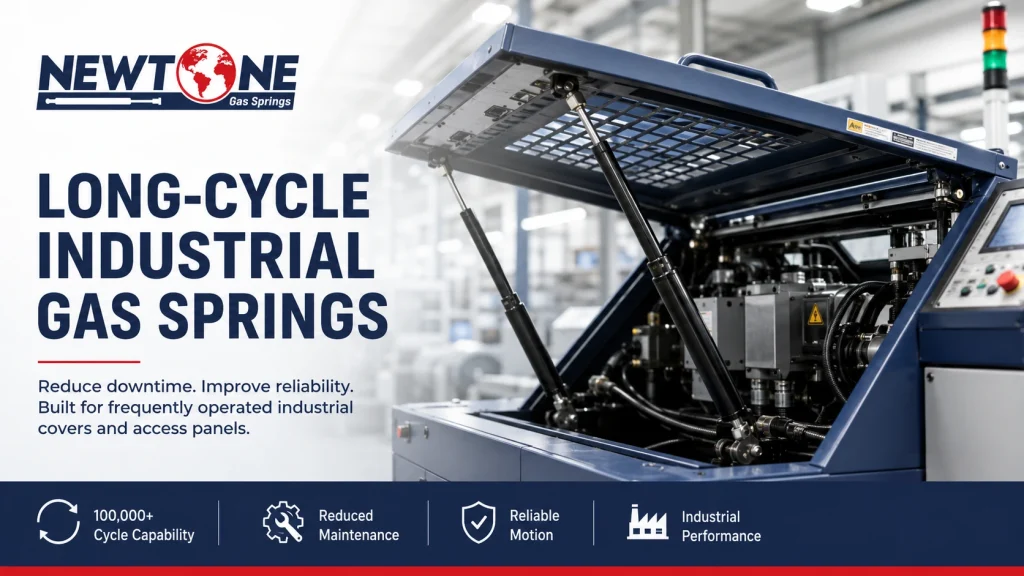
Long-cycle industrial gas springs reduce downtime when cycle rating, seal life, mounting alignment, force tolerance and replacement planning are specified together. A high cycle number helps, but it does not protect an industrial machine from downtime if the spring is side-loaded, over-forced, poorly mounted or replaced only after it fails.
In production equipment, the gas spring is often a small component attached to a large problem. A machine guard drops. A conveyor cover no longer stays open. An automation-cell access panel becomes heavy enough that operators stop using it correctly. The spring may still look installed, but the process is already losing time. For OEM engineers and maintenance teams, the real target is not only long life; it is predictable service life.
- 1 Why Long-Cycle Industrial Gas Springs Reduce Downtime
- 2 Cycle Life Is Not the Maintenance Plan
- 3 Where Long-Cycle Industrial Gas Springs Matter Most
- 4 Service-Life Planning for Long-Cycle Industrial Gas Springs
- 5 What Shortens Life Before the Cycle Count Runs Out?
- 6 Force Tolerance and Paired-Spring Matching
- 7 Standard vs Long-Cycle Industrial Gas Springs
- 8 Preventive Replacement Planning
- 9 Mounting Guidance for Long-Cycle Applications
- 10 Temperature and Environment Effects
- 11 Common Specification Mistakes
- 12 Downtime Reduction Checklist for Long-Cycle Industrial Gas Springs
- 13 Why Source Long-Cycle Industrial Gas Springs from Newtone?
- 14 Frequently Asked Questions About Long-Cycle Industrial Gas Springs
- 15 Final Engineering Takeaway
Why Long-Cycle Industrial Gas Springs Reduce Downtime
Long-cycle industrial gas springs reduce downtime by making the motion-support component last closer to the maintenance interval instead of failing unpredictably between service windows. In industrial equipment, the cost is rarely just the spring. The bigger cost is stopped production, technician time, operator workarounds and secondary damage to brackets or covers.
The highest-risk applications are covers and panels that are opened every shift: machine guards, tool covers, conveyor covers, service hatches, packaging-machine access doors, agricultural-machine covers, automation-cell panels and industrial vehicle compartments. These are not decorative panels. They are part of how operators inspect, clean, load, adjust and maintain equipment.
When a spring loses force, the equipment may not stop immediately. That is what makes the problem easy to ignore. A cover feels heavier, then it stops holding open, then someone props it up, then the hinge or bracket starts seeing loads it was not designed for. Downtime starts before the gas spring is completely dead.
Cycle Life Is Not the Maintenance Plan
Cycle life is the starting point for a maintenance plan, not the maintenance plan itself. A spring rated for a high number of cycles still needs correct force, correct mounting, clean rod movement, suitable seals and a replacement strategy matched to the machine’s duty cycle.
This is where many industrial specifications go wrong. A drawing calls for a gas spring with a cycle rating, but does not define cycles per day, side-load tolerance, paired-spring matching, closed-position load or replacement interval. The result is a part that looks acceptable on the bill of materials but behaves unpredictably in the plant.
A useful maintenance plan answers three questions: how often the panel moves, what happens if the panel cannot hold open, and whether failure stops production or only creates inconvenience. Critical access panels deserve a different service strategy than low-use inspection lids.
Where Long-Cycle Industrial Gas Springs Matter Most
Long-cycle industrial gas springs matter most on frequently operated covers, access panels and guards where failure interrupts production or maintenance. The more often a panel is opened, the less forgiving the application becomes.
Common examples include CNC machine covers, conveyor inspection covers, packaging machine guards, robotic-cell access panels, agricultural machinery covers, industrial battery compartments, tool enclosures, compressor covers and utility equipment hatches. Some of these panels are opened dozens of times per day. Others are opened less often but are safety-critical when they are used.
In these applications, the gas spring should not be treated as a generic lift support. It should be treated as a wear component with a defined duty cycle, known force tolerance, suitable rod treatment and installation rules that prevent side-load.
Service-Life Planning for Long-Cycle Industrial Gas Springs
The simplest way to connect cycle rating to downtime planning is to convert rated cycles into estimated service years. This does not predict exact life, because environment and installation quality still matter, but it gives maintenance teams a practical starting point.
Formula:
Service years ≈ Rated cycles ÷ cycles-per-day ÷ 365
Example: an industrial access cover uses a gas spring with a 100,000-cycle capability.
At 10 cycles per day:
Service years ≈ 100,000 ÷ 10 ÷ 365 = 27.4 years
At 50 cycles per day:
Service years ≈ 100,000 ÷ 50 ÷ 365 = 5.5 years
At 150 cycles per day:
Service years ≈ 100,000 ÷ 150 ÷ 365 = 1.8 years
The same gas spring can therefore look like a lifetime component in a low-use cover and a planned-replacement component in a high-use production cell. That difference is exactly why cycle life should be converted into a maintenance interval.
The number must also be adjusted by the real application. Side-load, dirt on the rod, high temperature, cold starts, poor brackets, wrong force and static over-compression can shorten service life before the theoretical cycle count is reached.
What Shortens Life Before the Cycle Count Runs Out?
Gas spring life is shortened when the rod, seal and brackets are forced to work outside their intended conditions. The cycle number matters, but side-load and seal wear often decide whether a spring reaches that number in real industrial service.
The biggest enemies are lateral load, misaligned pivots, dirt on the rod, damaged rod surfaces, incorrect rod orientation, excessive heat, low-grade seals and force that is higher than the mechanism actually needs. A spring that is too strong can keep the panel under unnecessary load when closed. That may feel safe at first, but it can increase stress on the brackets and sealing system.
We see this pattern in warranty waves. An industrial equipment OEM receives replacement complaints and assumes the cycle rating is too low. After reviewing the application, the issue is often not pure cycle fatigue. The spring may be slightly over-forced, mounted with poor alignment or held under heavy static load in the closed position. Correcting the force and bracket geometry can do more for downtime than simply choosing a larger spring.
Force Tolerance and Paired-Spring Matching
Force tolerance matters because industrial covers often use two gas springs, and unmatched pairs can create uneven motion. If one side pushes harder than the other, the panel can twist, bind or load one hinge more heavily.
For paired machine covers, conveyor panels and wide service doors, the springs should be specified as a matched pair from the same platform. Newtone controls force tolerance at ±5%, which supports consistent paired behavior across production batches.
Replacing only one spring on a paired cover can create a similar problem. The new spring may have full force while the older spring has already lost some output. The cover then moves unevenly. For critical paired applications, replacing both springs together is often the cleaner maintenance decision.
Standard vs Long-Cycle Industrial Gas Springs
Standard gas springs are suitable for many industrial panels, but long-cycle industrial gas springs should be reviewed when the panel is operated frequently or when failure creates production delay. The decision should be based on duty cycle and consequence of failure, not only on panel weight.
A low-use inspection cover may not need a special high-cycle review. A guard opened 80 times per day on a packaging line probably does. A service hatch on a mobile industrial vehicle may need a different review again because vibration, dust, temperature and outdoor exposure add wear drivers.
For Newtone, the baseline is already built around 100,000+ cycle capability, HNBR sealing and a black nitrided rod with 900–1000 HV surface hardness and 20–30 µm treatment depth. For very high-use or harsh applications, the specification should still be reviewed against the real duty cycle, mounting and environment.
Preventive Replacement Planning
Preventive replacement planning reduces downtime by replacing gas springs before the application reaches the failure zone. The replacement interval should follow the equipment’s operating pattern, not a generic calendar date.
Start with the service-life formula, then classify the panel. If the spring fails, does the machine stop? Does the operator lose access to a safety guard? Does maintenance become unsafe? Does the panel simply feel inconvenient? A critical guard should be inspected and replaced more conservatively than a non-critical cover.
Inspection should look for force loss, oil around the rod, rod scratches, slow extension, jerky motion, bracket movement, socket wear and panels that no longer hold open. Gas springs are sealed components; if force loss is caused by seal damage, replacement is normally the practical route rather than repair.
Mounting Guidance for Long-Cycle Applications
Long-cycle applications need clean axial loading. Gas springs are designed to work in compression along the rod axis, not as structural guides for a misaligned panel. Both pivots should stay in the same plane of motion.
Where the geometry allows it, mount the gas spring with the rod pointing down in the at-rest or closed position. This keeps oil near the seal and supports smoother damping. It is a small installation detail, but over thousands of cycles, small details matter.
The gas spring should not be used as the hard mechanical stop unless the design has been reviewed for that purpose. If the spring bottoms out before the panel reaches its stop, the rod, guide, seal and brackets can see shock loads. That is a fast way to turn a long-cycle component into a short-life installation.
Temperature and Environment Effects
Temperature changes can make the same gas spring feel stronger or weaker, which affects maintenance decisions. Gas spring force changes by about 0.3% per °C, so a spring specified at 20°C (68°F) will not feel exactly the same in a cold warehouse or hot machine enclosure.
The approximate relationship is:
F_T ≈ F_20 × [1 + 0.003 × (T − 20°C)]
A 400 N (90 lbf) spring at 20°C (68°F) may feel roughly 376 N (85 lbf) at 0°C (32°F), using this estimate. That is not a failure; it is gas behavior. The mistake is replacing or oversizing springs without checking operating temperature first.
Dust, oil mist, washdown, outdoor exposure and abrasive contamination can also shorten service life. For most industrial applications, Newtone’s black nitrided rod and HNBR seal package are a strong standard solution. Stainless steel should be reviewed for coastal, washdown, high-humidity or corrosive environments.
Common Specification Mistakes
The first mistake is treating 100,000 cycles as a guaranteed number of years. It is not. Cycles per day turn the same rating into very different maintenance intervals.
The second mistake is using more force than needed. Too much force can make covers hard to close, increase bracket load and keep the spring under unnecessary static stress when the cover is closed.
The third mistake is ignoring side-load. If the rod is bent sideways through the stroke, seal life drops quickly. Long-cycle performance depends on alignment as much as the spring itself.
The fourth mistake is replacing one spring of a pair. On wide covers, mismatched force can create uneven lift and one-sided hinge wear. The fifth mistake is waiting until the cover drops before acting. By then, the downtime has already begun.
Downtime Reduction Checklist for Long-Cycle Industrial Gas Springs
| Specification point | Why it matters for downtime |
|---|---|
| Cycles per day | Turns cycle rating into an estimated service interval. |
| Consequence of failure | Critical access panels need more conservative replacement planning. |
| Correct force | Prevents weak support without overloading brackets or seals. |
| Rod alignment | Reduces side-load and protects seal life through repeated cycles. |
| Paired-spring matching | Prevents twisting and uneven hinge wear on wide panels. |
| Rod orientation | Rod-down mounting helps keep oil near the seal where geometry allows it. |
| Environment | Dust, oil mist, heat, washdown and corrosion can shorten real service life. |
| Inspection interval | Finds weak force, leaks or bracket issues before the panel causes downtime. |
Why Source Long-Cycle Industrial Gas Springs from Newtone?
Manufacturer, Not Distributor
Newtone manufactures gas springs in Turkey and exports to more than 60 countries for OEM and aftermarket applications.
100,000+ Cycle Capability
Newtone gas springs are designed with 100,000+ minimum cycle capability for reliable industrial motion support.
Controlled Components
HNBR sealing, black nitrided rods and ±5% force tolerance support repeatable behavior across production batches.
Application Review
Engineering support is available for force, stroke, mounting points, paired springs, environment and replacement planning.
Frequently Asked Questions About Long-Cycle Industrial Gas Springs
What are long-cycle industrial gas springs?
Long-cycle industrial gas springs are gas springs specified for frequent operation in industrial covers, guards, hatches and access panels. They are selected to support repeated motion, predictable service life and reduced unplanned downtime.
How do long-cycle industrial gas springs reduce downtime?
Long-cycle industrial gas springs reduce downtime by lasting closer to the planned service interval and by helping prevent sudden cover or guard failures. The best results come when cycle rating, correct force, alignment, seal quality and replacement planning are specified together.
How many cycles should an industrial gas spring last?
Cycle life depends on design, environment and installation. Newtone gas springs are designed with 100,000+ minimum cycle capability, but real service life also depends on cycles per day, side-load, temperature, seal condition and contamination.
Should paired gas springs be replaced together?
For wide or critical industrial covers, paired gas springs should usually be replaced together. Replacing only one spring can create force imbalance, uneven lift and one-sided hinge wear if the older spring has already lost output.
Can a gas spring be repaired after force loss?
Gas springs are sealed pressurized components. If force loss is caused by seal damage or gas loss, replacement is normally the practical solution. For downtime-critical machines, preventive replacement is safer than waiting for complete failure.
Final Engineering Takeaway
Long-cycle industrial gas springs reduce downtime when they are specified as part of the maintenance strategy, not just as replacement parts. Cycle rating gives the starting point; cycles per day, installation quality, force tolerance, environment and failure consequence turn that rating into a real service plan.
For industrial OEMs and maintenance teams, the strongest specification is practical: correct force, clean alignment, rod-down mounting where possible, matched pairs on wide covers, suitable sealing and a replacement interval before the panel causes production delay. Newtone can review long-cycle industrial gas springs with your equipment geometry and operating pattern so the small component does not become the reason a larger system stops.