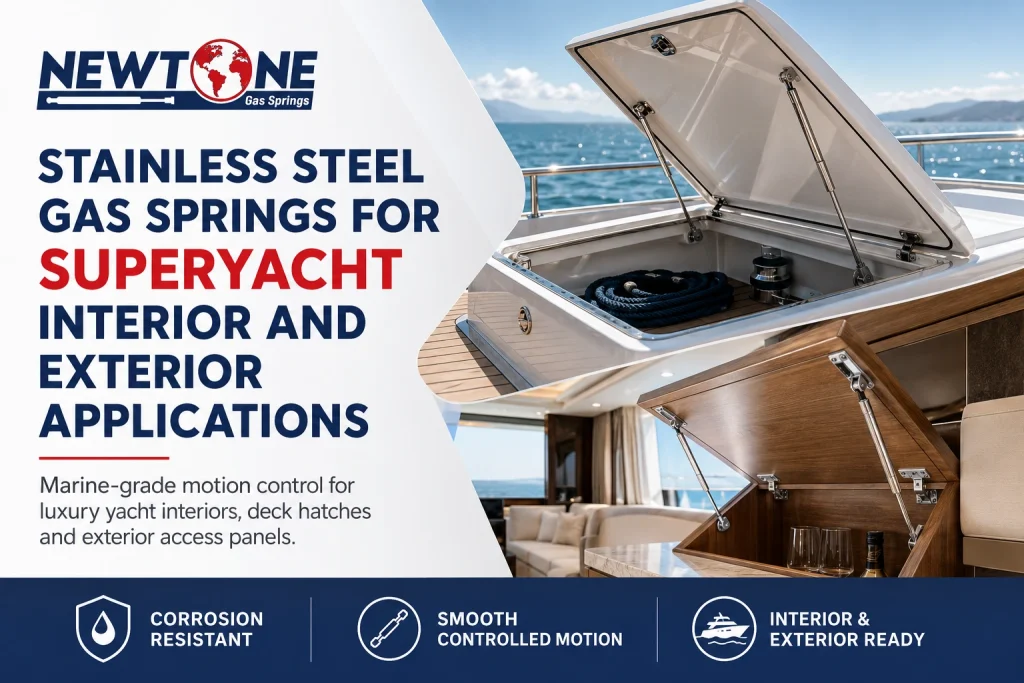
for Superyacht Interiors
From owner’s-suite joinery to tender garage doors and engine-room hatches — the spec that works on a deck hatch is usually wrong for a wardrobe door, and vice versa.
- 1 Stainless Steel Gas Springs for Superyacht Interiors: The Real Question First
- 2 Four Zones, Four Different Specifications
- 3 Engine Room and Tender Garage: Where Heat Meets Salt
- 4 Stainless Steel Gas Springs for Superyacht Interiors: When 316L Is Worth It
- 5 Paired Doors on Wide Joinery: Force-Matching Still Applies
- 6 Specification Quick-Reference by Zone
- 7 Why Superyacht Builders and Refit Yards Source from Newtone
- 8 Frequently Asked Questions
- 9 Conclusion
- 10 Get a Zone-Specific Specification or Quote
Stainless Steel Gas Springs for Superyacht Interiors: The Real Question First
Stainless steel gas springs for superyacht interiors are usually specified for finish-matching, not corrosion resistance — an owner’s-suite wardrobe door in a climate-controlled cabin never sees salt spray, so the reason to go stainless is that the rod has to look right next to polished hardware. Step outside that cabin to a tender garage door or an engine-room hatch, and the calculation flips entirely: there, stainless is a genuine, non-negotiable corrosion requirement.
That distinction gets lost in most sourcing conversations. A shipyard or refit outfitter asks for “marine-grade stainless gas springs” as a single line item, and gets quoted one spec for the whole vessel — usually the exterior one, because that’s what most gas spring suppliers know how to sell. At Newtone Gas Springs, we manufacture the full range ourselves in Turkey and export to 60+ countries, which means we spec each zone of a vessel on its own terms rather than applying a single “marine” catalogue entry everywhere.
Who this page is for: interior outfitters and joinery contractors specifying hardware for owner’s-suite and salon cabinetry, OEM engineers integrating hatches and tender garage doors into a new build, and refit-yard procurement teams sourcing replacements across both zones.
Four Zones, Four Different Specifications
“Superyacht gas spring” isn’t one product. Each zone below carries a different dominant constraint — and specifying the wrong constraint is the single most common mistake we see coming out of refit yards.
Owner’s Suite & Salon Joinery
Lightweight veneer or lacquered doors on wardrobes, entertainment units, and concealed servery cabinets. Dominant constraint: cosmetic finish match and near-silent operation, not corrosion. Force is usually low — 20–80 N (4–18 lbf).
Galley, Pantry & Crew Mess
Heavier-use cabinetry with more cycles per day and occasional moisture exposure from washdown or condensation. Needs the durability of marine-grade seals without the full cosmetic premium of visible owner-area finishes.
Tender Garage & Beach Club Doors
Large, heavy panels exposed to direct salt spray, sun, and — on some layouts — proximity to engine or generator heat. Full corrosion-resistant spec required, and usually paired springs on wider doors.
Engine Room & Lazarette Hatches
The most demanding zone: salt exposure combined with sustained ambient heat well above the 20°C bench reference most catalogue force ratings are quoted at. Temperature derating becomes a real design factor here, not a footnote.
Engine Room and Tender Garage: Where Heat Meets Salt
Gas spring force isn’t fixed — it shifts with internal gas temperature, and engine-room and tender-garage zones are exactly where that shift stops being a rounding error. Force changes by roughly 0.3% per °C relative to the 20°C bench reference (formula 38 in our internal reference set: F_T ≈ F_20 × [1 + 0.003 × (T − 20°C)]), which means a spring that’s correctly sized on the test bench can behave noticeably differently once it’s actually installed a few feet from a running generator, or sitting in an unheated refit shed over a Northern European winter.
Worked example — tender garage door, paired springs
Door weight: 10 kg (22 lb) · Hinge-to-CoG distance (Lg): 350 mm (13.8 in) · Spring moment arm (r): 140 mm (5.5 in) · Springs (n): 2 · Fully open, φ = 0°
Moment balance: F = (W × Lg × cos φ) ÷ (n × r)
W = 10 kg × 9.81 = 98.1 N
F = (98.1 × 350 × 1) ÷ (2 × 140) = 34,335 ÷ 280 ≈ 122.6 N per spring at 20°C bench reference — round to a 123 N (28 lbf) catalogue spring.
Temperature derating, F_T ≈ F_20 × [1 + 0.003 × (T − 20)]:
Engine-room-adjacent tender garage at 55°C: F_55 = 123 × 1.105 ≈ 136 N (30.6 lbf)
Unheated refit shed at −10°C: F_−10 = 123 × 0.91 ≈ 112 N (25.2 lbf)
The same catalogue-rated spring swings about ±11% across that realistic temperature band, before paired-spring ±5% batch tolerance is even added. Spec for the coldest condition the door will realistically see in service, so it still lifts and holds reliably — the hot end only means a firmer closing effort, not a failure.
This is where the mounting geometry matters as much as the force number. Moving the spring’s lower pivot changes the effective moment arm (r) far more than upgrading the force rating does — on a tight tender garage installation, that’s often the cheaper and more reliable fix than simply specifying a stronger spring.
Stainless Steel Gas Springs for Superyacht Interiors: When 316L Is Worth It
For interior joinery, specify stainless when the rod is visible against polished or satin stainless hardware — handles, hinges, drawer pulls — and a black-nitrided rod would read as a visible mismatch in a fitted cabin. It’s a finish decision, not a durability one: a climate-controlled owner’s suite doesn’t expose the spring to salt, so a standard rod with HNBR seals will run its full 100,000+ cycle rating without issue.
Exterior and engine-room zones are the opposite case. There, 316L stainless is worth specifying because the installation is genuinely exposed to salt spray, humidity, and UV, and a hard chrome or black-nitrided rod will show surface pitting over time that eventually compromises seal performance — the same failure mode we cover in detail on our saltwater corrosion resistance guide.
An interior outfitter working a 45-metre motor yacht refit sent us drawings for a pair of owner’s-suite wardrobe doors, specified with a mirror-polished 316 rod carried over from a tender garage hatch on a previous project — same finish family, wrong zone. When we ran the moment balance on the actual panel weight and hinge offset, the exterior-rated force came out almost double what those lightweight lacquered doors needed; at that force, the doors would have swung open hard and fought the soft-close drawer runners built into the same cabinet run. We resized to the correct interior force, kept the polished finish for the hardware match, and the doors now open the way a fitted cabinet door should — with no force compromise on the finish.
Paired Doors on Wide Joinery: Force-Matching Still Applies
Any door wide enough to need two springs — a double wardrobe, an entertainment console, a wide pantry unit — needs those springs force-matched to within ±5%, ideally from the same production batch.
⬤ Single Spring
- Narrow joinery door, under ~500 mm (20 in)
- Centered hinge, no lateral flex
- Most crew and pantry cabinetry
- Simpler installation, lower cost
⬤ Paired Springs
- Wide owner’s-suite or entertainment doors
- Tender garage and larger hatches
- Heavier composite or veneer-clad panels
- Must be matched within ±5%, same batch
Specification Quick-Reference by Zone
| Zone | Typical Force | Spring Count | Rod Finish | Primary Driver |
|---|---|---|---|---|
| Owner’s suite / salon joinery | 20–80 N (4–18 lbf) | 1–2 | Stainless (finish match) | Cosmetic + silent operation |
| Galley / pantry / crew mess | 40–110 N (9–25 lbf) | 1 | Standard chrome or stainless | Duty cycle + moisture |
| Tender garage / beach club | 150–300 N each (34–67 lbf) | 2 | 316L stainless | Salt spray + panel weight |
| Engine room / lazarette hatch | 100–350 N (22–79 lbf) | 1–2 | 316L stainless | Heat + salt combined |
These are starting-point figures. Final force depends on panel weight, hinge offset, and opening angle — share your drawings and we’ll run the moment balance and temperature check for your specific zone at no charge.
Why Superyacht Builders and Refit Yards Source from Newtone
We manufacture in our own facility in Turkey — no third-party distributor between your drawing and the finished part.
Frequently Asked Questions
Not for corrosion reasons in most cases. Interior joinery on a climate-controlled superyacht rarely sees salt exposure, so a standard black-nitrided rod with HNBR seals holds up fine. Stainless is usually specified for interior applications for a cosmetic reason instead: the visible rod has to match polished or satin stainless door hardware, hinges, and handles nearby. Exterior and engine-room zones are a different story — there, stainless is a genuine corrosion-resistance requirement.
Interior joinery doors are typically lightweight veneer or lacquered panels needing 20-80 N (4-18 lbf) per spring. Tender garage doors and engine-room hatches are heavier structural panels, often 100-350 N (22-79 lbf) per spring, and may need two or more paired units. Using an exterior-rated force on an interior door makes it slam open; using an interior-rated force on a hatch means it won’t lift or hold at all.
Gas spring force rises roughly 0.3% per degree Celsius above the 20°C bench reference, and drops by the same rate below it. A spring rated at 123 N at 20°C can run near 136 N in a 55°C engine room and drop to around 112 N in a -10°C unheated refit shed — an 11% swing in each direction. Size the spring so the coldest realistic condition still meets the required lift force; the hot end just means a firmer close, not a failure to hold.
Yes. Any door wide enough to need two springs needs them matched to within ±5% of each other and, ideally, from the same production batch. A mismatch pulls one side of the panel harder than the other, which shows up as uneven opening and, over time, hinge wear — more noticeable on a fitted interior door than on a utilitarian hatch.
Yes. Force, stroke, body diameter, rod finish, and end fitting are all specified independently per line item, so an owner’s-suite joinery spec and an engine-room hatch spec can ship in the same production run for the same vessel — useful for OEM builds and for refit yards ordering hardware for multiple zones at once.
Conclusion
A superyacht carries more gas-spring zones than most vessels, and each one is solving a different problem. Owner’s-suite joinery is a finish-and-silence spec. Tender garages and engine-room hatches are a corrosion-and-heat spec. Treating the whole vessel as one “marine gas spring” line item is how doors end up either too aggressive for a fitted cabinet or too weak for a salt-exposed hatch.
Newtone has built both ends of that range for OEM builders and refit yards for over two decades — same force tolerance, same seal standard, same manufacturing control, whichever zone you’re specifying for.
Share your door or hatch dimensions with us. We’ll come back with a zone-appropriate force recommendation, a datasheet, and a quote — typically within 5 business hours.
Get a Zone-Specific Specification or Quote
Tell us the zone, panel weight, and mounting geometry. Our engineering team handles the rest — free force calculation, sample datasheet, and competitive pricing.