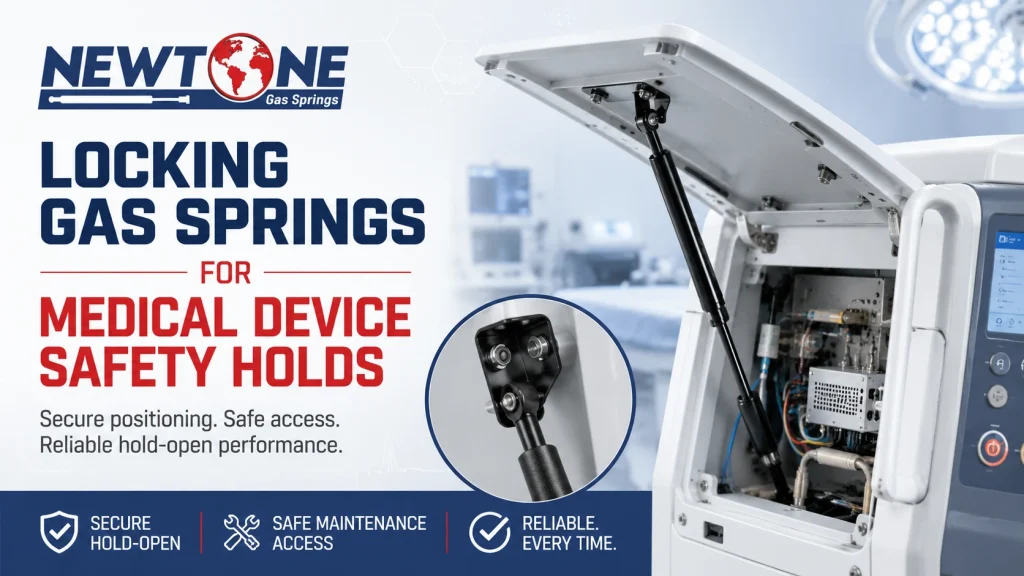
Medical Equipment Access Panels
Hold-open safety for diagnostic, lab, and sterilization equipment housings — for OEM design engineers building the enclosure, not the patient-facing furniture.
Locking Gas Springs for Medical Equipment Access Panels: The Short Answer
Locking gas springs for medical equipment access panels do one specific job: they hold a housing, cover, or door open by itself, so a technician doesn’t have to brace a panel with one hand while working with the other. That’s a different problem from lifting a patient bed backrest, and it deserves a different design conversation — this one is about protecting whoever has their hands inside the machine during service, not about patient comfort.
Picture a field service technician opening the rear access cover on a lab analyzer to replace a sensor, or a biomedical engineer lifting the housing on a sterilizer to check a heating element. If the cover only lifts and doesn’t hold, it either needs a second pair of hands or it gets propped with whatever’s nearby — a maintenance log entry waiting to happen. A locking gas spring removes that risk entirely.
Who this page is for: OEM engineers designing housings and service-access panels for diagnostic, laboratory, and sterilization equipment. If you’re specifying gas springs for patient-positioning furniture instead — beds, lifts, examination couches — see our dedicated guide on gas spring applications for hinged panels, or contact us directly for the patient-furniture page.
End-Lock or Rigid-Lock: Which Does a Service Panel Actually Need?
Most service-access panels only need an end-lock spring — one that holds firmly at full extension, which is the one position a technician actually needs during maintenance. A rigid-lock (lock-anywhere) version, which holds at any point along the stroke, is worth its extra cost only when a calibration step genuinely requires an intermediate angle — for instance, a service panel that needs to sit at a specific partial-open position to access a sensor without fully exposing an optical or electrical assembly.
This is a different decision than the one that governs patient-positioning equipment, where a rigid-lock spring is often the default because a clinician sets and leaves a position repeatedly. On a service panel, over-specifying rigid-lock adds cost and a release mechanism the technician doesn’t need. Start with end-lock unless the equipment’s service procedure specifically calls for a held intermediate position.
Formula Block: Sizing With a Deliberate Safety Margin
The baseline force for a hinged access panel is a standard moment balance about the hinge:
F = (W × Lg × cos φ) ÷ (n × r)
Where W is the panel weight in Newtons, Lg is the hinge-to-center-of-gravity distance, φ is the load-arm angle above horizontal at the position checked, n is the number of springs, and r is the spring’s perpendicular moment arm.
Worked example. An analyzer access cover weighs 4 kg (8.8 lb), so W = 4 × 9.81 = 39.2 N (8.8 lbf). With a hinge-to-CoG distance Lg of 250 mm (10 in), a spring moment arm r of 50 mm (2 in), and a single spring (n = 1) at the near-closed worst case (cos φ ≈ 1):
F = (39.2 × 250) ÷ (1 × 50) = 196 N (44 lbf)
That’s the baseline holding force. For a service-access application, apply a safety-factor surcharge before finalizing the spec:
F_design = F × SF = 196 × 1.2 = 235 N (53 lbf)
We use the higher end of the typical 1.1–1.3 safety-factor range here — 1.2 — because the panel will routinely be held open over a technician’s hands. That 39 N (9 lbf) margin over the bare calculation is what keeps the spring reliably solid at end-of-stroke through normal manufacturing tolerance and years of cycling, rather than borderline from day one.
We worked through exactly this calculation for a lab equipment OEM whose service technicians had flagged an access cover that would occasionally settle partway shut during extended maintenance sessions — not dropping outright, just not staying fully open. The as-built spring was sized to the bare panel weight with no margin at all. Adding the safety-factor surcharge and moving to an end-lock configuration resolved it, and the fix cost less than the service tickets it was generating.
Material and Environment Considerations for Equipment Housings
Standard black-nitrided rod (900–1000 HV, 20–30 µm) with HNBR seals handles most enclosed equipment housings reliably. Two environments on medical and lab equipment justify an upgrade.
Specify 316L stainless steel when the panel is exposed to disinfectant wipe-down, steam, or washdown cleaning — common on sterilizer, autoclave, and lab-bench housings. Stainless resists the surface pitting that eventually lets cleaning fluid reach the seal. For sterilizer and autoclave surfaces specifically, confirm the actual external surface temperature the spring will see during a cycle against our −40°C to +100°C (−40°F to +212°F) operating range before finalizing the spec — some autoclave exteriors run hotter than the housing might suggest, and that’s a detail worth checking rather than assuming.
Mount with the rod pointing down where the panel’s rest position allows it, so internal oil stays at the seal rather than draining away — this keeps damping consistent through the panel’s service life. Use a ball-socket end fitting wherever the opening angle changes through the stroke, and keep both pivots in the same plane of motion; side-loading from a misaligned mount is a common, avoidable cause of early seal wear on repeatedly-cycled service panels.
Specification Quick-Reference by Housing Type
| Housing / Panel Type | Typical Weight | Recommended Force | Spring Count | Notes |
|---|---|---|---|---|
| Diagnostic analyzer access cover | 2–5 kg (4–11 lb) | 50–150 N (11–34 lbf) | 1 | End-lock, safety-factor applied |
| Imaging system service panel | 3–8 kg (7–18 lb) | 80–200 N (18–45 lbf) | 1 | Rigid-lock only if a partial-open calibration step is required |
| Sterilizer / autoclave door | 6–12 kg (13–26 lb) | 150–300 N each (34–67 lbf) | 1–2 | Stainless steel — confirm surface temp |
| Lab equipment enclosure lid | 1–4 kg (2–9 lb) | 30–100 N (7–22 lbf) | 1 | Standard spec usually sufficient |
| Equipment cart / cabinet door | 3–6 kg (7–13 lb) | 60–150 N (13–34 lbf) | 1 | Check wipe-down exposure |
These figures are starting points, not a substitute for the moment-balance calculation above — geometry moves the required force as much as weight does. Share your panel dimensions and we’ll run it for you.
Why Equipment OEMs Source Locking Gas Springs from Newtone
We manufacture in-house in Turkey, so tolerance, seal material, and batch traceability stay under our control, not a distributor’s. This page covers the component only — regulatory clearance for the finished device remains the OEM’s responsibility.
Frequently Asked Questions
A locking gas spring for medical equipment access panels holds a housing, cover, or door open by itself, so a technician doesn’t need to brace it by hand while servicing or calibrating the equipment underneath. Unlike a standard gas spring, which only lifts and damps, a locking version adds a mechanical hold at full extension or, in a rigid-lock version, at any point along the stroke.
Most service-access panels only need an end-lock spring, which holds securely at full extension — that’s the position a technician needs during maintenance. A rigid-lock (lock-anywhere) version is worth the extra cost only if the panel or arm needs to be held at a partial angle, such as during a calibration step that requires a specific intermediate position.
A safety-factor of 1.1 to 1.3 above the calculated baseline force is standard practice, and the higher end of that range is appropriate when a technician’s hands or head will be positioned under the held-open panel during service. This margin accounts for manufacturing tolerance, minor wear over the panel’s service life, and the consequence of the hold failing being a safety event, not just an inconvenience.
Specify 316L stainless steel when the panel is exposed to disinfectant wipe-down, steam, or washdown cleaning, since it resists the pitting that eventually compromises seal performance. For sterilizer or autoclave surfaces that also see sustained high heat, confirm the actual surface temperature against the spring’s rated operating range before finalizing the specification, rather than assuming standard components will tolerate it.
Yes. Newtone supplies gas springs for new equipment integration and for service-network or aftermarket replacement, often from the same configuration, so a replacement spring matches the original force and stroke exactly. Batch traceability and engineering support are available for both paths.
Conclusion
A locking gas spring on a medical equipment access panel is a safety component wearing a mechanical component’s paperwork. The calculation isn’t complicated — a moment balance, a deliberate safety-factor margin, and a seal spec matched to the cleaning environment — but skipping the margin step is exactly how a panel that tests fine on the bench ends up unreliable in the field, over a technician’s hands.
Send us the panel weight, hinge geometry, and how it’s cleaned. We’ll return a force recommendation with the safety factor already applied, a datasheet, and a quote.
Get a Specification or Quote
Tell us the housing type, panel weight, and mounting geometry. Our team handles the force calculation — safety factor included — plus a sample datasheet and pricing.