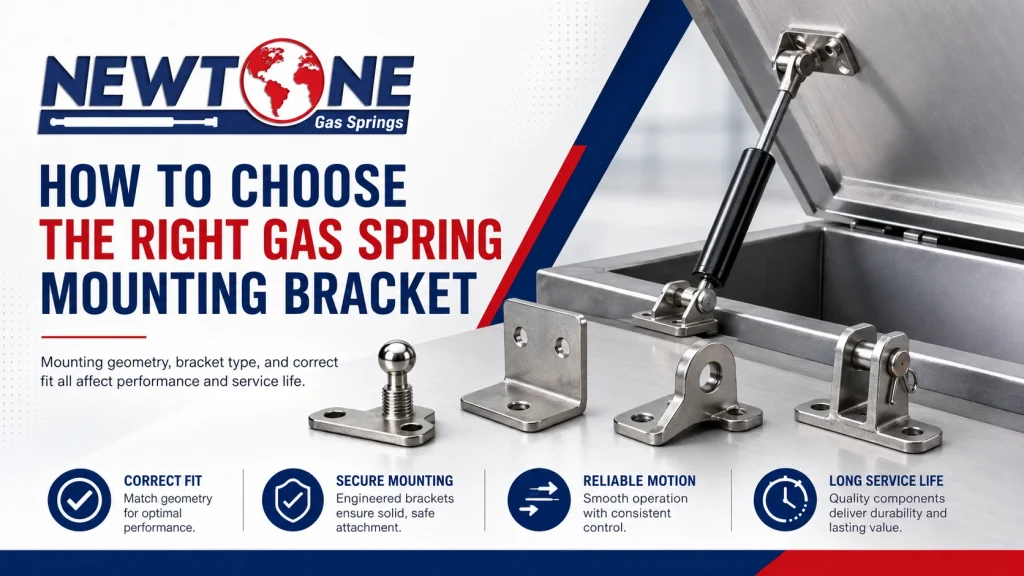
Gas Spring Mounting Bracket
A practical selection guide for OEM engineers and procurement teams — covering bracket type, rigidity, pivot geometry, and how a mounting decision quietly changes the force your gas spring actually needs to deliver.
- 1 How to Choose a Gas Spring Mounting Bracket: The Short Answer
- 2 Four Bracket Types and When Each One Fits
- 3 The Formula: Why Bracket Position Changes the Force You Need
- 4 Bracket Rigidity: The Hidden Force Multiplier
- 5 Material and Environment: When to Upgrade the Bracket
- 6 Installation: Getting the Geometry Right the First Time
- 7 Why OEMs Source Bracket and Spring Together from Newtone
- 8 Frequently Asked Questions
- 9 Conclusion
- 10 Get a Bracket and Force Recommendation
How to Choose a Gas Spring Mounting Bracket: The Short Answer
How to choose a gas spring mounting bracket comes down to three checks, in order: match the bracket’s end fitting to your spring’s rod and body ends, confirm the bracket is rigid enough that it won’t flex under the spring’s rated force, and position it so the mounting angle stays close to perpendicular to the direction of panel travel. Most bracket problems trace back to the third point, not the first two — a bracket can be the correct part number and still be mounted in a position that quietly demands more force than the spring was ever specified to deliver.
We see this constantly from the manufacturing side. A customer calls about a gas spring that “feels weak” or a door that won’t hold at full open, and the spring itself checks out fine on the bench. The bracket moved the pivot point, or it was mounted at an angle nobody accounted for in the original force calculation. At Newtone Gas Springs, we’ve supplied gas springs and matched mounting hardware to OEMs and distributors across 60+ countries for over two decades, and bracket geometry is one of the most under-discussed variables in the entire spec process.
Who this page is for: OEM design engineers specifying bracket hardware for a new platform, procurement managers sourcing replacement brackets that need to match original geometry, and anyone troubleshooting a gas spring that isn’t holding force the way it’s rated to.
Four Bracket Types and When Each One Fits
Bracket selection starts with matching the bracket to the gas spring’s end-fitting style and the motion the application requires.
Ball Socket Bracket
Accepts a ball-stud end fitting and allows multi-directional articulation. The default choice for most panel, lid, and hatch applications because it self-corrects for minor misalignment instead of transmitting it to the rod as a side load.
Clevis (Pin-and-Fork) Bracket
Rotation limited to a single plane via a pin through a forked bracket. Better suited to heavier-duty or more constrained layouts where controlled, predictable motion matters more than articulation range.
Weld-On / Bolt-On Plate Bracket
A flat mounting plate fixed directly to the structure, usually paired with a ball stud or eyelet. Common on machinery frames and equipment housings where the mounting surface itself is rigid enough to act as part of the bracket.
Adjustable / Slotted Bracket
Built with slotted holes so the mounting position can be fine-tuned after installation. Useful during prototyping or first-article fitting, when the ideal pivot position hasn’t been locked down by calculation yet.
The Formula: Why Bracket Position Changes the Force You Need
The gas spring’s effective moment arm — the leverage it has against the load — depends on where the bracket places the pivot and at what angle the spring’s line of action meets the lever. This is governed by the resolved moment-arm relationship:
Effective Moment Arm
r = d × sin ψ
Where d is the mounting distance from the pivot to the moving mount point, and ψ is the angle between the gas spring’s line of action and the lever arm. Force is minimized when the spring sits perpendicular to the lever (ψ = 90°); any deviation from that angle shrinks the effective arm and raises the force the spring must supply to hold the same load.
Worked example: A panel requires a holding torque of 45 Nm at its hinge. A bracket mounted at d = 120 mm (4.7 in) with the spring perpendicular to the lever (ψ = 90°) gives r = 120 mm, so F = 45 Nm ÷ 0.120 m = 375 N (84.3 lbf). If that same bracket is mounted 30° off the intended angle (ψ = 60°), the effective arm drops to r = 120 mm × sin 60° = 103.9 mm, and the required force rises to F = 45 Nm ÷ 0.1039 m = 433 N (97.4 lbf) — a 15% increase, with the spring’s rated force never having changed. We generally recommend sizing the spring with a 1.1–1.3× safety factor over the calculated value specifically to absorb small installation-angle variances like this, rather than relying on the bracket to land at a perfect 90°.
Bracket Rigidity: The Hidden Force Multiplier
Most bracket buying guides stop at “choose a rigid bracket.” That’s correct, but it skips the mechanism, which is worth understanding because it’s the failure mode we see most often after the spring itself has been ruled out. A bracket that flexes under load doesn’t just look wobbly — it changes the geometry described above while the spring is under force. As the bracket deflects a millimeter or two at the mounting point, the angle ψ shifts mid-cycle, which introduces a lateral component into what should be a purely axial load on the rod. Gas springs are built for axial force only; a repeated lateral component concentrates wear on one side of the seal package and shortens service life well below the rated cycle count, even though the spring passed every bench test before installation.
We picked this up first-hand on a platform for an industrial equipment OEM in the Midwest. The customer sent us their planned bracket dimensions for a new access panel ahead of tooling, and our moment-arm calculation showed their bracket position was roughly 25–30° off the angle their own force target assumed — not enough to be visually obvious on a drawing, but enough to explain why their prototype door felt heavy at full open and light at rest. We didn’t change the spring specification at all; adjusting the bracket’s mounting position by about 15 mm and correcting the angle brought the calculated force back in line with the target, and it went into production without a single spring change. That’s usually the fix: the spring was never wrong, the bracket geometry was.
Material and Environment: When to Upgrade the Bracket
Zinc-plated or black-oxide steel brackets are adequate for most indoor equipment and general outdoor use. The upgrade decision is straightforward: specify 304 or 316 stainless steel brackets when the application sees coastal air, washdown cycles, or sustained high humidity. A corroding bracket doesn’t just look bad — the pivot pin bore tightens as corrosion builds, the ball socket starts to bind, and the spring gets blamed for a stiffness problem that’s actually happening one component upstream of it. If the gas spring itself is already specified in stainless for corrosion resistance, mismatching it with a plated-steel bracket undercuts most of that investment; the two should be specified together.
Installation: Getting the Geometry Right the First Time
A few mounting practices consistently prevent the problems above, regardless of bracket type:
- Mount the spring with the rod pointing down in the resting position — this keeps the seals lubricated by internal oil and preserves the end-of-stroke damping behavior.
- Match the pivot pin diameter to the ball socket’s internal bore closely (typically within about 0.1 mm). An undersized pin allows rocking that mimics a worn spring; an oversized pin can prevent the socket from seating fully.
- Keep both mounting points — fixed and moving — in the same plane of motion. Even a slight out-of-plane offset introduces the side load that gas springs are not designed to absorb.
- Verify the bracket doesn’t deflect under hand pressure once torqued down. If it moves, either the bracket gauge is too thin for the load or the mounting surface behind it isn’t rigid enough to support it.
- For adjustable or slotted brackets used during prototyping, lock the final position with a proper fastener before production — a slotted bracket left loose is a slow-motion version of the same misalignment problem.
Why OEMs Source Bracket and Spring Together from Newtone
We manufacture gas springs and matched mounting hardware from the same platform, so geometry and force specification stay aligned from the first drawing to the production run.
Frequently Asked Questions
Match the bracket’s end-fitting type to your gas spring’s rod and body ends, confirm the bracket is rigid enough not to flex under the spring’s rated force, and position it so the mounting angle stays close to perpendicular to the panel’s motion. Getting the position wrong changes the effective moment arm even if the bracket itself is perfectly strong.
A ball socket bracket lets the gas spring articulate in multiple directions, which absorbs minor misalignment and is the standard choice for most panel and lid applications. A clevis bracket uses a pin through a single plane of rotation, giving a more controlled, single-axis motion that suits heavier-duty or more constrained mounting layouts.
Yes. The bracket sets the pivot location and mounting angle, and both determine the effective moment arm the spring works against. Moving a bracket a few centimeters, or mounting it a few degrees off the intended angle, can change the required force by 10-15% without anyone touching the spring specification itself.
They need brackets mounted at matching positions and angles on both sides, not just identical part numbers. If one bracket sits even slightly forward or at a different angle than its pair, the two springs carry unequal load even when both are force-matched to within +/-5%, and the panel lifts unevenly.
Zinc-plated or black-oxide steel is sufficient for most indoor and general outdoor use. Specify 304 or 316 stainless steel when the application sees coastal air, washdown chemicals, or sustained high humidity, since a corroding bracket eventually loosens or seizes at the pivot regardless of how well the gas spring itself is protected.
Conclusion
A gas spring’s force rating only means what it’s supposed to mean if the bracket puts it in the right position. Most of the “weak spring” complaints we investigate trace back to bracket geometry — an angle, a flexing plate, a mismatched pair position — not the spring itself. Treat bracket selection as part of the force calculation, not a separate hardware decision made afterward.
If you’re specifying brackets for a new platform or sourcing replacements that need to match original geometry exactly, share your dimensions with our team. We’ll run the moment-arm calculation, confirm bracket type and rigidity, and quote spring and bracket together.
Get a Bracket and Force Recommendation
Send us your pivot dimensions and load. Our engineering team verifies the geometry, recommends bracket type and material, and quotes the matched gas spring — free of charge.