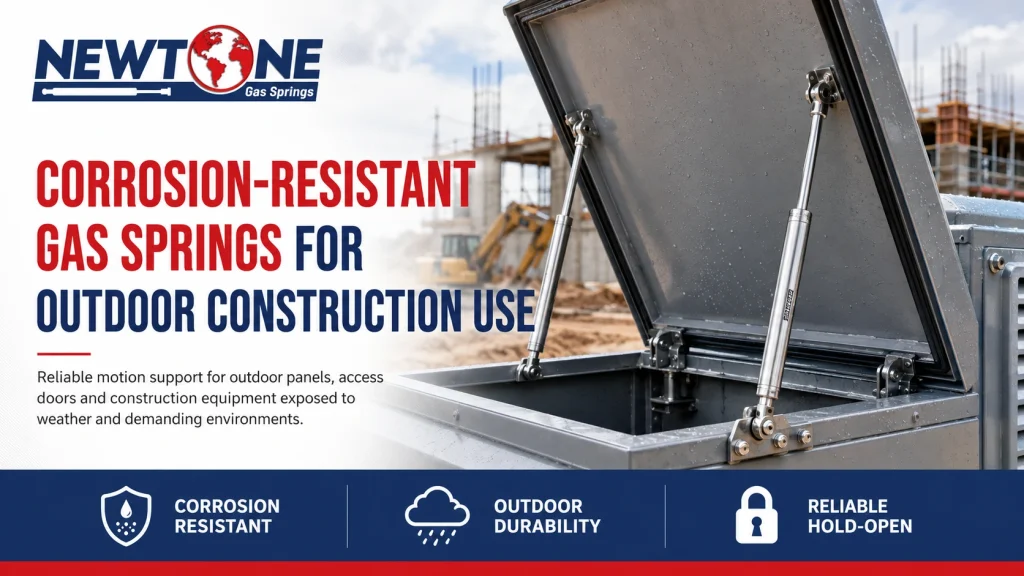
Outdoor Construction Use
Lift support built for toolboxes, generator enclosures, and site equipment that see mud, cement dust, and rough daily handling — for equipment OEMs, fleet procurement, and aftermarket distributors.
It’s Not Just Rust — It’s Grit
Corrosion-resistant gas springs for outdoor construction use need to survive something most “corrosion-resistant” ratings don’t actually test for: abrasion. Cement dust, concrete slurry, and site grit work their way into the point where the wiper seal rides against the rod, scratching through the hard chrome or black-nitride plating a fraction of a micron at a time. Once that layer is breached, ordinary moisture finishes the job in a fraction of the time it would take on an unmarked rod. That’s a different failure path than the salt-air pitting you’d worry about on a coastal marine hatch or a rooftop building panel — it’s mechanical wear first, corrosion second.
Picture a truck-mounted toolbox lid on a concrete crew’s service truck, opened and closed a dozen times a day, dusted in cement powder that turns to a fine abrasive paste the moment it rains. Or a generator enclosure on an active site, splashed with mud, kicked by a boot more than once, expected to still lift cleanly a year later. This is a harder environment on the rod surface than almost anything else a gas spring sees, and it’s worth treating as its own problem rather than folding it into a generic “outdoor” spec.
Who this page is for: OEM engineers designing gas springs into toolboxes, generator or compressor enclosures, and site-office cabin doors, procurement teams sourcing for a construction-equipment fleet, and distributors evaluating a manufacturing partner for job-site-grade parts.
Where This Actually Shows Up on a Job Site
Truck-Mounted Toolboxes
Saddle and step boxes on service trucks, opened multiple times a day, coated in whatever the crew tracked into the bed — cement dust being the most abrasive of it.
Generator & Compressor Enclosures
Weatherproof covers over site power equipment, often left closed for weeks and expected to still lift smoothly the first time someone needs fuel or maintenance access.
Site-Office Cabin Doors & Hatches
Access panels and lids on portable office units and storage containers, exposed to the same dust and moisture cycle as the rest of the site.
Equipment & Trailer Access Covers
Panels on trailers and mobile equipment that get opened for daily inspection, often by workers wearing gloves and not being especially gentle about it.
Sizing Force for a Toolbox or Enclosure Lid
For a lid that opens close to vertical rather than through a wide swinging arc, the force calculation simplifies to a mounting-distance form rather than the full angled moment balance.
W = m × g = 6 × 9.81 = 58.9 N (13.2 lbf)
F_total = (58.9 × 350) ÷ 90 ≈ 228.9 N (51.5 lbf)
F_each = F_total ÷ n = 228.9 ÷ 2 ≈ 114.5 N (25.7 lbf) per spring
Apply a safety-factor surcharge for rough daily handling (F_design = F × SF, SF ≈ 1.25 for job-site impact and misuse) and the design force per spring becomes ≈ 143 N (32 lbf).
The safety factor here is doing different work than it would on a building hatch. It’s not covering snow load — it’s covering the fact that job-site equipment gets used by people in a hurry, wearing gloves, sometimes kicking a lid shut rather than lowering it by hand. Sizing to the bare calculated minimum leaves no margin for that reality.
Rod Diameter: More Force, More Wear Margin
Rod diameter does two things at once on job-site equipment, and most force-only specifications only account for one of them.
A (10 mm rod) = π × 10² ÷ 4 ≈ 78.5 mm²
At equal pressure, the 10 mm rod delivers roughly 56% more force than the 8 mm rod (78.5 ÷ 50.3 ≈ 1.56), simply from the larger cross-section.
That extra area isn’t just about force headroom. A thicker rod presents more plated surface across the seal contact line, which means abrasive grit has to wear through more material before it compromises the seal — the same reasoning behind the “thicker rod, more force” rule of thumb, applied to an abrasion problem instead of a lift-capacity one. It’s not a substitute for correct force sizing or for choosing the right seal compound, but on equipment that’s going to eat cement dust for years, it’s a real piece of the margin.
Stainless Steel vs. Standard for Job-Site Equipment
Specify 316L stainless for equipment that gets regular wash-down cleaning, sits outdoors near standing water or mud for extended periods, or works coastal or high-humidity sites. For equipment that stays reasonably dry between uses and gets stored under cover — a toolbox on a truck that’s garaged overnight, for instance — a black-nitrided rod with HNBR seals is sufficient and considerably more cost-effective. HNBR’s UV and ozone resistance matters here too, since job-site equipment sits exposed to full sun for months at a stretch.
We’ve worked with a construction-equipment distributor supplying replacement gas struts to a regional fleet of site toolboxes and generator enclosures, where the original struts were wearing out well ahead of their rated cycle life. The root cause wasn’t a bad batch — it was grit abrasion at the seal line on equipment that saw daily cement-dust exposure without ever being wiped down. Matching force, stroke, and end fittings on the replacement kept the fleet consistent, but the longer-term fix was stepping up plating spec on the units seeing the heaviest dust exposure rather than treating every unit in the fleet identically.
Mounting for Dust and Grit Exposure
Mount with the rod pointing down whenever the lid or panel geometry allows it, so dust and moisture don’t collect at the seal — the same best practice that applies everywhere, but more consequential here given what’s collecting. Use ball socket end fittings that tolerate the minor misalignment that comes from a lid that’s been kicked shut a few hundred times rather than closed gently. Keep both pivot points in the same plane of motion; side load shortens gas spring life regardless of environment, and job-site installation tends to be less precise than a factory jig, so the tolerance for misalignment matters more here than on a controlled indoor assembly.
Specification Quick-Reference by Equipment Type
| Equipment Type | Typical Weight | Recommended Force | Material | Notes |
|---|---|---|---|---|
| Truck-mount toolbox lid | 4–8 kg (9–18 lb) | 90–150 N each (20–34 lbf) | Standard, unless wash-down cleaned | Twin-strut typical; consider 10 mm rod for dusty use |
| Generator / compressor enclosure | 8–15 kg (18–33 lb) | 120–200 N (27–45 lbf) | Stainless if outdoor-stored long-term | Long idle periods before opening — sizing must not rely on frequent use |
| Site-office cabin door / hatch | 5–10 kg (11–22 lb) | 100–180 N (22–40 lbf) | Standard, unless coastal site | Similar exposure profile to the rest of the site |
| Equipment / trailer access cover | 3–7 kg (7–15 lb) | 80–140 N (18–31 lbf) | Standard, unless wash-down cleaned | Frequent rough handling — size safety factor toward 1.3 |
| Wash-down / coastal site equipment | Any of the above | Per equipment type | Stainless steel recommended | Applies regardless of equipment category |
These figures are a starting point for early sourcing conversations. Lid weight, hinge offset, and dust/moisture exposure vary enough between fleets that we’d rather run the calculation against your actual drawings than have you spec from a table.
Why Construction Equipment OEMs Source from Newtone
We’re a manufacturer, not a distributor. Every spring is built in our own facility in Turkey, giving us direct control over rod plating, tolerances, and lead times.
Frequently Asked Questions
More often than plain corrosion, it’s abrasion. Cement dust and concrete slurry work into the point where the wiper seal contacts the rod, gradually scratching through the hard chrome or black-nitride plating. Once that layer is breached, ordinary moisture finishes the job much faster than it would on an unmarked rod.
It depends on lid weight and mounting geometry. A 6 kg (13.2 lb) toolbox lid with a typical hinge offset commonly needs around 115 N (26 lbf) per spring on a twin-strut setup, but the only reliable figure comes from running the calculation against your actual lid dimensions.
Yes, in two ways. A larger rod diameter delivers more force at the same internal pressure, and it gives grit and abrasive dust more plated surface area to wear through before the seal contact line is compromised. It’s not a substitute for correct force sizing, but it does add real margin in an abrasive environment.
Specify 316L stainless when equipment is regularly wash-down cleaned, stored outdoors near standing water or mud, or used on coastal or high-humidity sites. For equipment that stays reasonably dry and is stored under cover between uses, a black-nitrided rod with HNBR seals is sufficient and more cost-effective.
Yes. We match force, stroke, and end fittings to the original part so a fleet of toolboxes, generator enclosures, or site cabins can be serviced with replacements that behave identically to the units they’re replacing, even years after the original production run.
Conclusion
Corrosion-resistant gas springs for outdoor construction use have to survive a combination most catalog specs don’t address directly: abrasive grit wearing at the seal line, moisture finishing what the grit started, and daily rough handling that a gentler application never sees. Size the force correctly, size the safety factor for how the equipment actually gets used rather than how it’s used in a demo video, and step up to stainless or a thicker rod only where the exposure genuinely calls for it.
Newtone builds gas springs for construction-equipment OEMs and supplies matched aftermarket replacement for existing fleets. Share your lid or panel dimensions and typical site conditions, and we’ll return a force recommendation, a datasheet, and a quote — typically within 5 business hours.
Get a Specification or Quote
Tell us your equipment type, panel weight, and site conditions. Our engineering team handles the rest — free force calculation, sample datasheet, and competitive pricing.