Product Guide — Special Applications
Mechanical Gas Spring Alternative
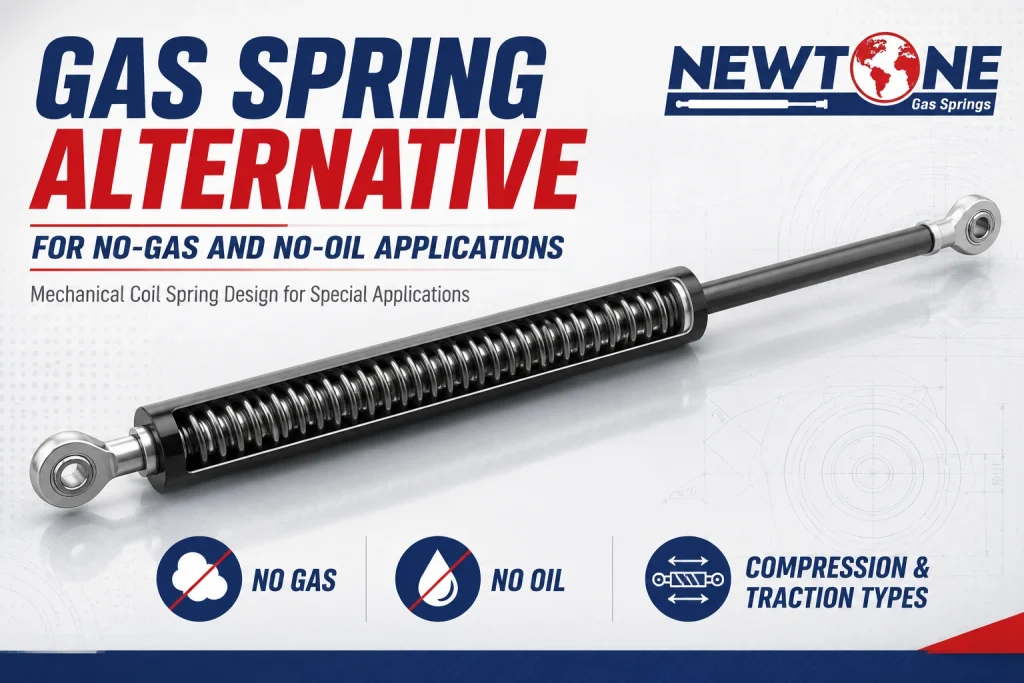
No-gas, no-oil motion support for applications where a pressurized cylinder isn’t an option — built to the same mounting footprint as a standard gas spring.
What Is a Mechanical Gas Spring Alternative
A mechanical gas spring alternative looks like a standard gas spring from the outside — same cylindrical body, same end fittings, same mounting geometry — but the gas and oil inside are replaced by an ordinary mechanical coil spring. There’s nothing pressurized to leak, no seal to fail, and no oil to migrate out of position. It fits where a gas spring would fit and moves the same way, but nothing inside it can escape. We get this request more often than the product’s low profile would suggest. It usually comes from an engineer who already knows exactly what force and stroke they need — they’ve done that part of the specification already — and the real question they’re stuck on is whether a sealed, gas-filled cylinder is even allowed in their application at all. At Newtone Gas Springs, alongside our standard nitrogen-filled product line, we manufacture custom mechanical spring struts for exactly this situation: same external form, internal mechanism swapped for one that has nothing to seal in the first place.
Who this page is for: OEM engineers designing equipment for dusty, wet, vibration-heavy, or contamination-sensitive environments, and procurement teams who’ve been told a standard gas spring keeps failing for reasons unrelated to force or stroke.
2
Configurations — Compression & Traction
20–7,500 N
Custom Force Range (4–1,686 lbf)
50+
End Fitting Types Available
0
Pressurized Gas, Oil, or Dynamic Seals
Why Some Applications Cannot Use Gas or Oil
A standard gas spring fails when its internal pressure or oil charge is compromised — by seal wear, by abrasive contamination reaching the rod, or by an environment that attacks the rubber compound faster than expected. In most industrial settings that’s a maintenance conversation. In a handful of applications, it’s disqualifying before the first unit ever ships: laboratory and clean-area equipment where any internal fluid is a contamination risk, food-processing covers and enclosures where a seal failure could put oil near a product line, and machinery operating in continuous dust or grit where a gas spring’s seals wear through in a fraction of their rated life. This isn’t a hypothetical concern. We’ve had procurement teams come to us after running standard gas springs on dust-heavy production equipment — grinding stations, bulk material handling covers, that kind of environment — and watching seals fail every few months as fine grit worked past the wiper and into the sealing package. Nothing was wrong with the force spec; the environment itself was outside what any sealed gas spring, regardless of brand, is built to tolerate long-term. Moving to a mechanical strut with the same mounting footprint removed the failure mode entirely, because there was no longer a seal or a pressurized chamber for the grit to compromise. These aren’t certification claims for any specific regulated industry — Newtone doesn’t hold medical or food-grade certifications — but the underlying engineering fact holds regardless of sector: a mechanical strut has no internal fluid or gas charge to contaminate a product or process, which is why it gets reviewed for clean-area mechanisms, laboratory enclosures, and sensitive equipment housings even without a formal certification attached to the request.Compression Type vs Traction Type Mechanical Spring Struts
Compression-Type Mechanical Strut
Extends under spring force, same as a compression gas spring. Used for lift-assist on lids, hoods, and access panels — the coil spring pushes the strut open and resists closing.Traction-Type Mechanical Strut
Pulls closed under spring tension, same role as a traction gas spring. Used where a panel or mechanism needs to be drawn back toward a rest position rather than pushed open.Force Curve Difference: Why a Coil Spring Rises Where a Gas Spring Doesn’t
A gas spring holds a nearly constant force through most of its stroke because it’s working against a fixed volume of compressed gas; a mechanical coil spring’s force rises linearly with deflection, per Hooke’s law, so it pushes noticeably harder the further it’s compressed. This is the one physical trade-off every buyer needs to understand before swapping a gas spring for a mechanical one — same footprint, genuinely different feel through the stroke.
Coil Spring Force vs. Deflection
F = F₀ + k × X
F₀ = preload force at full extension, k = spring rate (N/mm), X = deflection as the strut compresses.
Example: replacing a 150 N (34 lbf) gas spring with a 200 mm (7.9 in) stroke. A mechanical strut built to the same 150 N holding force at full extension, with a coil rate of 0.5 N/mm, reaches F = 150 N + (0.5 N/mm × 200 mm) = 250 N (56 lbf) at full compression — a 67% rise across the stroke. A comparable gas spring typically runs a K-factor (P2 ÷ P1) of 1.2–1.4, a 20–40% rise over the same travel. The mechanical strut starts at the same holding force but finishes noticeably firmer.
That steeper curve isn’t a defect — it’s just a different tool, and it can be tuned. A lower coil rate flattens the rise (at the cost of a longer or larger-diameter spring for the same force), while a higher rate gives a more pronounced progressive feel, which some applications actually want on the final few degrees of closing. The point is that force and stroke alone don’t fully specify this product the way they do a gas spring — the curve shape needs to be part of the conversation with whoever is building it.
Damping Difference: Why No Oil Usually Means No End-of-Stroke Cushioning
Standard gas springs use their internal oil charge to slow the rod down in the last portion of extension, which is why they’re mounted rod-down and why a good one opens smoothly rather than snapping to full extension. A mechanical strut has no oil, so it has nothing metering that final movement — it reaches full extension or full compression at whatever speed the coil spring and the mechanism’s own friction allow, then stops against its mechanical limit. For most of the environments that call for a mechanical strut in the first place — dusty, vibration-heavy, rarely-cycled, or maintenance-averse — that trade-off is acceptable, because the alternative (a leaking or seized gas spring) is worse. But if soft, cushioned closing is a hard requirement for the application, that needs to be solved separately, either with a mechanical end stop or a supplementary damper, rather than assumed to come built into the strut the way it does with a gas-filled unit.What Can Be Customized
Force, stroke, overall length, coil rate, and end-fitting type are all specified per order, the same way they are on our standard gas spring line. Body diameter and mounting style follow from the force and space envelope you’re working with. What we can’t do is publish a single fixed temperature or cycle-life rating that applies to every build — those depend on the specific coil material, wire diameter, and duty cycle of your application, so we size and confirm them per project rather than quoting a blanket number that might not hold for your specific case.When a Mechanical Alternative Makes Sense — and When a Standard Gas Spring Still Wins
⬤ Mechanical Alternative Fits Well
- Dust, grit, or airborne contamination is unavoidable
- Any internal oil or gas is a contamination risk to the process
- Rarely-cycled mechanisms sitting loaded for long periods
- Vibration or impact environments that stress seals
- Soft end-of-stroke damping is not a hard requirement
⬤ Standard Gas Spring Still Wins
- Consistent, near-flat holding force across the full stroke matters
- Smooth, cushioned closing is a functional requirement
- Compact force-to-size ratio is the priority
- The environment is otherwise clean and well-sealed already
Why OEM Buyers Bring This Request to Newtone
We build custom mechanical spring struts alongside our standard gas spring line from the same facility in Turkey, which means the same engineering team specifies both.Compression & Traction Configurations
Built to push open or pull closed, matching the role of the gas spring it replaces.
Full Custom Specification
Force, stroke, length, coil rate, and end fittings set per order, not selected from a fixed catalog.
Compatible End Fittings
Uses the same eyelet, ball socket, and blade fitting range as our standard gas spring line.
Honest Scope
We size force, stroke, and coil rate to your application rather than quoting a blanket spec that may not hold for it.
Direct Engineering Review
Your dimensions and duty cycle are reviewed by the team that will build the part.
OEM & Aftermarket Supply
Custom builds and replacement parts from the same manufacturing platform.
Frequently Asked Questions
What is a mechanical gas spring alternative?
It’s a strut built to the same external shape and mounting geometry as a standard gas spring, but using an internal coil spring instead of pressurized nitrogen and oil. There’s nothing inside it to leak or lose pressure.
Does a mechanical gas spring alternative provide the same end-of-stroke damping as a gas spring?
No. Damping in a standard gas spring comes from the internal oil charge, which a mechanical strut doesn’t have. It reaches full travel against a mechanical limit rather than slowing gradually, so soft-close needs to be addressed separately if it’s required.
Is a mechanical strut’s holding force the same throughout the stroke as a gas spring’s?
No. A gas spring holds a near-constant force with a mild rise (roughly 20–40% from extended to compressed). A coil-based mechanical strut rises linearly with deflection per Hooke’s law, so the compressed-end force can be considerably higher than the extended-end force — the exact rise depends on the coil rate chosen.
Can a mechanical gas spring alternative be built in both compression and traction types?
Yes. Compression-type units push open the same way a compression gas spring does; traction-type units pull closed the same way a traction gas spring does. Both can use the same end-fitting range as our standard gas spring line.
When should I choose a mechanical alternative instead of a standard gas spring?
When any internal gas or oil is unacceptable in the application, or when the environment (dust, grit, vibration, long static loading) would compromise a gas spring’s seals faster than is practical to maintain. If smooth cushioned closing and a flat force curve matter more than contamination risk, a standard gas spring is usually still the better fit.
Conclusion
A mechanical gas spring alternative solves a specific problem: an application where the force and stroke are already worked out, but a sealed, pressurized cylinder isn’t allowed or won’t survive the environment. Swapping the internal mechanism for a coil spring removes the leak path entirely, at the cost of a steeper force curve and the loss of built-in end-of-stroke damping — trade-offs worth understanding before specifying rather than after. If you’re evaluating whether this fits your application, send us the force, stroke, mounting geometry, and operating environment, and we’ll size a compression or traction configuration and confirm what’s realistic for the coil rate and duty cycle you need.Request Engineering Review
Share your force, stroke, and environment details. Our engineering team will confirm whether a mechanical alternative fits and return a configuration and quote.Email: info@newtonegs.com
Response: Within 5 business hours
Supply: OEM & Aftermarket — Global Export