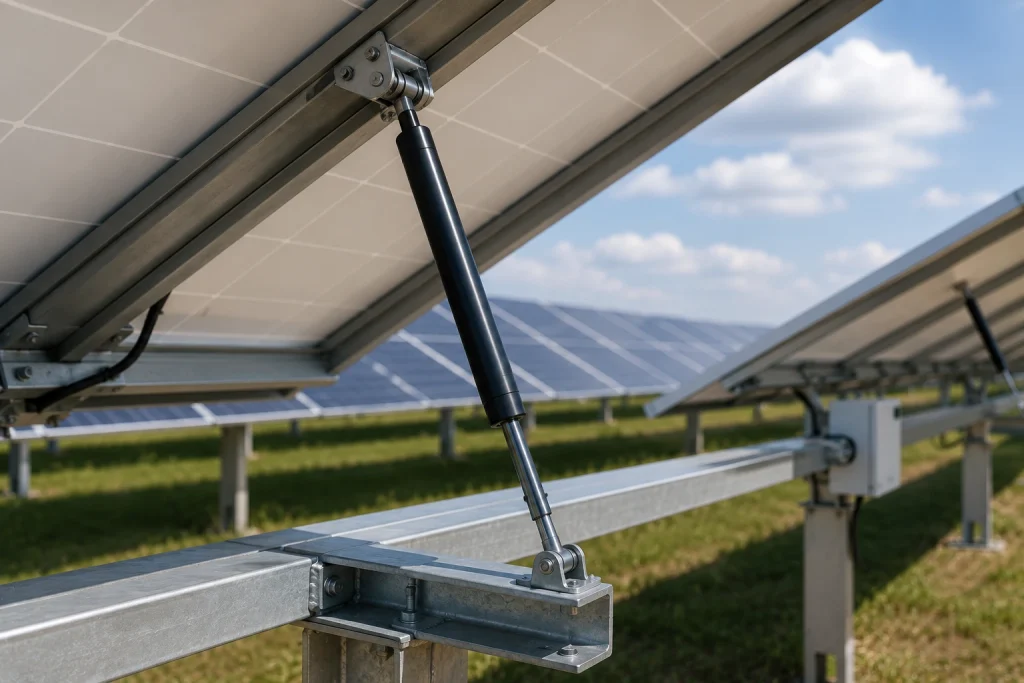
Solar Panel Tracking & Tilt Systems
Balanced tilt assist and controlled motion for solar trackers, adjustable mounts, and ground-mount tilt frames — built to hold an array steady against wind and survive years of outdoor exposure.
- 1 The Spring That Balances an Array Against the Wind
- 2 Where Gas Springs for Solar Panel Tilt Systems Are Used
- 3 One Spring or Two on a Solar Tilt Frame
- 4 When to Specify Stainless Steel or Locking Gas Springs
- 5 Specification Quick-Reference by Tilt System
- 6 How to Calculate Gas Spring Force for a Solar Tilt Frame
- 7 Why Solar OEMs Source Tilt Springs from Newtone
- 8 Frequently Asked Questions
- 9 Conclusion
- 10 Get a Specification or Quote
The Spring That Balances an Array Against the Wind
Gas springs for solar panel tilt systems do a job that gets harder the moment the wind picks up: hold or assist a heavy panel array at a set angle, smoothly, while the panel acts like a sail trying to slam it one way or the other. Picture a ground-mount tilt frame or a manual seasonal-adjust mount — an installer wants to change the array angle by hand without wrestling the full dead weight, and once it is set, the panel has to stay put through gusts and a winter of temperature swings. The spring takes the weight out of the adjustment and adds a controlled, balanced feel. Undersize it or ignore the wind, and the frame becomes a two-person fight on a calm day and a hazard on a windy one.
This page is for the people engineering and sourcing that hardware: solar mounting and tracker OEM engineers, procurement teams supplying installers and EPC contractors, and distributors serving the renewable-energy market. The focus is the tilt-angle force curve, wind loading, and the outdoor material choice — the three things that decide whether a tilt spring works for a decade or fails in a season.
Who this page is for: solar mounting, tracker, and tilt-frame OEM engineers specifying counterbalance and adjustment assist, procurement teams supplying installers and EPC contractors, and distributors serving the renewable-energy and off-grid market.
Where Gas Springs for Solar Panel Tilt Systems Are Used
Solar tilt and tracking hardware spans hand-adjusted mounts to assisted frames, and each one asks something different of the spring. Weight, tilt range, and how often it moves all change the spec, but every one shares the outdoor environment.
Seasonal-Adjust Ground Mounts
Frames an installer tilts a few times a year to track the sun’s seasonal height. The spring counterbalances the array so one person can change the angle, then holds it. Low cycle count, but high weight and full wind exposure.
Single-Axis Tilt & Tracker Assist
Frames that rotate through the day or across a wider range. The spring assists the drive or balances the array through its arc, so the force has to behave sensibly across the whole tilt range, not just at one angle.
Rooftop & Tilt-Up Panel Frames
Adjustable rooftop mounts and tilt-up panels on flat roofs. Often lifted for cleaning or angle change, so a controlled, assisted motion matters and the spring must clear the panel and roof through travel.
Agrivoltaic & Off-Grid Frames
Tilt frames over farmland, off-grid sites, and portable installations. Add dust, chemicals, and sometimes salt to the outdoor exposure, which pushes the material choice toward higher-grade stainless.
One Spring or Two on a Solar Tilt Frame
Most solar tilt frames use two springs, and on a wide array that is structural as much as it is balance. A single spring on one side of a broad panel frame loads it unevenly and lets it rack — and a racked frame puts twisting load on the pivot bearings and the spring rod, which outdoors is a fast route to wear. Two matched springs, one each side, keep the array square through its tilt and share the load so each runs below its limit. A single spring is for narrow or light mounts only.
⬤ Single Spring Setup
- Narrow or single-panel mounts
- Light frames, centred load
- Drive mechanism shares the load
- Lower part count and cost
⬤ Paired Spring Setup
- Wide multi-panel arrays
- Frames that would rack on one spring
- Even balance through the full tilt arc
- Springs force-matched to ±5% from one batch
When to Specify Stainless Steel or Locking Gas Springs
Solar tilt systems are one of the clearer cases for stainless steel, because the spring lives outdoors for the design life of the array — often 10 to 25 years. Rain, UV, and daily condensation pit a standard rod, and once pitted the seals leak and the balance is lost; coastal, agricultural, and de-iced sites add chlorides and chemicals that make the case stronger still. A stainless steel gas spring, with a 316-grade build for the harshest sites, is the right default here, paired with HNBR seals for UV and ozone resistance.
Locking earns its place where the array must be held firmly at a set or service angle. A locking gas spring holds the frame at full extension until released, which is useful for a maintenance-tilt position where a technician works under or behind the panel, or to secure an array against movement. For motion control on a frame that must tilt smoothly without slamming in gusts, a hydraulic damper alongside the spring controls the speed. Match the locking and damping choice to the tilt mechanism and confirm at design stage.
Specification Quick-Reference by Tilt System
| System Type | Typical Array Weight | Recommended Force | Spring Count | Notes |
|---|---|---|---|---|
| Seasonal-adjust ground mount | 20–50 kg (44–110 lb) | 300–800 N each (67–180 lbf) | 2 | Stainless + wind safety factor |
| Single-axis tilt / tracker assist | 25–60 kg (55–132 lb) | 400–1000 N each (90–225 lbf) | 2 | Check force across full tilt range |
| Rooftop / tilt-up frame | 12–30 kg (26–66 lb) | 200–500 N each (45–112 lbf) | 1–2 | Clear panel and roof through travel |
| Coastal / agrivoltaic frame | Any of the above | Per type | 2 | 316-grade for chlorides / chemicals |
| Small / single-panel mount | 8–15 kg (18–33 lb) | 120–300 N (27–67 lbf) | 1 | Single spring plus pivot |
How to Calculate Gas Spring Force for a Solar Tilt Frame
A tilt frame pivots, so size it with a moment balance about the tilt axis — and the key feature here is the cosine term, because the balancing load changes as the panel angle changes. The spring fights the most weight-moment when the panel is nearest flat and less as it tilts up:
F = (W × Lg × cos φ) ÷ (n × r)
F = force per spring · W = array weight (N) · Lg = pivot-to-CoG distance · φ = panel angle above horizontal · n = number of springs · r = perpendicular moment arm
Worked example — 30 kg (66 lb) array, two springs, near flat (φ ≈ 0°):
W = 30 × 9.81 = 294.3 N (66 lbf) · Lg = 600 mm (23.6 in) = 0.60 m · cos 0° = 1 · n = 2 · r = 120 mm (4.7 in) = 0.12 m
F = (294.3 × 0.60 × 1) ÷ (2 × 0.12) = 176.6 ÷ 0.24 = 736 N (165 lbf) per spring
That figure is the dead-weight balance at one angle, and on a solar frame it is only the start. Apply a wind safety factor at the high end — 736 N × 1.3 ≈ 957 N (215 lbf) — because the panel’s wind load is the governing case, not its weight. Then check the force at the other end of the tilt range, where cos φ is smaller, so the spring is not badly over-balanced when the panel is steep. Finally, correct for temperature at about 0.3% per °C (FT ≈ F20 × [1 + 0.003 × (T − 20)]); across a −20°C to +60°C site that is a swing of roughly ±12% in force. Wind load and tilt geometry are array-specific, so confirm the final spec with our engineering team rather than guess.
Mounting on an outdoor tilt frame combines the usual rules with a moving-frame twist. Fit the spring rod-down at the rest position so oil keeps the seals lubricated and water does not pool at the seal. Use ball-socket or eyelet end fittings that allow angular play, because the frame swings through an arc and the spring’s working angle changes — a rigid fitting would side-load the rod and kill it early. Keep both pivots in the plane of rotation, match the pair from one batch so the array tilts square, and use corrosion-resistant mounting brackets so the bracket is not the first part to rust in the field.
Why Solar OEMs Source Tilt Springs from Newtone
We manufacture in our own plant in Turkey, so the stainless grade, force, stroke, and matched-pair production are ours to control — which is what an array balanced outdoors for a decade or more actually needs.
Frequently Asked Questions
Take a moment balance about the tilt pivot, and remember the load changes with tilt angle through the cosine term: F = (W × Lg × cos φ) ÷ (n × r). A 30 kg (66 lb) array with the CoG 600 mm (23.6 in) from the pivot, balanced near flat on two springs at a 120 mm (4.7 in) arm, needs about 736 N (165 lbf) each before the wind safety factor. Send Newtone the array weight, pivot geometry, and tilt range for an exact figure.
Yes, and it is the dominant load case. A tilted panel acts like a sail, so wind can add far more force than the panel weight alone, in both push and lift directions. Size the spring with a wind safety factor at the high end, around 1.3, and confirm the panel’s rated wind load with the structural design rather than springing for dead weight only.
Usually yes. A solar tilt system lives outdoors for years in rain, UV, and condensation, and coastal or agricultural sites add salt and chemicals, so a stainless steel rod and body resist the pitting that would otherwise reach the seals. This is a clear outdoor case for stainless, with HNBR seals adding UV and ozone resistance.
Mount it rod-down at the rest position so oil keeps the seals lubricated, the damping stays even, and water does not pool at the seal. Use ball-socket or eyelet fittings that allow slight angular play so the rod is not side-loaded as the frame tilts through its arc, and keep both pivots in the plane of rotation. Side-load from a twisting frame is a common cause of early failure outdoors.
Gas spring force changes about 0.3% per °C, so a spring set at 20°C reads noticeably weaker on a cold morning and firmer in summer heat. On a tilt frame that means the balance point shifts with the seasons unless the spring is sized at the operating temperature range, not at bench temperature.
Conclusion
A solar tilt spring is judged over years and against the wind, not on a calm install day. The mistakes are specific to the job: sizing for dead weight when wind is the governing load, balancing at one tilt angle and ignoring how the cosine term changes the force across the range, running a single spring under a wide array until it racks, or using a standard rod where a decade of weather will pit it. Each one turns a smooth, balanced frame into a maintenance or safety problem.
Newtone builds these springs for the outdoor, wind-loaded reality: stainless with 316-grade options for long exposure, force sized for wind and checked across the tilt range, matched pairs to ±5% so wide arrays tilt square, and capability to 7500 N (1686 lbf) for large frames. Engineering support is available to set the grade, force, stroke, and damping for a specific tilt system and site.
Send us the array weight, pivot geometry, tilt range, and site conditions. We’ll come back with a force recommendation, a datasheet, and a quote — usually within 5 business hours.
Get a Specification or Quote
Tell us your array weight, pivot-to-CoG geometry, tilt range, and site environment. Our engineering team handles the rest — moment balance across the tilt range, wind and temperature margins, stainless grade, and damping or locking selection.