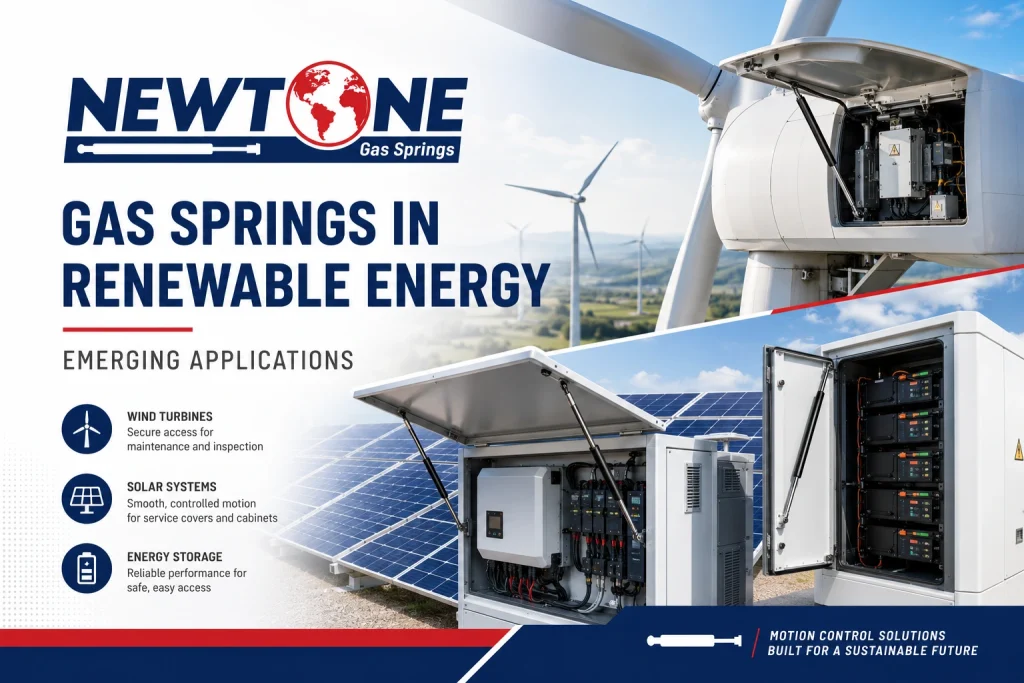
Gas springs in renewable energy are used wherever access panels, hatches, cabinets or service covers need controlled lifting, hold-open support or safe maintenance access. The right gas spring depends on panel weight, mounting distance, opening angle, environment, service frequency and whether the application needs standard lift support, locking support, stainless steel or damping.
Renewable energy equipment is often discussed as if it were mostly static: solar panels, wind towers, battery cabinets and inverter boxes. In the field, however, these systems include many moving covers, hatches, doors and service panels. Technicians open them for inspection, cleaning, wiring, cooling-system checks, battery access, control maintenance and repair. If those panels are heavy, exposed to weather or awkward to reach, controlled motion becomes part of the equipment design.
- 1 Why Gas Springs in Renewable Energy Are Becoming More Important
- 2 Renewable Energy Is Creating More Access Points, Not Fewer
- 3 Where Gas Springs Are Used in Renewable Energy
- 4 Force Calculation for Renewable Energy Access Panels
- 5 Wind Energy Applications
- 6 Solar, Inverter and Tracker Applications
- 7 Battery Storage, Hydrogen and Monitoring Equipment
- 8 Choosing Standard, Locking, Stainless or Damper Solutions
- 9 Material and Environment Selection
- 10 Common Specification Mistakes in Renewable Energy Equipment
- 11 Renewable Energy Gas Spring Application Map
- 12 Why Source Renewable Energy Gas Springs from Newtone?
- 13 Frequently Asked Questions About Gas Springs in Renewable Energy
- 14 Final Engineering Takeaway
Why Gas Springs in Renewable Energy Are Becoming More Important
Gas springs in renewable energy are becoming more important because renewable equipment now includes more serviceable enclosures, access hatches and moving panels than many people expect. Wind turbines, solar tracker systems, battery energy storage systems, inverter cabinets and hydrogen equipment all need safe, repeatable access.
A gas spring helps reduce lifting effort, supports the panel in the open position and makes maintenance access more predictable. On a small inverter cabinet, that may mean a technician can open a top cover without fighting its weight. On a wind turbine nacelle hatch, it may mean safer hands-free access. On a battery cabinet, it may mean a service door stays controlled instead of swinging or dropping during inspection.
The role is simple but important: the gas spring turns a heavy or awkward panel into a controlled service interface. That is why the selection should not be made by panel weight alone. The real design includes mounting distance, stroke, environment, service frequency, safety requirement and whether the panel is opened by one technician or a maintenance crew.
Renewable Energy Is Creating More Access Points, Not Fewer
Renewable energy is creating more access points, not fewer. Wind turbines need nacelle covers, hub hatches, tower-base doors and service panels. Solar sites need inverter cabinets, tracker service covers, combiner boxes and monitoring stations. Battery storage systems need weatherproof doors, top covers and maintenance panels. Hydrogen and electrolyzer equipment add more enclosed systems with service access requirements.
This is the part many broad renewable hardware pages miss. The industry is not only installing more energy-generating equipment; it is installing more equipment that must be inspected, opened, cleaned and repaired over long service lives. Every one of those access points needs a decision: simple hinge, gas spring, locking gas spring, damper, safety tube or a combination.
We often see this during first-article reviews. An OEM working on a renewable-energy enclosure may request a high-force gas spring because the cover feels heavy. After the mounting distance is reviewed, the better solution is sometimes a lower-force spring with a better bracket position. The cover still holds open, but it closes more smoothly and loads the brackets less. Force alone is not the design.
Where Gas Springs Are Used in Renewable Energy
Gas springs are used in renewable energy equipment wherever a hinged cover, service hatch or cabinet door needs controlled motion. The most common emerging applications are wind turbine access panels, solar tracker service covers, photovoltaic inverter cabinets, battery energy storage enclosures, hydrogen equipment covers, monitoring stations and rooftop plant access hatches.
Wind turbine applications often need hold-open support for nacelle, hub, tower and service enclosure access. Solar applications may use gas springs on tracker covers, maintenance lids and tilted service panels. Battery energy storage systems may need controlled doors or covers that allow inspection without sudden panel movement. Hydrogen and electrolyzer equipment may need careful material review because enclosure access can combine service safety with humidity, outdoor exposure or ventilation constraints.
The common factor is not the energy source. The common factor is maintenance access. A gas spring is useful when the panel is too heavy, too awkward, too frequently opened or too safety-relevant to rely on uncontrolled motion.
Force Calculation for Renewable Energy Access Panels
A useful first calculation for renewable energy access panels is the mounting-distance form. It shows why bracket placement can reduce the force needed from the gas spring. In many access covers, moving the mounting point improves behavior more than simply choosing a stronger spring.
Formula:
F = (W × L) ÷ d
Where:
F = total gas spring support force required
W = panel weight in Newtons
L = horizontal distance from hinge to the panel centre of gravity
d = perpendicular distance from hinge to the gas spring line of action
First convert panel mass to Newtons:
W = m × g
Example: an inverter cabinet top cover weighs 16 kg (35 lb). Its centre of gravity is 350 mm (13.8 in) from the hinge. The effective perpendicular gas spring moment distance is 120 mm (4.7 in). Two gas springs will be used.
W = 16 × 9.81 = 157 N (35 lbf)
F_total = (157 × 350) ÷ 120
F_total = 458 N (103 lbf)
With two gas springs:
F_each = 458 ÷ 2 = 229 N per spring (51 lbf per spring)
With a moderate outdoor service factor of 1.15 for field variation, wind exposure and installation tolerance:
F_design = 229 × 1.15 = 263 N per spring (59 lbf per spring)
Now look at the mounting distance. If the bracket geometry is improved and d increases from 120 mm (4.7 in) to 150 mm (5.9 in), the same panel needs:
F_total = (157 × 350) ÷ 150 = 366 N (82 lbf)
F_each = 183 N per spring (41 lbf per spring)
The panel did not change weight. The spring label was not the starting problem. The bracket geometry changed the required force. This is why renewable energy access covers should be reviewed as a mechanism, not as a loose hardware item.
Wind Energy Applications
Wind energy applications use gas springs mainly for access panels, hatches, tower-base doors, nacelle covers, hub service panels and equipment enclosures. These panels may be opened in confined, elevated or weather-exposed locations, so controlled hold-open behavior matters.
For a protected tower-base cabinet, a standard compression gas spring may be enough. For nacelle or hub access, the decision may shift toward locking gas springs or safety tubes if a technician works under or near the raised panel. A standard gas spring provides lift support, but it is not a mechanical safety lock.
Material choice depends on exposure. Many onshore applications can use black nitrided rods with HNBR seals. Offshore or coastal wind applications should be reviewed for stainless steel gas springs, stainless fittings and compatible brackets because salt air and humidity can attack the rod, seal path and mounting hardware.
Solar, Inverter and Tracker Applications
Solar and inverter applications use gas springs where technicians need to open covers, adjust panels or access enclosed electronics. Examples include solar tracker service covers, inverter cabinet lids, monitoring equipment doors, combiner box covers and rooftop plant access hatches.
Solar equipment creates a different design challenge from wind turbines. Many panels are low to the ground or mounted at awkward angles. Space around the hinge can be limited. The spring must not block cable access, ventilation, latches or inspection paths. A tidy drawing can still produce a poor service experience if the spring sits in the technician’s hand path.
For tracker and tilted-panel mechanisms, force alone is not enough. Pivot geometry decides whether the panel opens smoothly or feels heavy at one point and over-assisted at another. Where speed is the concern rather than lifting force, hydraulic dampers may be reviewed to control movement.
Battery Storage, Hydrogen and Monitoring Equipment
Battery storage, hydrogen and monitoring equipment often need gas springs on weatherproof service doors, top covers and inspection panels. These applications are growing because renewable infrastructure increasingly depends on cabinets and enclosures, not only turbines and panels.
Battery energy storage systems may include large doors, cooling access panels, electrical service covers and inspection hatches. The gas spring specification should consider panel weight, service frequency, heat, outdoor exposure and whether the cover is safety-critical during maintenance.
Hydrogen and electrolyzer equipment should be reviewed carefully because enclosure access may involve ventilation, moisture, outdoor exposure and technician safety. Gas springs can support access covers, but the complete mechanism should be reviewed with the equipment’s safety requirements. Do not use a standard lift-assist spring as a substitute for a required mechanical hold-open or locking device.
Choosing Standard, Locking, Stainless or Damper Solutions
The correct motion-control product depends on the function of the renewable energy panel. A standard gas spring is suitable when the panel needs lift assistance and open-position support. A locking gas spring should be reviewed when the panel must hold a position during service. A safety tube can provide full-extension backup when hands-free access matters.
Stainless steel gas springs should be reviewed for offshore wind, coastal solar equipment, washdown zones, high humidity and corrosive environments. For many protected onshore enclosures, Newtone’s black nitrided rod with HNBR sealing is a strong standard solution.
Hydraulic dampers are different. They are used when the main need is speed control, not support force. A heavy cover may need a gas spring to reduce lifting effort and a damper to prevent fast movement. Mixing these functions correctly is often what makes the panel feel engineered rather than improvised.
Material and Environment Selection
Material selection for renewable energy gas springs should start with exposure: protected indoor enclosure, outdoor cabinet, coastal installation, offshore platform, washdown area or high-humidity equipment room. The environment decides whether black nitrided steel is enough or stainless steel should be reviewed.
Newtone’s black nitrided rods have a typical surface hardness of 900–1000 HV and a treatment depth of 20–30 µm. HNBR sealing is standard and selected for UV and ozone resistance. This combination suits many industrial and outdoor renewable applications.
For offshore, coastal or high-humidity service, corrosion risk changes the specification. Rod pitting can damage the seal path. Corroded fittings can bind or create side-load. A stainless gas spring should be considered together with compatible end fittings, brackets and fasteners. A stainless spring mounted with weak hardware is not a complete corrosion-resistant system.
Common Specification Mistakes in Renewable Energy Equipment
The first mistake is treating renewable energy equipment as static. Many renewable systems contain service panels, cabinet doors, hatches and adjustable covers that move through repeated maintenance cycles.
The second mistake is choosing a gas spring by panel weight only. Weight matters, but hinge geometry, mounting distance, stroke, opening angle and service position decide how the panel actually behaves.
The third mistake is ignoring corrosion. Outdoor renewable systems may see UV, humidity, dust, temperature swings, salt air or washdown. If the rod, fittings and brackets are not specified for the same environment, the whole mechanism can fail at the weakest point.
Other mistakes include replacing only one spring of a paired set, using a standard gas spring where a locking device is needed, allowing the spring to bottom out as a hard stop and placing the spring where it blocks service access.
Renewable Energy Gas Spring Application Map
| Application area | Typical gas spring requirement |
|---|---|
| Wind turbine nacelle and hub hatches | Controlled lift support, paired springs, locking review and material selection for exposure. |
| Tower-base and control cabinet doors | Standard gas springs for access support, with bracket and service-clearance review. |
| Solar tracker service covers | Geometry-sensitive force selection and possible damping for controlled movement. |
| PV inverter and monitoring cabinets | Compact gas springs for top covers or doors, with attention to cables and ventilation paths. |
| Battery energy storage enclosures | Access-door support, heat/environment review and safe service positioning. |
| Hydrogen and electrolyzer equipment | Application-specific review for enclosure access, material exposure and hold-open safety. |
Why Source Renewable Energy Gas Springs from Newtone?
Manufacturer, Not Distributor
Newtone manufactures gas springs in Turkey and exports to more than 60 countries for OEM and aftermarket applications.
Multiple Product Options
Standard gas springs, locking gas springs, stainless steel options, hydraulic dampers and mounting brackets can be reviewed by application.
Controlled Components
HNBR sealing, black nitrided rods, ±5% force tolerance and 100,000+ cycle capability support repeatable performance.
Application Review
Engineering support is available for force, stroke, mounting points, paired springs, materials and service-access safety.
Frequently Asked Questions About Gas Springs in Renewable Energy
Where are gas springs used in renewable energy?
Gas springs in renewable energy are used on wind turbine access panels, solar tracker covers, inverter cabinets, monitoring stations, battery energy storage enclosures, hydrogen equipment covers and service hatches that need controlled access.
What type of gas spring is best for renewable energy equipment?
The best type depends on the function. Standard gas springs are used for lift assistance, locking gas springs or safety tubes are reviewed for maintenance hold-open safety, stainless steel is reviewed for corrosive exposure, and dampers are used when speed control matters.
Do renewable energy applications need stainless steel gas springs?
Not always. Protected onshore enclosures may use black nitrided rods with HNBR seals. Offshore, coastal, washdown or high-humidity renewable energy applications should be reviewed for stainless steel gas springs and compatible hardware.
How do you calculate gas spring force for renewable energy access panels?
Calculate gas spring force from panel weight, hinge-to-centre-of-gravity distance, mounting distance, opening angle and number of springs. Mounting geometry often changes the required force more than the panel weight alone.
Why are gas springs important for renewable energy maintenance?
Gas springs help technicians open, hold and close access panels safely and predictably. In renewable energy equipment, reliable access can reduce maintenance effort, prevent panel drop risks and make service work more efficient.
Final Engineering Takeaway
Gas springs in renewable energy are becoming more important because wind, solar, storage, hydrogen and monitoring systems all create service access points. The right gas spring turns a heavy or awkward panel into a controlled maintenance interface.
The best specification starts with the application, not the catalogue. Panel weight, mounting distance, stroke, environment, service frequency, locking need and paired-spring behavior should be reviewed together. Newtone can support renewable energy OEMs and aftermarket teams with standard, locking, stainless, damper and bracket options for emerging energy applications.