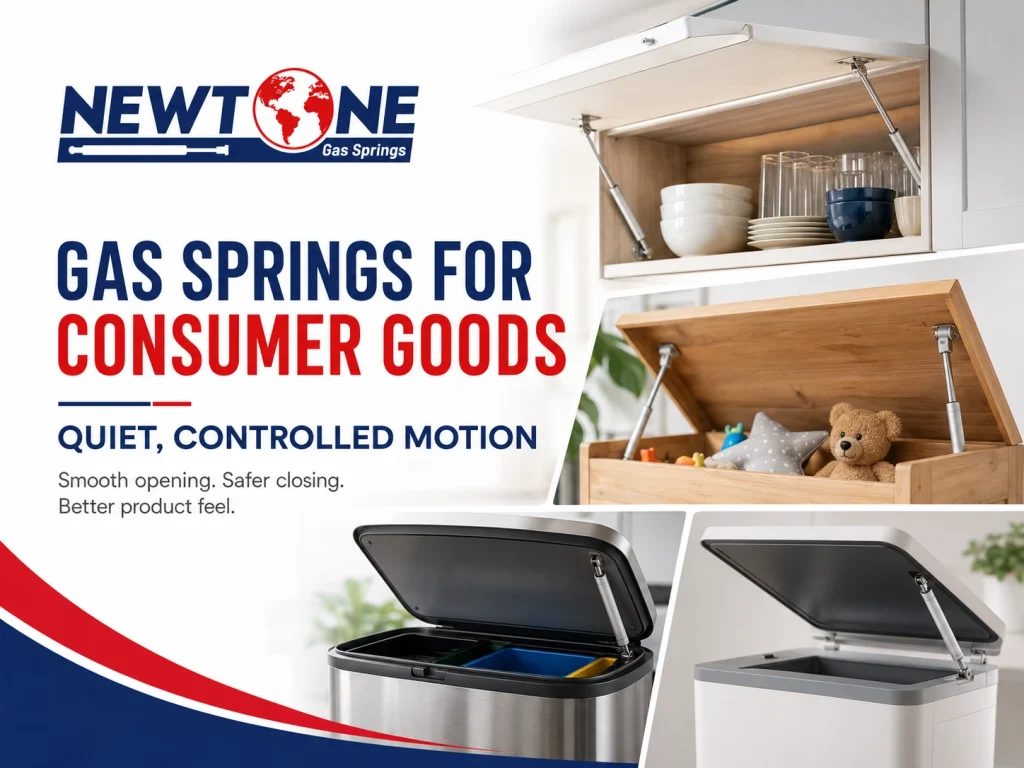
Gas springs for consumer goods are used to make lids, covers and adjustable parts open smoothly, hold safely and close with controlled motion. The right specification depends on supported weight, hinge geometry, user handling force, damping requirement, stroke, mounting space and the product environment.
In consumer products, the user rarely thinks about Newtons, stroke length or rod orientation. They notice whether a storage bench lid drops too fast, whether a kitchen cabinet flap feels cheap, whether a toy box pinches fingers, or whether an appliance cover still moves smoothly after months of use. That product feel is not magic. It comes from force, geometry, damping and repeatability working together.
- 1 Why Gas Springs for Consumer Goods Improve Product Feel
- 2 Product Feel Is an Engineering Variable, Not a Marketing Word
- 3 Where Gas Springs Are Used in Consumer Goods
- 4 Gas Spring, Damper or Locking Gas Spring?
- 5 Closing Force Calculation for Consumer Product Lids
- 6 Force, Damping and Geometry Selection
- 7 Mounting and Packaging Guidance for Consumer Goods
- 8 Material and Environment Selection
- 9 Common Specification Mistakes
- 10 Consumer Goods Gas Spring Specification Checklist
- 11 Why Source Consumer Goods Gas Springs from Newtone?
- 12 Frequently Asked Questions About Gas Springs for Consumer Goods
- 13 Final Engineering Takeaway
Why Gas Springs for Consumer Goods Improve Product Feel
Gas springs for consumer goods improve product feel by reducing lifting effort, controlling lid movement and helping covers stay where the user expects them to stay. In a consumer product, the motion is part of the perceived quality.
A lid that opens with a harsh snap feels unfinished. A cover that drops at the end of travel feels unsafe. A flap that needs too much closing force feels badly balanced. These are not only comfort issues; they affect returns, reviews, service calls and brand perception for the OEM.
The challenge is that consumer products are usually compact. The hinge space is limited, the spring must often be hidden, and the user may operate the product with one hand. That means the gas spring cannot be selected from force alone. The mounting point, moment arm, handle distance and damping behavior decide what the user actually feels.
Product Feel Is an Engineering Variable, Not a Marketing Word
Product feel is an engineering variable because the user’s impression comes from measurable factors: breakaway force, closing effort, damping, side-load, friction, paired-spring balance and force tolerance. If those are wrong, the product feels wrong even if the gas spring technically fits.
This is especially visible on storage lids, cabinet flaps and wide consumer-product covers. Two springs with the same label may not behave the same if they come from different tolerance bands or production batches. On a wide lid, that difference can create a slight twist during opening. The user does not call it force tolerance; they simply feel that the lid moves unevenly.
We see this type of issue in consumer-product first-article reviews. A wide storage lid or cabinet cover may open, but one side rises faster and the closing feel is not balanced. Matching the spring force, reviewing the mounting arms and keeping both sides in the same motion plane can turn the same product from “functional” into “finished.”
Where Gas Springs Are Used in Consumer Goods
Gas springs are used in consumer goods wherever a moving lid, flap, cover or adjustable part needs lift support, controlled movement or safer handling. Common applications include kitchen cabinets, wall units, storage benches, toy boxes, trash-bin lids, recycling enclosures, appliance covers, outdoor consumer enclosures and adjustable furniture components.
Kitchen cabinet lift-up doors often need light support and quiet motion in a compact space. Storage benches and toy boxes need safer closing and predictable hold-open behavior. Trash bins and recycling lids need repeated opening, noise reduction and sometimes outdoor durability. Appliance covers may need controlled support without blocking service access or user hands.
The common factor is not the product category. It is the motion problem. If the part is heavy, frequently used, noisy, unsafe, awkward to hold open or unpleasant to close, a gas spring or damper should be reviewed as part of the product design.
Gas Spring, Damper or Locking Gas Spring?
A gas spring provides support force, a damper controls speed, and a locking gas spring holds a selected position. Consumer goods can use one of these functions or combine them depending on the product’s motion requirement.
A standard gas spring is useful when a lid needs help opening or needs to stay open during normal use. A damper is useful when the lid already moves easily but closes too quickly or too noisily. A locking gas spring is useful when the product must stay at a chosen angle, although many consumer products do not need a full locking function.
This distinction matters because soft-close and hold-open are not the same job. A product can stay open but still slam near the end of closing. Another product can close slowly but not hold open. The right design starts by deciding whether the product needs support force, speed control, position holding or a combination.
Closing Force Calculation for Consumer Product Lids
The closing or handling force relationship helps estimate how much effort a user may feel when closing a gas-spring-assisted lid. This is a useful consumer-goods check because a lid can be mechanically supported and still feel wrong in the user’s hand.
Formula:
F_close = (n × F1 × r) ÷ L_lid
Where:
F_close = approximate force the user must apply at the handle or contact point
n = number of gas springs
F1 = gas spring force near the extended position
r = effective perpendicular moment arm of the gas spring
L_lid = distance from hinge to the user handle or contact point
Example: a storage bench lid uses two gas springs rated at 120 N (27 lbf) each. Each spring has an effective perpendicular moment arm of 60 mm (2.4 in). The user closes the lid from a handle area about 420 mm (16.5 in) from the hinge.
F_close = (2 × 120 × 60) ÷ 420
F_close = 34 N (8 lbf)
That is a reasonable closing force for many adult-operated consumer products. But if the same design is changed to two 180 N (40 lbf) springs because the lid felt heavy during early testing, the closing effort becomes:
F_close = (2 × 180 × 60) ÷ 420
F_close = 51 N (11 lbf)
The lid may still function, but the product now feels harder to close. If the product is a toy box, bench lid or home-storage system, that difference can be enough for the user to notice. More force is not automatically a more premium feel.
For the support side, a hinged lid can also be checked with a moment balance:
F = (W × Lg × cos φ) ÷ (n × r)
That calculation answers whether the spring can support the lid. The closing-force calculation answers whether the user can comfortably control it. Consumer goods need both checks.
Force, Damping and Geometry Selection
Force, damping and geometry should be selected together because each one changes the user’s experience. A stronger spring can reduce lift effort, but it can also make closing harder. A damper can reduce slam, but it will not support a heavy lid by itself.
Mounting geometry controls leverage. Moving the spring line of action farther from the hinge usually increases the effective moment arm and reduces the force required. Placing the spring too close to the hinge forces the designer to use a higher Newton rating, which may make the lid feel springy or hard to close.
Damping controls speed. For quiet closing, the relevant relationship is:
F_damp = c × v
That means damping force rises when motion speed rises. This is why a damped mechanism can resist a fast drop but still allow gentle movement at lower speed. A plain gas spring does not behave the same way; it provides support force based mainly on pressure and geometry.
Mounting and Packaging Guidance for Consumer Goods
Consumer-goods gas springs should be mounted so the rod moves axially, with both pivots in the same plane of motion. Side-load shortens life and can create noise, rough motion or seal wear.
Where the geometry allows it, mount the gas spring with the rod pointing down in the at-rest or closed position. This helps keep oil near the seal and supports smoother damping. It is a small detail, but in quiet consumer products small details are often the difference between acceptable and pleasant.
Packaging matters. The gas spring should not block storage space, bag liners, appliance access, hinges, hand paths or cleaning areas. On products used by children or in home environments, pinch points should be reviewed carefully. The mechanism should guide the lid; it should not become a hazard hidden inside the product.
End fittings should allow the required angular movement. Ball sockets, eyelets and brackets are not interchangeable by appearance alone. A compact fitting that looks clean on a rendering may still bind if the lid path changes angle through the stroke.
Material and Environment Selection
Material selection for consumer-goods gas springs depends on whether the product is indoor, outdoor, high-humidity, coastal, washable or exposed to cleaning chemicals. Most indoor consumer products can use black nitrided rods with HNBR seals.
Newtone’s black nitrided rods have a typical surface hardness of 900–1000 HV and a treatment depth of 20–30 µm. HNBR sealing is standard and selected for UV and ozone resistance. This combination is suitable for many furniture, cabinet, storage and indoor appliance applications.
Stainless steel gas springs should be reviewed for outdoor enclosures, coastal products, high-humidity storage, food-service equipment, washdown areas or consumer products exposed to aggressive cleaning. The brackets, pins and fasteners should be reviewed with the same environmental logic. A corrosion-resistant spring mounted with weak hardware is not a complete solution.
Common Specification Mistakes
The first mistake is choosing too much force. In consumer goods, too much force can make a lid hard to close, keep it half-open or create a harsh product feel. Correct support is better than maximum support.
The second mistake is confusing soft-close with hold-open. A lid stay, gas spring, damper and locking support are not the same thing. The product may need one function or several, depending on the desired motion.
The third mistake is copying cabinet hardware into a harsher product environment. A kitchen cabinet lift mechanism may not be suitable for outdoor storage, trash-bin enclosures or products exposed to cleaning liquids, humidity or frequent public use.
Other mistakes include replacing only one spring of a paired lid, ignoring handle distance, allowing the spring to bottom out as the mechanical stop, mounting the spring where it blocks useful space and selecting by extended length alone without reviewing force and geometry.
Consumer Goods Gas Spring Specification Checklist
| Specification point | Why it affects product feel |
|---|---|
| Lid or cover weight | Defines the supported load, but does not determine the user feel alone. |
| Hinge geometry | Controls leverage, closing effort and hold-open behavior. |
| Handle distance | Changes how much force the user feels when closing the lid. |
| Damping requirement | Needed when the product must close quietly or avoid slam. |
| Single or paired layout | Wide lids need balanced support to avoid twisting and cheap-feeling motion. |
| Mounting clearance | The spring must not block storage space, cleaning access or hand paths. |
| Environment | Outdoor, humid or washable products may need stainless steel review. |
| Cycle expectation | Frequently used consumer products need repeatable motion over many cycles. |
Why Source Consumer Goods Gas Springs from Newtone?
Manufacturer, Not Distributor
Newtone manufactures gas springs in Turkey and exports to more than 60 countries for OEM and aftermarket applications.
Motion Feel Review
Engineering support is available for force, stroke, damping behavior, mounting points and paired-spring layouts.
Controlled Components
HNBR sealing, black nitrided rods, ±5% force tolerance and 100,000+ cycle capability support repeatable product motion.
OEM + Aftermarket Supply
Newtone can support consumer-product OEM programs and replacement supply from the same manufacturing platform.
Frequently Asked Questions About Gas Springs for Consumer Goods
Where are gas springs used in consumer goods?
Gas springs for consumer goods are used in kitchen cabinets, storage benches, toy boxes, trash-bin lids, appliance covers, outdoor enclosures and adjustable furniture parts where controlled opening, support or safer closing is needed.
Do gas springs make consumer products close softly?
Not by themselves in every design. Gas springs provide support force, while soft-close behavior often needs damping. A product may need a gas spring, a damper or both depending on the lid weight and desired closing speed.
Can a gas spring be too strong for a consumer product?
Yes. Too much force can make a lid hard to close, keep it partly open or create an aggressive feel. Consumer goods should be specified for comfortable handling force, not simply the highest lift force.
Should wide lids use one gas spring or two?
Wide or flexible lids usually work better with two matched gas springs because paired support reduces twisting. The two springs should be force-matched so the lid rises and closes evenly.
Do consumer goods need stainless steel gas springs?
Most indoor consumer goods can use black nitrided rods with HNBR seals. Stainless steel should be reviewed for outdoor, coastal, high-humidity, washdown or aggressive-cleaning environments.
Final Engineering Takeaway
Gas springs for consumer goods should be selected around the user’s real experience: opening effort, closing force, quiet movement, safety, available space, cycle life and environmental exposure.
The best consumer-product motion does not feel engineered, even though it is. It simply feels smooth, balanced and safe. Newtone can review gas spring force, damping behavior, mounting geometry and material choice so lids, covers and adjustable consumer products move the way users expect them to move.