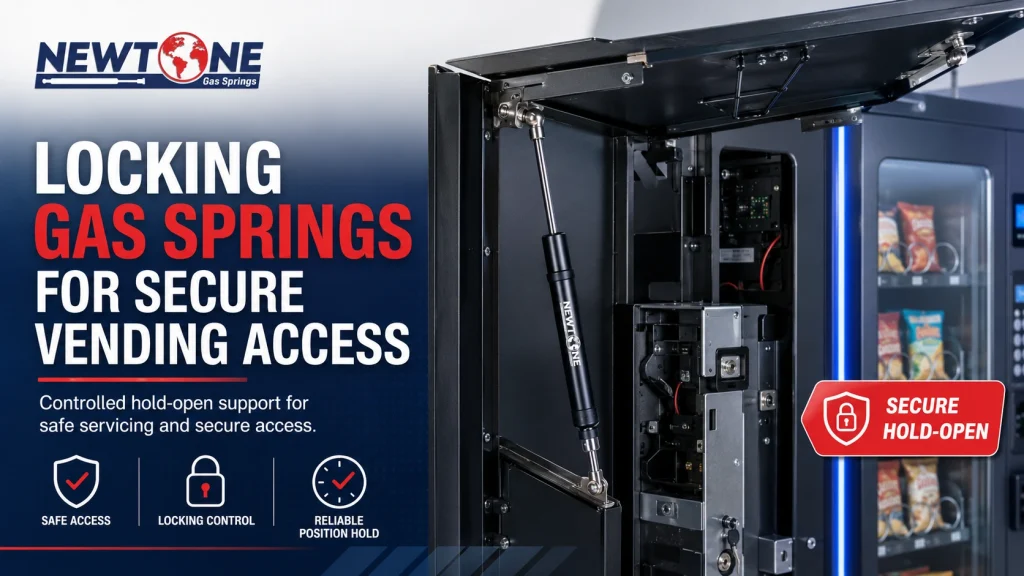
Vending Machine Access Panels
Hands-free hold-open support for service panels, payment module doors, and micro-market kiosk lids — for OEM manufacturers, route technicians, and equipment fleet operators.
- 1 The Panel That Needs to Stay Open While You Work
- 2 Locking Doesn’t Mean Secure
- 3 Sizing Locking Gas Springs for Vending Machine Access Panels
- 4 Cycle Life on a Service Route: Why It’s Rarely the Limiting Factor
- 5 Stainless Steel for Outdoor Kiosks and High-Humidity Locations
- 6 Specification Quick-Reference for Locking Gas Springs for Vending Machine Access Panels
- 7 Why Vending & Kiosk OEMs Source from Newtone
- 8 Frequently Asked Questions
- 9 Conclusion
- 10 Get a Specification or Quote
The Panel That Needs to Stay Open While You Work
Locking gas springs for vending machine access panels do one specific job: they hold a service panel, coin-mechanism door, or payment-module lid open at full extension so it can’t fall shut on a technician’s hands while both are busy inside the machine. That’s the whole function — a mechanical hold-open, not a security device. It’s worth saying plainly up front, because the word “locking” gets read two different ways in this industry, and mixing them up leads to the wrong part being ordered.
Picture a route technician kneeling in front of a snack machine, restocking columns with one hand while the other braces a panel that has no business staying open on its own. Or a micro-market kiosk lid that needs to stay up while someone swaps out the card reader. These are small, low-drama moments — right up until a panel drops on a wrist or a hand gets caught, at which point it becomes a service-time incident report. A properly specified locking gas spring makes that moment a non-event.
Who this page is for: OEM engineers designing access panels into new vending, micro-market, or self-service kiosk platforms, procurement teams sourcing replacement parts for a route-service fleet, and distributors evaluating a manufacturing partner for ongoing supply.
Locking Doesn’t Mean Secure
This is worth a dedicated section because it causes real sourcing mistakes. A locking gas spring locks the rod position, not the machine. Depress the release sleeve or pull the release pin and the strut compresses freely — there’s no key, no code, nothing standing between a curious hand and the open panel. If the goal is preventing unauthorized access to cash, product, or electronics, that’s a cylinder lock or an electronic access system on the cabinet door — a different product entirely, and not something Newtone manufactures.
What a locking gas spring does provide is positional safety during legitimate service: the panel stays exactly where the technician left it, at whatever angle the design calls for, until they intentionally release it. For anything hinged and heavy enough to injure someone on the way down — which describes most vending and kiosk access panels — that’s the actual value proposition, and it’s a safety spec, not a security one.
Sizing Locking Gas Springs for Vending Machine Access Panels
Force sizing for a hinged access panel comes down to a moment balance about the hinge — the same relationship that governs any top-hinged or side-hinged lid.
W = m × g = 3.5 × 9.81 = 34.3 N (7.7 lbf)
F = (34.3 × 220 × cos 15°) ÷ (1 × 45) = (34.3 × 220 × 0.966) ÷ 45 ≈ 162 N (36 lbf)
Apply a safety-factor surcharge (F_design = F × SF, SF ≈ 1.15 for panels handled frequently) and the design force lands around 186 N (42 lbf).
That 162–186 N range only holds for this exact geometry. Move the mounting point, change the hinge-to-CoG distance, or add weight for a larger payment module, and the required force shifts — sometimes by a wide margin. There’s no substitute for running the calculation against the real panel dimensions, which is something we do at no charge when a customer shares drawings.
We saw this play out with a route-service operator running snack and drink machines across a regional convenience-store chain. Technicians had been propping payment-module panels open with whatever was on hand — a clipboard, a knee — because the panels had no hold-open support at all. After a couple of near-miss pinched-finger incidents got reported up the chain, the fix wasn’t a redesign of the panel, just adding a correctly sized locking gas spring to the existing hinge. The mounting geometry didn’t change; the panel just stopped needing a human hand to keep it up.
Cycle Life on a Service Route: Why It’s Rarely the Limiting Factor
Vending equipment gets opened far less often than people assume when they’re pricing out mechanical components, and that changes how you should think about cycle rating.
Service years ≈ 100,000 ÷ 1 ÷ 365 ≈ 274 years
Even a machine serviced daily — more frequent than most route schedules, which typically run two to three visits per week — burns through its rated cycle life over a timescale no equipment owner will ever reach. The mechanical cycle count essentially never fails first. What actually limits service life in the field is seal compound degradation from temperature swings and, for kiosks and machines placed outdoors, UV exposure breaking down a low-grade seal over years of sun rather than years of use. That’s why HNBR seals — rated for UV and ozone resistance — matter more here than cycle rating on the spec sheet ever will.
Stainless Steel for Outdoor Kiosks and High-Humidity Locations
Standard black-nitrided rods with HNBR seals hold up well for the large majority of indoor placements — break rooms, offices, factory floors, indoor retail. The calculation changes for equipment placed outdoors: transit hubs, gas station forecourts, coastal convenience stores, or any self-service kiosk exposed to salt air or constant humidity. In those environments, a 316L stainless body and rod resists the surface pitting that eventually works its way into seal contact surfaces and shortens service life regardless of how well the seal compound itself was chosen. For an OEM building a single kiosk platform sold into both indoor and outdoor placements, it’s common to spec stainless as the default rather than maintaining two separate part numbers.
Specification Quick-Reference for Locking Gas Springs for Vending Machine Access Panels
| Panel Type | Typical Weight | Recommended Force | Locking? | Notes |
|---|---|---|---|---|
| Payment / card-reader module door | 2–4 kg (4–9 lb) | 100–180 N (22–40 lbf) | Recommended | Technician works with both hands inside |
| Coin mechanism / cash box access | 1.5–3 kg (3–7 lb) | 60–120 N (13–27 lbf) | Optional | Security handled by cabinet lock, not the spring |
| Micro-market kiosk lid | 3–6 kg (7–13 lb) | 130–200 N (29–45 lbf) | Recommended | Wider lid — consider paired springs above ~5 kg |
| Top-loading restock panel | 2–5 kg (4–11 lb) | 80–160 N (18–36 lbf) | Recommended | Held open during full restocking cycle |
| Outdoor / high-humidity placement | Any of the above | Per panel type | Per panel type | Stainless steel recommended |
These figures are starting points for early-stage sourcing conversations, not a substitute for the moment-arm calculation. Panel dimensions vary enough between platforms that we’d rather run the numbers against your actual drawings than have you spec from a table.
Why Vending & Kiosk OEMs Source from Newtone
We’re a manufacturer, not a distributor. Every spring is built in our own facility in Turkey, which gives us direct control over tolerances, materials, and lead times.
Frequently Asked Questions
No. A locking gas spring holds a panel open at full extension so it can’t fall on someone during service — it has nothing to do with theft prevention. Anyone can release it by pressing the sleeve or pulling the release pin. Vending machine security is handled by the cabinet’s cylinder or electronic lock, a completely separate part.
It depends on panel weight, hinge offset, and the angle at which it sits when open. A 3.5 kg (7.7 lb) access panel typically needs around 160 N (36 lbf) per spring, but the only reliable way to get an exact figure is a moment-arm calculation using your actual panel dimensions.
Almost never from cycles alone. A gas spring rated at 100,000+ cycles opened once daily for service reaches that count in roughly 274 years. In real vending use, seal degradation from temperature swings and, for outdoor units, UV exposure is the actual limiting factor — not the number of times the panel opens.
Specify stainless (316L) for machines placed outdoors, at gas stations, transit hubs, or coastal/high-humidity locations. For indoor break rooms, offices, and standard retail placements, a black-nitrided rod with HNBR seals is sufficient and more cost-effective.
Yes, provided force, stroke, and end fittings are matched to the original spec. Newtone supplies both new-unit production and aftermarket replacement from the same product configuration, which keeps a service network stocked with parts that behave identically to the original.
Conclusion
A locking gas spring on a vending access panel solves one problem well: it keeps a panel exactly where a technician left it, without a hand holding it there. It doesn’t lock out unauthorized users, and treating it as a security feature is where mismatched expectations start. Get the force calculation right for the actual panel geometry, choose HNBR seals as standard, and step up to stainless only where the placement genuinely calls for it — outdoors, coastal, or high-humidity — and the spring becomes one less thing anyone on a service route has to think about.
Newtone builds gas springs for OEM vending, micro-market, and kiosk platforms as well as aftermarket replacement for existing service fleets. Share your panel dimensions and we’ll return a force recommendation, a datasheet, and a quote — typically within 5 business hours.
Get a Specification or Quote
Tell us your panel type, weight, and mounting geometry. Our engineering team handles the rest — free force calculation, sample datasheet, and competitive pricing.