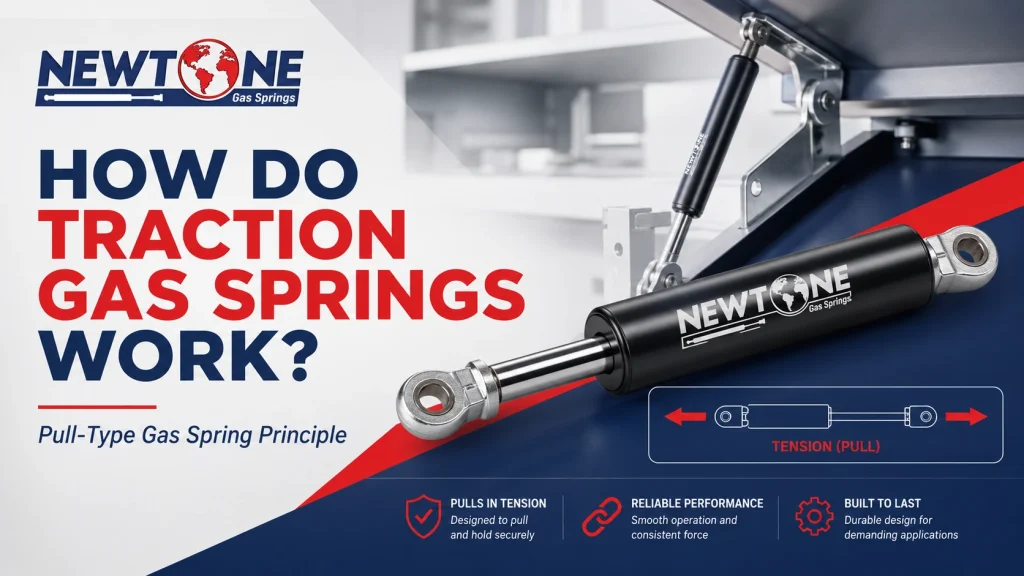
Traction Gas Spring Losing Force?
A diagnostic guide for OEM engineers, maintenance teams, and procurement staff trying to work out whether a pull-type gas spring has genuinely failed — or whether something else is going on.
- 1 Why Is My Traction Gas Spring Losing Force?
- 2 Four Things That Get Mistaken for a Failed Traction Gas Spring
- 3 When It’s a Real Failure: Formula Block
- 4 So Why Is My Traction Gas Spring Losing Force — For Real?
- 5 When It’s Not the Spring: Paired-Force Mismatch
- 6 Why Source Traction Gas Springs from Newtone
- 7 Why Source Traction Gas Springs from Newtone
- 8 Frequently Asked Questions
- 9 Conclusion
- 10 Get a Diagnosis or a Quote
Why Is My Traction Gas Spring Losing Force?
Why is my traction gas spring losing force? Most of the time, it’s a slow nitrogen leak past a worn seal — internal pressure drops a fraction at a time until, one day, the pull that used to feel firm just isn’t there. That’s the real failure mode. But a large share of the “it’s losing force” complaints we hear from customers turn out not to be a failed part at all. They’re a spring doing exactly what it was built to do — just in conditions, or a geometry, nobody accounted for.
That distinction matters more than it sounds like it should. Replace a perfectly good spring because it’s cold in the workshop, and the “fix” will feel weak too. Chase a mounting problem as if it’s a seal problem, and the real cause never gets addressed. This page walks through how to tell the two apart before you reach for a replacement part.
Who this page is for: maintenance engineers troubleshooting a pull-type gas spring in service, OEM engineers investigating a batch of early-return complaints, and procurement teams trying to decide whether a “failed” spring is actually a specification problem.
Four Things That Get Mistaken for a Failed Traction Gas Spring
Before assuming the worst, run the symptom against this table. A genuine seal or gas failure is only one of four common explanations — and it’s usually the easiest to rule in or out first.
| Symptom | Likely Cause | Genuine Failure? |
|---|---|---|
| Soft or absent pull at every temperature, every position | Nitrogen loss through a worn or damaged seal | Yes — replace |
| Noticeably weaker only on cold mornings, normal by afternoon | Temperature-driven pressure change (expected behavior) | No — normal |
| One side of a two-spring panel feels stronger than the other | Paired springs from mismatched production batches | No — spec issue |
| Panel never held properly, even brand new | Wrong force or wrong geometry from the original spec | No — design issue |
When It’s a Real Failure: Formula Block
Temperature is the variable people most often confuse with failure, so it’s worth quantifying. Gas spring force follows a near-linear temperature relationship:
F_T ≈ F_20 × [1 + 0.003 × (T − 20°C)]
Take a traction spring rated at 200 N (45 lbf) at 20°C (68°F). On a cold morning at −10°C (14°F), ΔT is −30°C:
F_T ≈ 200 × [1 + 0.003 × (−30)] = 200 × 0.91 = 182 N (41 lbf)
That’s a 9% drop — noticeable to a technician’s hand, well within tolerance, and not a fault. This behavior traces back to Gay-Lussac’s law (pressure and absolute temperature are directly proportional at constant volume), which is the physical reason gas spring force always tracks ambient temperature.
A genuine wear-out failure is a separate calculation. For planning purposes:
Service years ≈ Rated cycles ÷ cycles per day ÷ 365
A spring rated at 100,000 cycles, used 40 times a day on a production line, gives an expected service life of roughly 100,000 ÷ 40 ÷ 365 ≈ 6.8 years. If a spring is losing force at 18 months instead, the cause almost certainly isn’t ordinary wear-out — it’s contamination, incorrect force spec, or side-loading, and worth investigating rather than accepting as normal.
So Why Is My Traction Gas Spring Losing Force — For Real?
When it is a genuine failure, two mechanisms account for most cases. The first is straightforward seal degradation from normal aging — HNBR compounds resist UV and ozone well, but no seal lasts indefinitely under constant cycling. The second is more specific to traction springs and less obvious: because the rod sits retracted at rest and extends when the mechanism is in use, it’s exposed to dust, washdown fluid, or grit precisely while extended — and that contamination gets drawn back past the seal as the rod retracts.
We had a customer running traction springs on a food-processing line replace the same position three times in under a year, each time assuming a bad batch. The real cause turned out to be washdown residue collecting on the exposed rod every cycle and working past the seal on retraction — a material and sealing issue, not a manufacturing defect. Once the seal specification and rod finish were reviewed for that washdown environment, the replacement interval returned to normal.
If a traction spring operates somewhere the rod is regularly exposed to grit, wash-down chemicals, or salt air, that exposure — not the spring itself — is usually the root cause of early force loss.
When It’s Not the Spring: Paired-Force Mismatch
On any mechanism using two traction springs side by side, an uneven pull almost always means the pair isn’t force-matched — not that one has failed. Newtone manufactures to a ±5% force tolerance, but two springs pulled from different production runs, even both within spec individually, can still differ enough to feel lopsided on a wide panel. Request same-batch matched pairs for anything sensitive to balance; it costs nothing extra and removes this failure mode entirely.
Side-loading compounds the problem. Traction springs are built for axial pull only — if the mounting pivots drift out of the same plane as the mechanism moves, the rod takes lateral load it wasn’t designed for, and the seal wears unevenly on one side well before the rated cycle count. Keep both pivots aligned in the same plane of motion, and use ball-socket end fittings where the pivot angle changes through the stroke, rather than forcing a rigid eyelet to absorb misalignment.
Why Source Traction Gas Springs from Newtone
Why Source Traction Gas Springs from Newtone
We manufacture in-house in Turkey, which means tolerance, seal material, and batch traceability are under our control — not a distributor’s.
Frequently Asked Questions
The most common real cause is a slow nitrogen leak past a worn seal, which drops internal pressure a little at a time until the pull feels noticeably weaker. But not every “losing force” complaint is a true failure — cold weather, a mismatched paired spring, or a spring sized for the wrong geometry from the start can all feel identical to a worn-out unit.
No. Gas springs are sealed at the factory and are not designed to be refilled or recharged in the field. Once a unit has genuinely lost pressure through seal wear, replacement is the only reliable fix.
Gas spring force drops by roughly 0.3% per °C as temperature falls, because the internal gas pressure is temperature-dependent. A spring rated at 200 N (45 lbf) at 20°C (68°F) can measure around 9% lower on a cold morning. This is normal behavior, not a fault, and it should be accounted for at the specification stage rather than mistaken for a failing part.
Uneven pull between two springs on the same mechanism is almost always a force-tolerance mismatch, not a failure of either unit. Springs from different production batches can differ enough in force to create a noticeable imbalance. Paired springs should always be force-matched from the same batch, ideally within ±5%.
A gas spring rated for 100,000+ cycles used around 40 times a day should last roughly 6-7 years under normal conditions. If a spring is losing force well before that point, the likely cause is contamination reaching the seal, incorrect force specification, or side-loading from misaligned mounting — not simple end-of-life wear.
Conclusion
Not every complaint about a traction gas spring “losing force” is actually a failed part. Cold weather, mismatched pairs, and wrong-geometry specs all produce the same symptom as a genuine worn seal — and only one of those four is fixed by ordering a replacement. Run the symptom against the cause before assuming the worst.
If you’re seeing early returns, uneven pull, or a spring that never felt right from installation, send us the details — force rating, cycle count, operating environment, and how long it lasted. We’ll help work out whether it’s the part, the pairing, or the spec.
Get a Diagnosis or a Quote
Tell us what you’re seeing — force, environment, cycle count — and our engineering team will help pin down the actual cause before you order a replacement.