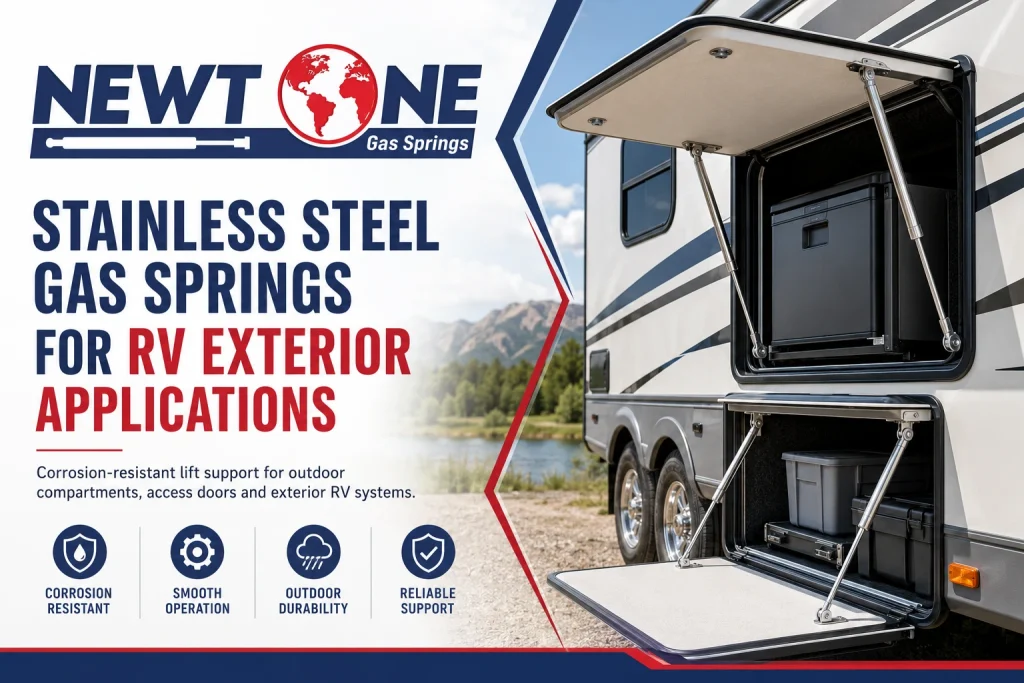
Why winter de-icing brine, not just marine saltwater, is the corrosion problem most compartment door struts actually face.
Gas springs for RV road salt exposure fail more often from winter de-icing brine than from cycle wear — magnesium and calcium chloride anti-icing chemicals cling to a vehicle’s underside far longer than dried rock salt, and they’re sprayed directly onto low-mounted compartment door struts by tire splash, even on an RV that’s garaged and never sees the coast. Most sizing guidance treats “road salt” as a footnote next to marine exposure. It shouldn’t be — the chemistry, the exposure pattern, and the fix are different.
This shows up every winter service season: struts and mounting screws on baggage and storage compartment doors, rusted enough to bind, seize, or strip out, on RVs whose owners never took them near saltwater. If your RV winters in a state that uses anti-icing brine on the highways, this is worth specifying for directly rather than assuming a marine-grade recommendation covers it.
- 1 Why Gas Springs for RV Road Salt Exposure Need a Different Approach
- 2 Service Life Under Brine Exposure: Cycles Aren’t the Limiting Factor
- 3 Mounting Gas Springs Away from Road Salt Splash
- 4 Material Selection for Road Salt vs. Marine Exposure
- 5 Frequently Asked Questions
- 6 Sourcing Gas Springs for Winter Road-Salt Regions
Why Gas Springs for RV Road Salt Exposure Need a Different Approach
Sodium chloride road salt was the old story. Most states and provinces now use magnesium chloride or calcium chloride brine for anti-icing, applied to the road surface before a storm arrives rather than after, specifically because it stays liquid at much lower temperatures than plain salt water. That same property is what makes it harder on a vehicle: it doesn’t dry out and blow off the way rock salt residue does. It stays wet, keeps absorbing moisture from the air, and remains chemically active on metal surfaces for days after the RV is off the road and parked.
A compartment door strut mounted low on the RV body — which is most of them, since baggage doors sit close to the wheel wells — sits directly in the splash zone where tires throw that brine upward. It doesn’t matter whether the RV ever sees an ocean. If it’s driven on treated winter roads and then parked, the struts and their mounting hardware are getting a chemical exposure that’s arguably more persistent than a boat hatch that gets rinsed by rain or a hose after every trip out.
Service Life Under Brine Exposure: Cycles Aren’t the Limiting Factor
Service-life framing
Service years ≈ Rated cycles ÷ Cycles-per-day ÷ 365
Worked example — a compartment door strut rated for 100,000 cycles, opened twice a day on average during active RV use:
Service years ≈ 100,000 ÷ 2 ÷ 365 = 137 years
That number is the point. Under normal RV use, a gas spring essentially never wears out from cycling — it would take well over a century of daily use to reach its rated cycle count. So when a compartment strut fails after five or six winters, cycle fatigue isn’t what killed it. Corrosion at the rod surface and seal interface is, and de-icing brine accelerates that timeline far faster than the mechanical rating would suggest.
Cold makes it worse in a second way, independent of corrosion: gas spring force drops roughly 0.3% per °C below the reference temperature. Take a 150 N (34 lbf) strut out to −15°C (5°F), a common winter-storage temperature in salt-belt states:
FT ≈ F20 × [1 + 0.003 × (T − 20)]
FT ≈ 150 N × [1 + 0.003 × (−15 − 20)] = 150 N × 0.895 = 134.3 N (30.2 lbf)
A roughly 10.5% force drop on its own is manageable if the strut was specified with margin. Stack that against a rod surface that’s already lost some of its seal-lubricating finish to brine pitting, and a door that felt fine in October can feel noticeably weak by February — for two compounding reasons, not one.
Mounting Gas Springs Away from Road Salt Splash
We worked with an RV service operation in a winter-salt region that was replacing baggage door mounting screws every one to two seasons — not the struts themselves, which still tested fine, but the fasteners holding the brackets. The screws were standard plated steel, mounted low on the body directly behind the front wheel path. Switching to stainless fasteners and moving the bracket mounting point a few centimeters higher, out of the direct splash line, stopped the recurring failure without any change to the strut itself.
That’s the practical takeaway: the strut body is rarely the first thing to go. Fasteners and brackets, especially plated or mild steel hardware paired with a stainless or black-nitrided strut, corrode first and faster, because they’re a smaller mass with a thinner protective layer. A few points worth building in:
- Where the door geometry allows it, keep the strut’s lower mounting point as high above the wheel path as the design permits — every few centimeters of clearance reduces direct splash exposure.
- Match bracket and fastener material to the strut. Mounting a stainless strut with plain plated screws creates a weak point that corrodes first and can eventually let the whole bracket work loose, even though the spring itself is fine.
- Mount the rod pointing down where possible, so oil stays at the seal — this is good practice generally, but it also means any brine that reaches the rod has less time sitting directly on the seal lip before gravity clears it.
- Allow drainage. A bracket pocket that traps and holds brine residue instead of letting it run off keeps the corrosion process active long after the road trip is over.
Material Selection for Road Salt vs. Marine Exposure
For most inland RVs that see road brine but not direct coastal air, a black nitrided rod (900–1000 HV, 20–30 µm treatment) with HNBR sealing is often sufficient, provided the mounting position keeps the strut reasonably clear of direct splash and the bracket hardware matches. For RVs stored or driven in states with heavy, prolonged brine application, or for any RV that also sees coastal use part of the year, stainless steel is worth reviewing — AISI 304 for general corrosion resistance, or 316 / 316L where exposure is more severe or combined with salt air. The right call depends on splash exposure, mounting height, and how many winter seasons the RV will see, not on a blanket “coastal or not” rule.
Most common spec mistake: assuming that because an RV never goes near the ocean, standard steel mounting hardware is fine anywhere on the exterior. Low-mounted compartment door brackets in the wheel-splash zone see a corrosion load that can rival or exceed marine exposure during a hard winter, and mismatched fastener material is usually what fails first.
Frequently Asked Questions
Do I need stainless steel gas springs if my RV never goes near saltwater?
Possibly, if the RV is driven on roads treated with de-icing brine and the strut is mounted low, in the splash zone. Magnesium and calcium chloride brine is chemically active on metal for longer than dried rock salt, so inland winter exposure can be a real corrosion driver even without any coastal use.
Why do my compartment door mounting screws rust faster than the strut itself?
Fasteners and brackets are usually a smaller mass with a thinner protective coating than the strut body, so they corrode first — especially plated steel screws mounted low near the wheel path. Matching fastener material to the strut and moving the mount point higher where possible both help.
Will my RV gas springs wear out from normal use before they corrode?
Under typical RV use, cycle wear is rarely the limiting factor — a 100,000-cycle strut opened twice a day would take well over a century to reach that count. In winter-salt regions, corrosion at the rod and seal interface is usually what ends service life, not mechanical fatigue.
Is road salt brine worse than seawater for gas springs?
It can be, in a specific way: anti-icing brine (magnesium or calcium chloride) is hygroscopic, meaning it keeps drawing in moisture and stays chemically active on a surface for days, rather than drying out or being rinsed away like a boat exposed to rain after a trip out. The exposure duration is often longer even if the total chloride load is lower.
Should I use black nitrided rod or stainless steel for road salt exposure?
Black nitrided rod with HNBR sealing is often sufficient for inland RVs where the strut is mounted clear of direct splash. Stainless steel (304, or 316/316L for heavier or combined marine exposure) is worth reviewing for low-mounted struts in states with heavy winter brine use.
Sourcing Gas Springs for Winter Road-Salt Regions
A compartment door strut on a winter-driven RV rarely dies from being opened too many times — it dies from what’s splashed onto it in a mounting position most designs never account for. Spec the fastener material and mounting height with the same care as the strut itself, and the corrosion clock stops being the thing that decides replacement.