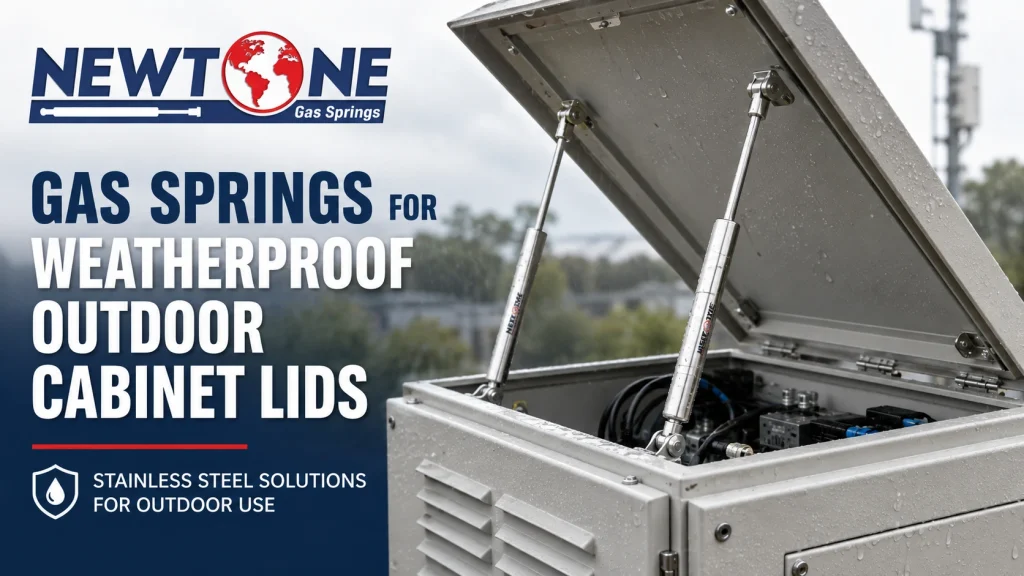
Force sizing, seal selection, and mounting orientation for lids that live outdoors — sun, rain, and temperature swings included, not designed around.
Gas springs for weatherproof cabinet lids typically run 60–250 N (13–56 lbf) per spring, sized from the lid’s weight and geometry, then adjusted for the actual surface temperature the lid reaches in service — not just the shaded air temperature on a datasheet. A telecom cabinet on a rooftop, a control enclosure on a utility pole, or an equipment box beside a field access road all share the same problem: the lid sits outside, unprotected, and has to open the same way in January frost as it does after eight hours of direct August sun. Get the force wrong in either direction and the technician standing under it notices immediately — a lid that won’t stay up, or one that slams down on its own.
Sizing Gas Springs for Weatherproof Cabinet Lids: Force, Geometry, and a Worked Example
The governing relationship for a hinged, top-opening cabinet lid is a moment balance around the hinge: the spring has to generate enough torque to counter the lid’s own weight at whatever angle you want it to hold. Get the geometry into the equation correctly and the force number falls out on its own — guessing at it, or copying a number off a similar-looking product page, is how lids end up either creeping shut on their own or requiring two hands to close.
Moment balance about the hinge:
F = (W × Lg × cos φ) ÷ (n × r)
W = lid weight (N) · Lg = hinge-to-center-of-gravity distance · φ = load-arm angle above horizontal at the hold-open point · n = number of springs · r = spring’s perpendicular moment arm
Worked example — a mid-size telecom equipment cabinet lid:
Lid mass: 7 kg → W = 7 × 9.81 = 68.7 N (15.4 lbf). Hinge-to-CoG distance Lg = 350 mm (13.8 in). Hold-open angle 75° above horizontal, so cos 75° = 0.259. Two springs (n = 2), each with a perpendicular moment arm r = 40 mm (1.6 in).
F = (68.7 × 350 × 0.259) ÷ (2 × 40) = 6,228 ÷ 80 ≈ 77.8 N (17.5 lbf) per spring, calculated at a 20°C bench reference. That’s the starting number — but for a lid that lives outside, it isn’t the finishing number.
Why Gas Springs for Weatherproof Cabinet Lids Need More Than an Ambient Rating
Every gas spring datasheet gives you a force at 20°C and a temperature coefficient to adjust from there — roughly 0.3% force change per °C, since the internal nitrogen charge follows the same pressure-temperature relationship as any sealed gas. Most application pages stop at that point and tell you to plug in the ambient air temperature for your climate. For an indoor part, that’s close enough. For a lid sitting outdoors in direct sun, it understates the real number, because the lid’s surface and the surrounding air are not the same temperature.
A dark, unshaded panel absorbs solar radiation on top of whatever the air is doing, and the skin temperature of that panel commonly runs well above the shaded air reading — a widely used rule of thumb in outdoor enclosure design puts that gap at roughly 25–40°C above ambient on a still, sunny day, depending on color and material. Take the worked example above and run both numbers:
- Sized off a 40°C ambient air maximum: F = 77.8 × [1 + 0.003 × (40 − 20)] = 77.8 × 1.06 ≈ 82.5 N (18.5 lbf)
- Sized off a realistic 65°C skin temperature in full sun: F = 77.8 × [1 + 0.003 × (65 − 20)] = 77.8 × 1.135 ≈ 88.3 N (19.8 lbf)
Those two figures are about 7% apart — inside a spring’s own ±5% manufacturing tolerance, that gap doesn’t just eat into the margin, it can push a marginal design past it. On the cold end, the same lid at a −10°C morning ambient drops to F = 77.8 × [1 + 0.003 × (−10 − 20)] = 77.8 × 0.91 ≈ 70.8 N (15.9 lbf) — so the real operating window for this lid, sun to frost, spans roughly 71–88 N, not the narrower band an ambient-only calculation would suggest. Add a safety-factor surcharge of 1.15 for wind gust loading on an exposed outdoor lid, and the design point lands near 102 N (22.9 lbf) per spring, which is the figure to hand to engineering support when requesting a matched pair.
This is also where a preventable warranty issue tends to start. Newtone has seen field cases where an outdoor cabinet OEM specified force purely from an ambient air rating, without accounting for the lid’s own solar-heated skin temperature. The lid closed slightly under-lifted in the hottest months, resting with the rod carrying a bit of constant static preload at the closed position — and constant preload on a rod under UV and ozone exposure is exactly the condition that accelerates seal cracking, since a compressed seal has more stored stress for the ozone to attack. The failures didn’t show up in testing; they showed up eighteen months into the field, as early warranty claims traced back to a force spec that was correct for the datasheet and wrong for the actual cabinet.
The most common spec mistake on this application: pulling the force number from a spring’s 20°C rating or a generic ambient range, without correcting for the lid’s real surface temperature in full sun. It’s a small-looking gap on paper and a real one in the field, especially once you’re inside a ±5% tolerance band to begin with.
Mounting Orientation for Outdoor, Weather-Exposed Lids
Orientation matters more outdoors than it does inside a dry enclosure, because there’s an extra variable: where does water go when it lands on the spring. The default rule still applies first — mount with the rod pointing down in the closed position, so the internal oil film stays on the seals by gravity rather than draining away from them, which keeps damping consistent and extends seal life.
Top-hinged outdoor lids don’t always allow that. When the lid geometry forces the rod to point up in the closed position, the fix isn’t to avoid gas springs — it’s to orient the gland so the seal line sheds water rather than collecting it, and to check that the mounting bracket itself doesn’t form a small basin where rain sits against the rod. A rod that’s merely wet dries out; a rod that sits in standing water for days at a time is a different problem. Keep both pivot points in the same plane of motion, as with any gas spring installation — side load shortens life fast, and an outdoor lid catching wind gusts is more likely to see an off-axis load than an indoor one ever will.
Standard Black-Nitrided Rod or Stainless Steel?
Black nitrided rod + HNBR
The right default for most outdoor cabinet lids. The rod treatment (900–1000 HV, 20–30 µm) resists ordinary weather exposure, and HNBR seals are UV and ozone resistant by material choice, not as an upgrade. This covers the large majority of telecom, utility, agricultural, and general industrial outdoor enclosures.
Stainless steel
Specify it for coastal installations, marine-adjacent sites, washdown environments, or anywhere de-icing salt is in regular contact with the hardware. Salt is a corrosion driver a black nitrided rod isn’t built to resist indefinitely, regardless of how good the seal compound is — the material call is about the rod substrate, not the seal.
When a Locking Gas Spring Makes Sense
A standard gas spring holds a lid open under normal conditions, but it’s still a spring — a hard bump or a strong gust can move it. For cabinets that get opened for actual service work, with a technician’s hands or head under the lid, that’s a real consideration, not a theoretical one. A locking gas spring gives a positive, hands-free hold at the set position that won’t drift or drop until it’s deliberately released, which turns “the lid is open” into “the lid is secured open.” It’s the right call for telecom equipment cabinets, utility control boxes, and any outdoor enclosure where maintenance access happens more than occasionally. For a lid that’s opened briefly to check a gauge or flip a switch, a standard spring is enough.
Specification Quick Reference
| Lid size class | Approx. lid area | Typical force per spring | Springs | Notes |
|---|---|---|---|---|
| Small | < 0.3 m² (3.2 ft²) | 60–90 N (13–20 lbf) | 1 | Junction and small control boxes |
| Medium | 0.3–0.6 m² (3.2–6.5 ft²) | 70–120 N (16–27 lbf) | 2, batch-matched | Typical telecom / utility cabinet lid |
| Large | 0.6–1.0 m² (6.5–10.8 ft²) | 100–180 N (22–40 lbf) | 2, batch-matched | Consider a locking spring for service access |
Paired-spring lids need batch-matched springs within ±5% of each other, not just individually within tolerance of the target force — two springs from different batches can each be in spec on their own and still lift a lid crooked if their forces sit at opposite ends of the tolerance band.
Why Source Outdoor Cabinet Lid Gas Springs From Newtone
Manufactured, Not Distributed
Production in Turkey, exported to 60+ countries, with the same platform serving new-build OEM programs and long-term aftermarket replacement.
HNBR Seals as Standard
UV and ozone resistance built into the default seal spec for outdoor and exposed applications, not offered as a paid upgrade.
Engineering Support
Force and geometry calculation, including temperature and solar-load adjustments, is available for lid-specific sizing — not a generic catalog lookup.
Fast Response
Response within 5 business hours for quotes, spec questions, and paired-spring matching requests.
Frequently Asked Questions
What force gas spring do I need for a weatherproof outdoor cabinet lid?
Most weatherproof outdoor cabinet lids need 60–250 N (13–56 lbf) per spring, but the correct number comes from the lid weight, the hinge-to-center-of-gravity distance, the hold-open angle, and the spring’s mounting position, not from a generic catalog figure. A moment-balance calculation around the hinge gives the base force, which is then adjusted for the temperature the lid will actually see in service.
Do outdoor cabinet lid gas springs need stainless steel?
Not automatically. A black nitrided rod with HNBR seals is UV and ozone resistant and holds up fine in ordinary outdoor exposure. Stainless steel becomes the right call specifically for coastal, marine, washdown, or de-icing-salt environments, where a standard rod would pit over time regardless of how good the seal is.
Which way should the gas spring be mounted on an outdoor lid?
As a default, mount the spring with the rod pointing down when the lid is closed, so gravity keeps the internal oil film on the seals rather than draining away from them. On lids where the geometry forces the rod to point up in the closed position, orient the gland so any water that reaches the rod sheds away from the seal line rather than pooling against it, and confirm the bracket doesn’t create a low point where water can sit.
How does direct sunlight affect gas spring force on an outdoor cabinet?
A dark, unshaded lid can run significantly hotter than the surrounding air, since it is heated by direct solar radiation on top of ambient temperature. Sizing off the air temperature alone can understate the actual operating force by several percent, which matters when the spring’s force tolerance is already tight. The lid’s realistic surface temperature, not the shaded ambient reading, is the number to design against.
Should an outdoor cabinet lid use a locking gas spring?
Locking gas springs are worth specifying whenever a technician needs to work under the open lid, for example during service or component swaps on telecom, utility, or control cabinets. A standard gas spring holds the lid open under normal load, but a locking spring gives a positive, hands-free hold that won’t drift closed if the lid gets bumped or catches a gust of wind.
Ready to Spec Your Cabinet Lid Gas Springs?
Getting a weatherproof cabinet lid right means sizing for the temperature the lid actually reaches, not the one on a weather report, and matching seal material and mounting orientation to real outdoor exposure. Newtone’s engineering support can work through the geometry, temperature range, and paired-spring matching for your specific cabinet.