Locking Gas Springs
Both are sold with the word “locking” somewhere in the description. They solve two different problems — here’s the mechanical difference and how to pick the right one.
Click and Go vs Locking Gas Springs: The Short Answer
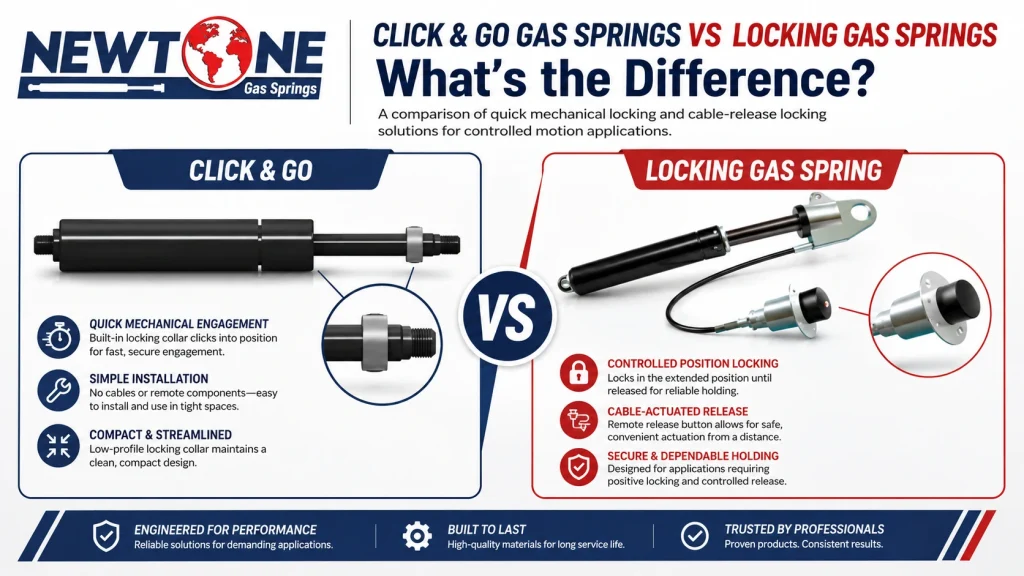
Click and go vs locking gas springs comes down to one mechanical fact: a click and go gas spring locks in exactly one position — fully compressed — and releases with a light push to extend fully on its own, while a locking gas spring can be arrested at virtually any point along its stroke using a push button, lever, or cable. They’re often grouped together because both are marketed with the word “locking” somewhere on the spec sheet, but they answer different questions: one gives you a single convenient snap-open action, the other gives you continuous, held-position control.
This mix-up comes up more often than it should. We’ve had OEM engineers specify a click and go unit for an application that actually needed the panel to stop and hold at a chosen angle for maintenance access — and that’s a mismatch you don’t want to discover after tooling. At Newtone Gas Springs, we manufacture both product lines, and the two get confused often enough that this comparison is worth spelling out plainly.
Who this page is for: OEM engineers choosing between click and go and locking gas springs for a new mechanism, procurement teams sourcing a replacement and unsure which category the original part falls into, and anyone who’s seen both terms used interchangeably in a supplier catalog and wants the actual difference.
Side-by-Side: Click and Go vs Locking Gas Springs
The clearest way to see the difference is mechanism against mechanism, not marketing description against marketing description.
| Characteristic | Click & Go Gas Spring | Locking Gas Spring |
|---|---|---|
| Lock positions | One — fully compressed | Virtually any point along the stroke |
| Locking mechanism | Mechanical latch (push-pen action) | Internal valve, gas or oil-controlled |
| Release method | Light push on the rod — no external system | Push button, lever, or Bowden cable |
| Typical behavior | Push to unlock, extends fully on its own | Held open or closed at any chosen point until released |
| Best suited to | Two-state components: closed or fully open | Adjustable positioning, hold-open safety, ergonomic settings |
The Physics: Why One Locks Anywhere and the Other Locks Once
A locking gas spring can hold position anywhere on its stroke because of how internal gas pressure behaves, not because of a more elaborate mechanical part. The relationship is Boyle’s Law:
Pressure at Any Stroke Position
P1 × V1 = P2 × V2
As the rod is pushed in, the internal gas volume drops and pressure rises proportionally. A locking gas spring’s valve can close at the exact moment the user releases the button — trapping whatever gas volume, and therefore whatever pressure and holding force, exists at that instant.
Worked example: take a gas spring extending fully at F1 = 150 N (34 lbf), with a typical progression ratio (K) of about 1.3, meaning force at full compression runs to roughly F2 = F1 × K ≈ 195 N (43.8 lbf). A locking gas spring’s valve can trap gas at any point in between — release the button halfway through the stroke and the holding force locks in somewhere around 170 N (38 lbf), depending on the exact volume at that position. A click and go spring’s mechanical latch, by contrast, only ever engages at one physical point: the fully compressed end, where the force sits at roughly F2. It doesn’t have a valve to trap an intermediate pressure state — it has a latch that catches at one spot, full stop.
This is the actual mechanical reason the two products aren’t interchangeable. It isn’t that one is a “better” or “cheaper” version of the other — a click and go spring is intentionally simple because most furniture pop-open and cargo-lid applications only ever need two states, closed and open. A locking gas spring carries the added valve mechanism because the application genuinely needs a range of held positions.
Choosing Between Them
⬤ Choose Click & Go When
- The component only ever needs two states: closed or fully open
- A single push-to-release action is the desired user experience
- No external release system (button, lever, cable) should be needed
- Typical fit: recliners, adjustable beds, foldable tables, pop-up lids
- No pull force will be applied once the spring is in the extended position
⬤ Choose a Locking Gas Spring When
- The component needs to hold securely at more than two positions
- Ergonomic or maintenance access requires a range of held angles
- A dedicated release (button, lever, or Bowden cable) fits the operating pattern
- Typical fit: exam tables, adjustable seating, machine guards, access panels
- Rigid or elastic locking characteristics can be matched to the application
A Note on Terminology
Part of the confusion is that both products get described with locking language. Click and go is genuinely an integrated locking mechanism — it locks the rod, just only at one point, and the “click” refers to the same detent action as a retractable ballpoint pen. A locking gas spring uses a different kind of lock entirely: an internal valve system, available in rigid locking (minimal movement once locked, best for maximum positional stability) or elastic locking (a small amount of give under load, sometimes preferred for comfort in seating applications). When a spec sheet just says “locking,” it’s worth confirming which mechanism is actually being described before ordering.
One caution specific to click and go units: because there’s no valve to compensate for extra load once the rod is extended, pulling on the component after it reaches full extension isn’t recommended — the mechanism is built for push-to-release and free extension, not for bearing additional force in the open state. If an application involves someone pulling on the panel once open, a locking gas spring’s valve-held position is the more appropriate choice.
Why OEMs Source Both Product Lines from Newtone
We manufacture click and go and locking gas springs from the same platform, so switching between them during design doesn’t mean switching suppliers.
Frequently Asked Questions
A click and go gas spring has a single fixed lock point at full compression, released with a light push and extending fully on its own. A locking gas spring uses an internal valve that can arrest the rod at virtually any point along the stroke, released by a button, lever, or cable. One offers one lock position; the other offers a continuous range.
No. Click and go gas springs only latch at full compression. Once released, the rod extends fully on its own momentum and has no mechanism to arrest at an intermediate point. If a partially open, held position is required, a locking gas spring is the correct product.
Push buttons, levers, and Bowden cable systems are the standard release methods, with custom release configurations available for specific OEM requirements. The choice depends on where the user needs to actuate the release relative to the gas spring’s mounting position.
No, even though both are sometimes marketed with the word locking. A click and go gas spring is a single-position mechanical latch. A locking gas spring is a multi-position, valve-controlled device. They solve different problems and shouldn’t be treated as interchangeable terms.
Choose click and go for applications where the component only ever needs two states, fully closed and fully open, and convenience of a single push-to-release action matters. Choose a locking gas spring where the component needs to be held securely at a range of positions, such as adjustable furniture, medical equipment, or maintenance access points.
Conclusion
Both products lock. Neither is an upgrade of the other. The real question is how many states your mechanism needs — if it’s genuinely closed-or-open, click and go gives you that with the simplest possible operation. If it needs to stop and hold anywhere in between, that’s what the locking gas spring’s valve is built for. Getting this right before tooling avoids exactly the kind of mid-project mismatch we see when a spec sheet’s use of “locking” gets taken at face value.
If you’re not sure which category your application falls into, describe how the component needs to behave — how many held positions, what triggers the release — and we’ll confirm which product actually fits.
Get the Right Mechanism Recommendation
Tell us how your mechanism needs to move and hold. Our engineering team will confirm whether click and go, a locking gas spring, or another configuration fits — before you commit to tooling.