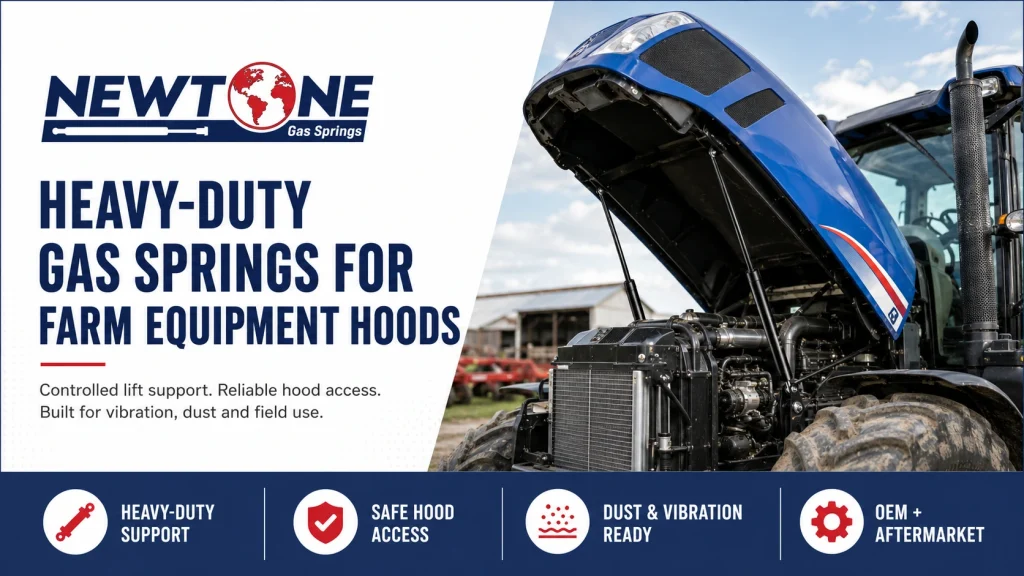
Gas springs for farm equipment hoods should be selected by hood weight, hinge-to-centre-of-gravity distance, spring mounting geometry, vibration exposure, service position and whether a mechanical hold-open backup is required. A heavy-duty hood gas spring is not correct just because it has a high Newton rating; if the force is too high, or the brackets are poorly positioned, the hood skin, hinge or mounting plate can fail before the gas spring does.
Farm equipment hoods live a harder life than ordinary vehicle hoods. A tractor engine hood may be opened in a cold yard before sunrise, closed after a dusty service job, then spend the day vibrating over uneven ground. A combine or sprayer service hood may be wide, flexible and mounted on light sheet metal or composite structure. The right gas spring must make the hood lift with control, hold open safely and close without overloading the machine.
Why Gas Springs for Farm Equipment Hoods Need More Than High Force
Gas springs for farm equipment hoods need more than high force because agricultural hoods are exposed to vibration, dust, mud, temperature swings and repeated service access. More force can lift a hood, but it can also make the hood harder to close and increase load around the hinge and bracket area.
The hood itself is often the limiting part of the system. A steel hood, plastic hood or composite engine cover may have local reinforcement near the bracket, but that reinforcement is not unlimited. If the gas spring force is too high, or if the spring angle creates a poor moment arm, the mounting area can flex, crack or pull out over time.
The better specification starts with the hood geometry. Hood weight matters, but the centre of gravity, open angle, bracket distance, number of springs and effective moment arm decide the real force. A smaller spring in a better mounting position can outperform a stronger spring in the wrong position.
Why Farm Equipment Hoods Fail at the Mounting Points Before the Gas Spring Fails
Farm equipment hoods often fail at the mounting points before the gas spring fails because the bracket area carries every opening cycle, every vibration event and every closing shock. If the hood structure is thin, cracked, unsupported or already stressed by a stiff hinge, a stronger replacement strut can make the problem worse.
This is a common mistake in aftermarket replacement. A dealer or repair shop finds a gas spring with similar length and chooses a higher force because the old hood felt weak. The part fits, but the hood now pushes harder against the bracket and closes with more resistance. The owner sees lift support; the sheet metal sees extra stress.
We see this type of case when a replacement looks right on paper but the hood behavior gets worse. The stroke is close, but the force is not matched to the original geometry, the hinge is stiff from dirt or corrosion, and the bracket sees the combined load. The fix is not simply “use a bigger spring.” It is to match force, stroke, end fittings, bracket plane and hinge condition as one system.
Where Heavy-Duty Hood Gas Springs Are Used on Farm Equipment
Heavy-duty hood gas springs are used on tractor engine hoods, combine service hoods, sprayer engine covers, forage harvester panels, battery covers, cooling-system access lids and large agricultural service covers. The common requirement is controlled access to heavy or awkward components.
A tractor hood usually needs one-hand lift support and safe open-position holding during inspection. A combine service hood may need paired springs because the panel is wide and flexible. A sprayer hood may need material review because chemical exposure and washdown can reach the rod, fittings or brackets.
Not every farm hood needs the same gas spring. A compact tractor hood and a large harvester engine cover may both be “farm equipment hoods,” but their weight, hinge line, mounting space, vibration level and service posture can be completely different. The product label should follow the machine geometry, not the other way around.
Force Calculation for Gas Springs for Farm Equipment Hoods
The first force calculation for a hinged farm equipment hood is the moment balance about the hinge. Hood weight alone is not enough because the hinge-to-centre-of-gravity distance and spring moment arm decide how much force each gas spring must provide.
Formula:
F = (W × Lg × cos φ) ÷ (n × r)
Where:
F = required force per gas spring
W = hood weight in Newtons
Lg = hinge-to-centre-of-gravity distance
φ = hood angle above horizontal
n = number of gas springs
r = effective perpendicular moment arm of the gas spring
First convert hood mass to Newtons:
W = m × g
Example: a heavy farm equipment hood weighs 42 kg (93 lb). The centre of gravity is 600 mm (23.6 in) from the hinge. The hood is checked at a 55° open angle. Two gas springs are used, and each spring has an effective perpendicular moment arm of 180 mm (7.1 in).
W = 42 × 9.81 = 412 N (93 lbf)
F = (412 × 0.60 × cos55°) ÷ (2 × 0.18)
F = 142 ÷ 0.36 = 394 N per spring (89 lbf per spring)
With a moderate agricultural service factor of 1.2 for vibration, dirt, hinge friction and field variation:
F_design = 394 × 1.2 = 473 N per spring (106 lbf per spring)
This does not mean every farm equipment hood needs 473 N (106 lbf). It means this specific hood geometry points to that range. Moving the bracket to increase the moment arm may reduce the required force. Moving it poorly may require more force and load the hood structure harder.
Single vs Paired Gas Springs for Farm Equipment Hoods
Single gas springs can work on narrow or lighter farm equipment hoods, but paired gas springs are usually better for wide, heavy or flexible hoods. Two springs spread the load and reduce twisting across the hinge line.
Paired springs must be force-matched. If one side is stronger, the hood can lift unevenly and load one hinge or bracket harder than the other. On a farm machine, that imbalance is amplified by vibration, uneven ground and repeated service cycles.
Newtone controls gas spring force tolerance at ±5%, which supports repeatable paired behavior. For OEM production, matched springs from the same platform are cleaner than mixing parts that only share a nominal Newton rating. For aftermarket replacement, paired springs should usually be replaced together when hood balance matters.
Mounting Guidance for Farm Equipment Hood Gas Springs
Farm equipment hood gas springs should be mounted so the rod moves axially through the stroke, not sideways. Both pivots should stay in the same plane of motion, and the end fittings should allow the angular movement required by the hood.
Where the geometry allows it, mount the gas spring with the rod pointing down in the at-rest or closed position. This helps keep oil near the seal and supports smoother damping. On equipment exposed to dust and vibration, protecting the rod-seal interface matters.
The lower body-side pivot is especially important. Moving that pivot changes the effective moment arm and can change the required force more than many people expect. If the hood is hard to close or does not stay open, the bracket location should be reviewed before simply increasing the gas spring force.
The gas spring should not be used as the hard stop unless the design has been reviewed for that purpose. A hood needs a proper structural stop or hinge limit where required. If the spring bottoms out before the hood reaches its intended stop, the rod, guide, seal and brackets can see shock loads.
Vibration, Dust, Mud and Cold Starts
Farm equipment hood gas springs must be specified for vibration, dust, mud and temperature swings because agricultural machines work in conditions that shorten weak gas spring installations. A hood may be opened only a few times per day, but the spring still spends thousands of hours mounted on a vibrating machine.
Dust and mud can contaminate the rod area. If abrasive material reaches the rod-seal interface, seal wear increases. Vibration can loosen brackets or amplify small misalignments. Cold weather can make the same gas spring feel weaker, because gas spring force changes by about 0.3% per °C.
The approximate temperature relationship is:
F_T ≈ F_20 × [1 + 0.003 × (T − 20°C)]
A 500 N (112 lbf) gas spring specified at 20°C (68°F) may feel about 470 N (106 lbf) at 0°C (32°F). That does not mean the spring failed. It means hood support should be reviewed at the real operating temperature, especially for machines used in cold mornings and hot engine compartments.
When to Specify Locking Safety or Stainless Steel
Locking safety should be reviewed when a farm equipment hood must stay open while a technician works under or near it. A standard gas spring supports the hood, but it is not a mechanical safety lock. If unexpected closing could injure a person or damage components, a locking gas spring or safety tube deserves review.
For many tractor and combine hoods, a standard compression gas spring is enough when the hood has suitable geometry and the service position is not hazardous. For heavy top-hinged hoods, elevated service covers or panels used during longer maintenance work, mechanical backup becomes more important.
Stainless steel gas springs should be reviewed for coastal farms, fertilizer exposure, chemical-handling areas, sprayers, washdown zones and high-humidity storage. For most general agricultural hoods, Newtone’s black nitrided rod with HNBR sealing is a strong standard solution. The surrounding brackets, pins and fasteners should be reviewed with the same environmental logic.
Common Specification Mistakes
The first mistake is choosing gas springs for farm equipment hoods by force label alone. A higher Newton rating can lift the hood, but it can also make closing harder and increase stress around the brackets.
The second mistake is matching only extended length and compressed length during replacement. Length matters, but force, stroke, end fittings and bracket geometry matter just as much. A same-length gas spring can behave very differently if the force is wrong.
The third mistake is ignoring hinge condition. A stiff or dirty hinge can make a good gas spring feel weak. Adding force may hide the hinge problem while increasing hood structure load. The hinge should move freely before the gas spring specification is blamed.
Other mistakes include replacing only one spring of a paired hood, allowing side-load at the rod, using weak brackets on heavy hoods, mounting the rod upward where rod-down is possible and using a standard spring where service safety needs a mechanical hold-open backup.
Farm Equipment Hood Gas Spring Specification Checklist
| Specification point | Why it matters |
|---|---|
| Hood weight | Defines the supported load, but does not determine force by itself. |
| Hinge-to-CG distance | Controls the closing moment around the hinge. |
| Spring moment arm | Often changes required force more than the hood weight does. |
| Single or paired layout | Wide hoods usually need matched pairs to avoid twisting. |
| Bracket reinforcement | Prevents hood skin or mounting plate damage under repeated load. |
| Rod orientation | Rod-down mounting helps keep oil near the seal where geometry allows it. |
| Environment | Dust, mud, vibration, cold starts and washdown affect real service life. |
| Safety requirement | Locking support should be reviewed when technicians work under a raised hood. |
Why Source Farm Equipment Hood Gas Springs from Newtone?
Manufacturer, Not Distributor
Newtone manufactures gas springs in Turkey and exports to more than 60 countries for OEM and aftermarket applications.
Heavy-Duty Application Review
Engineering support is available for hood force, stroke, mounting points, paired springs, brackets and safety requirements.
Controlled Components
HNBR sealing, black nitrided rods, ±5% force tolerance and 100,000+ cycle capability support repeatable performance.
OEM + Aftermarket Supply
Newtone can support original equipment programs and replacement supply from the same manufacturing platform.
Frequently Asked Questions About Gas Springs for Farm Equipment Hoods
How do you choose gas springs for farm equipment hoods?
Choose gas springs for farm equipment hoods by checking hood weight, hinge-to-centre-of-gravity distance, opening angle, number of springs, bracket position, stroke, end fittings, vibration exposure and whether mechanical hold-open safety is required.
Are heavy-duty gas springs always better for tractor hoods?
No. A stronger gas spring is not automatically better. Too much force can make the hood hard to close and increase stress around hinges, brackets and hood mounting points. Correct geometry is usually better than simply adding force.
Should farm equipment hoods use one gas spring or two?
Narrow and lighter hoods may use one gas spring. Wide, heavy or flexible tractor, combine and sprayer hoods usually work better with two matched gas springs because paired support reduces twisting and uneven hinge load.
Do farm equipment hood gas springs need stainless steel?
Not always. General farm equipment hoods can often use black nitrided rods with HNBR seals. Stainless steel should be reviewed for coastal farms, sprayer applications, fertilizer exposure, washdown areas and high-humidity storage.
When should locking gas springs or safety tubes be used on farm equipment hoods?
Locking gas springs or safety tubes should be reviewed when a technician works under or near a raised hood, or when unexpected closing could cause injury or component damage. A standard gas spring supports motion, but it is not a mechanical safety lock.
Final Engineering Takeaway
Gas springs for farm equipment hoods should be specified as part of the hood system, not selected as loose replacement hardware. The correct design balances hood weight, hinge geometry, bracket strength, force tolerance, vibration exposure, temperature behavior and service safety.
For tractors, combines, sprayers and heavy agricultural machinery, the safest specification is practical: correct force, clean bracket geometry, rod-down mounting where possible, matched pairs on wide hoods, suitable sealing and locking support when a technician needs secure access. Newtone can review hood gas springs with your machine geometry so the hood opens smoothly, holds safely and does not punish the hinge.