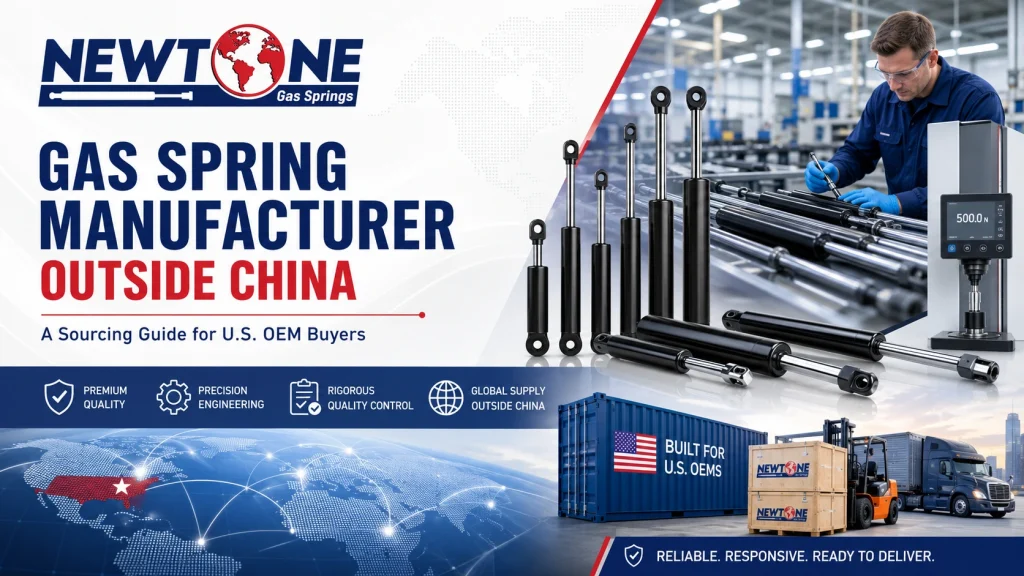
Gas Spring Manufacturer
Outside China
A practical guide for U.S. OEM buyers and procurement teams reviewing Turkey-based gas spring manufacturing as part of a China+1 or China-alternative sourcing strategy.
What Makes a Credible Gas Spring Manufacturer Outside China
A credible gas spring manufacturer outside China needs to prove three things a buyer can actually verify: it owns the production line rather than reselling someone else’s output, it can document force tolerance tighter than the ±10–15% common among commodity suppliers, and it can trace any given spring back to a specific production batch. Turkey has become one of the manufacturing bases U.S. OEM buyers are now reviewing for these reasons, alongside Vietnam, India, and parts of Eastern Europe.
This isn’t a theoretical exercise anymore. Procurement teams that spent a decade treating “gas spring supplier” as a commodity line item on a bill of materials are now running formal supplier-qualification projects for a part that used to get a one-line purchase order. At Newtone Gas Springs, we’ve been on the receiving end of a steady increase in these inquiries over the past two years — RFQs from OEM engineers and procurement managers who are qualifying a second or third source, not replacing anything overnight, but building the option to shift volume if they need to.
Who this page is for: U.S. and EU-based OEM procurement managers evaluating supply diversification, engineers who need a second qualified source for gas springs already specified against a Chinese supplier, and distributors comparing manufacturing partners outside China.
Why U.S. Buyers Are Reviewing Supply Outside China
The honest answer is not a single tariff percentage — it’s the volatility itself. Trade policy affecting China-origin goods has changed direction more than once in the past year, including a Supreme Court ruling in early 2026 that struck down one major tranche of tariffs on legal grounds, followed by a replacement tariff structure under separate statutory authority with its own expiration clock. Specific rates published six months ago are frequently out of date by the time a purchasing decision gets made. That instability is, on its own, a legitimate reason to qualify a second source: a landed-cost model that depends on one country’s current tariff schedule is a model that can break on short notice.
Layer onto that the more familiar risks — shipping transit times of five to seven weeks from Chinese ports versus two to three weeks from Turkey to U.S. East Coast ports, freight rate spikes during peak season, and the general preference among boards and CFOs for supply chains with redundancy built in — and the case for reviewing a non-China source stops being political and starts being ordinary risk management. Most of the procurement teams we talk to aren’t trying to exit China entirely. They’re building a qualified second source so a single country’s policy or logistics disruption doesn’t stop production.
China Alternative Does Not Just Mean a Lower Tariff Number
Buyers who source purely on landed-cost spreadsheets often qualify a new country and then discover the real problem was never the tariff line — it was verifying that the new supplier can hold a spec consistently, order after order. A gas spring that meets print on the first sample lot and drifts on the fifth reorder costs more in warranty claims and line-down time than any tariff saved sourcing it elsewhere. The tariff conversation gets the RFQ started; supplier qualification is what actually determines whether the switch works.
That’s the gap in most “sourcing alternatives to China” content available online right now — it’s written for private-label consumer goods and Amazon sellers, where a slight cosmetic variance between batches is tolerable. It doesn’t hold up for a precision mechanical component like a gas spring, where force output, seal life, and dimensional tolerance directly affect how a hatch, panel, or access door behaves in the field.
What to Check in a Gas Spring Manufacturer Outside China
Before sending an RFQ to any non-China supplier, verify these directly rather than taking a sales page’s word for it:
- Do they own the production facility, or are they a trading company placing orders with a factory they don’t control?
- What is the stated force tolerance, and is it demonstrated with batch test data — not just a datasheet claim?
- Can a specific unit be traced back to its production batch if a field issue comes up?
- Do they support custom force, stroke, and end-fitting configuration, or only a fixed catalog?
- Will they work from a technical drawing and dimensions, or only from an existing sample to copy?
- What seal compound and rod treatment do they use as standard, and is it suited to the exposure environment?
- What is their realistic response time on a technical question — hours or days?
A supplier that can’t answer the first two questions plainly is a trading company, whatever the website says. That distinction matters more to consistency than the country it’s based in.
Why Turkey Is a Practical Sourcing Base for Gas Springs
Turkey sits inside the EU Customs Union for industrial goods and has direct shipping lanes into U.S. East Coast and Gulf ports, typically putting ocean transit in the two-to-three-week range rather than the five-to-seven weeks common from Chinese ports to the U.S. West Coast plus inland freight. It also has a mature precision-manufacturing base — automotive component and industrial hardware production has been established there for decades, which means the machining, heat-treatment, and quality-control infrastructure a gas spring needs already exists locally rather than needing to be built from scratch.
None of that replaces supplier vetting. A manufacturing base being practical doesn’t make every factory in it qualified — the same diligence applies whether the candidate is in Turkey, Vietnam, or Poland. What Turkey offers is a reasonable starting shortlist for U.S. and EU buyers on transit time and industrial maturity; it’s still on the buyer to confirm the specific supplier meets the checklist above.
Manufacturer or Trading Company: Why Production Control Decides Consistency
The real alternative to a China-only supply chain is not a country. It’s a controlled manufacturing system — one where the same company that quotes the order also owns the tooling, runs the tolerance checks, and can tell you which production run a given part came from. A trading company can offer a lower quoted price on the first order because it’s shopping the job across multiple factories to whichever one is cheapest that month. What it usually can’t offer is the same factory, the same tooling, and the same QC process on the fifth reorder — because there’s no guarantee it’s still the same factory.
| What Matters | Owned Manufacturer | Trading Company / Broker |
|---|---|---|
| Production ownership | Direct control of tooling & process | Outsourced to whichever factory is available |
| Force tolerance | Can commit to and test a stated figure | Often quotes catalog tolerance without in-house verification |
| Batch traceability | Traceable to a specific production run | Rarely available past the current order |
| Reorder consistency | Same factory, same process, order to order | May shift factories between orders without notice |
| Custom drawing support | Engineering team reviews and quotes to print | Usually limited to matching an existing sample |
We’ve seen the consistency problem firsthand. A U.S.-based OEM in the material-handling equipment space came to us after several years of buying gas springs through two different trading companies in order to keep unit cost down. Force output on the springs varied enough between reorders — sometimes from the same trading company but a different factory behind it — that their assembly line started seeing intermittent hold-open failures on a hinged access panel. Nothing about the part number had changed on paper. What had changed was which unaudited factory filled that quarter’s order. Moving to a single manufacturing source with documented batch tolerance resolved it within one reorder cycle, without any change to the original spring specification.
Force Tolerance, Sealing, and Rod Treatment: What Actually Varies Between Suppliers
Force tolerance is where supplier inconsistency shows up first, and it’s measurable. If two gas springs are meant to share a load — a common configuration on wider doors and panels — a tolerance band that’s too wide produces an imbalance that’s easy to calculate and easy to feel in the field.
Worst-Case Force Mismatch Between Two Paired Springs
F_mismatch = 2 × tolerance × F_nominal
For a nominal 200 N (45 lbf) spring pair: at Newtone’s ±5% tolerance, the worst-case spread between two units is 2 × 0.05 × 200 N = 20 N (4.5 lbf). At a typical commodity tolerance of ±15%, the same pair can spread by 2 × 0.15 × 200 N = 60 N (13.5 lbf) — three times the imbalance, on the exact same nominal spec sheet. That 60 N difference is enough to make a panel visibly tilt or drag on one side as it opens, and to concentrate wear on one hinge.
Sealing and rod treatment matter just as much for consistency, though they show up later — as premature failure rather than an immediate imbalance. HNBR seals resist UV and ozone degradation significantly better than standard NBR compounds, which matters for anything exposed outdoors or in an engine bay. A black-nitrided rod at 900–1000 HV resists surface wear and corrosion better than untreated or lightly plated rod stock, which is the difference between a spring that lasts through its full 100,000+ cycle rating and one that starts leaking well before that.
Custom Gas Springs for U.S. OEM and Aftermarket Programs
Buyers qualifying a non-China source are rarely looking for an exact catalog match — they’re usually trying to replicate or improve on a spec that already works, which means the manufacturer needs to support custom configuration, not just a fixed part list. Force, stroke, body diameter, end-fitting type, and rod finish can all be specified independently around a given application, and a manufacturer with in-house engineering can run the force calculation from your door or panel dimensions rather than asking you to guess and test.
The same production line typically supports both OEM integration volumes and aftermarket or dealer-network replacement supply, which matters for buyers who need a second source that can cover an existing product line’s full lifecycle — new-build and service parts — rather than just the initial order.
Logistics, Communication, and Engineering Support
A sourcing switch that works on paper can fail in practice over something as simple as time zone overlap and response speed. Turkey’s working day overlaps with the tail end of the U.S. East Coast morning, which shortens the back-and-forth on technical questions compared with a 12-to-13-hour gap. What matters in practice is getting a real answer from an engineer — not a sales rep relaying a question to someone else — within hours rather than a day or more.
Shipping from a Turkish manufacturer to U.S. ports is typically handled through established freight-forwarding lanes with predictable transit windows, which is part of why procurement teams building supply-chain redundancy have been reviewing this base specifically — predictability matters as much as speed when you’re qualifying a second source to sit alongside an existing one.
What to Send Before Requesting a Quote
A useful first RFQ to a gas spring manufacturer outside China should include: the supported weight or load, the hinge-to-center-of-gravity distance (for pivoting applications), the desired open angle and stroke, how many springs will share the load, the operating environment (indoor, outdoor, coastal, high-temperature), and the cycle life or service-duration target. Sending this up front, rather than just a competitor part number to match, gets a faster and more accurate first quote — and it’s the fastest way to find out whether a candidate supplier actually has engineering support behind the quote or is just pricing a copy.
Why OEM Buyers Are Reviewing Newtone as a Non-China Source
We’re a manufacturer, not a trading company. Every spring is built in our own facility in Turkey, which means we control tolerances, material sourcing, and batch traceability directly — not a third party we don’t audit.
Frequently Asked Questions
Owned production rather than a trading-company middleman, a documented and tested force tolerance tighter than the ±10–15% common on commodity parts, and batch-level traceability. Any manufacturer that can’t speak plainly to these three points is worth a second look before committing volume.
Turkey has a mature precision-manufacturing base and shorter ocean transit to U.S. East Coast ports than most Chinese ports, which is why it’s on the shortlist for many China+1 sourcing reviews. That said, the base being practical doesn’t replace vetting the specific supplier — the same qualification checklist applies regardless of country.
A manufacturer owns the tooling and production line and can commit to a tested tolerance and batch traceability. A trading company places your order with whichever factory is available that month, which can mean the factory behind your part changes between reorders without you being told.
Not automatically. Landed cost depends on unit price, freight, and current tariff treatment, all of which shift. The more durable argument for reviewing a non-China source is supply-chain redundancy and consistency, not a guaranteed cost saving on day one.
Supported weight or load, hinge-to-center-of-gravity distance, desired open angle and stroke, number of springs sharing the load, operating environment, and target cycle life. This gets a faster, more accurate quote than sending a competitor part number alone.
Conclusion
Reviewing a gas spring manufacturer outside China isn’t really about picking a new country on a map. It’s about deciding whether your current supply chain can survive a tariff schedule that changed twice in the past year, a shipping delay, or a factory substitution you were never told about. The buyers who get this right aren’t chasing the lowest landed cost this quarter — they’re qualifying a manufacturer who owns its own production, tests its own tolerance, and can trace a part back to the batch it came from.
Newtone has built for exactly that kind of scrutiny for two decades, supplying OEM and aftermarket customers across 60+ countries from our own facility in Turkey. If you’re qualifying a second source or reviewing your China exposure for the first time, send us the application details and we’ll come back with a force recommendation, a datasheet, and a quote.
Request a Quote or Supplier Review
Share your current spec, drawing, or an existing part number. Our engineering team will review it and respond with a force recommendation, sample datasheet, and pricing.