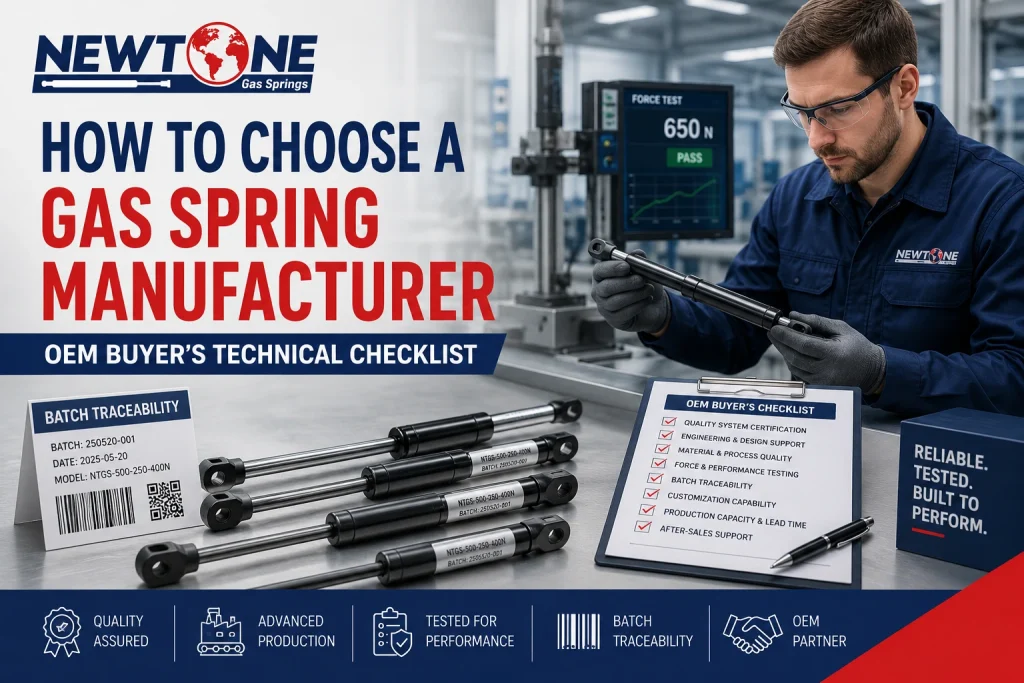
Checklist
What OEM engineers, procurement teams, and distributors should send a manufacturer before requesting a quote — so the first number that comes back is the right one.
The Gas Spring Specification Checklist: Five Numbers to Get Right First
A gas spring specification checklist for OEM buyers comes down to five geometry values before any force number can be trusted: supported weight, hinge-to-center-of-gravity distance, opening angle, how many springs will share the panel, and the mounting-point distance from the hinge. Send those five, add the operating environment and expected cycle life, and a manufacturer can return an accurate quote on the first pass. Skip any one of them, and the force value that comes back is a guess dressed up as a specification.
We see the consequences of that gap constantly. A buyer emails a weight and a rough sketch, we quote a force based on typical geometry for that class of application, the prototype ships, and the panel either slams shut or won’t stay open past 40 degrees. Nobody did anything wrong exactly — the information just wasn’t there to do anything else. This page is the checklist we’d hand you if you called us before drafting an RFQ.
Who this is for: OEM engineers speccing gas springs into a new product, procurement managers preparing an RFQ for a new supplier, and distributors who need to translate a customer’s rough requirements into something a manufacturer can quote against.
What Actually Goes on the Checklist
Split the checklist into four groups, because each one changes a different part of the final spec — force, tolerance, material, or lead time.
Geometry & Load
Supported weight, hinge-to-CoG distance, opening angle, and mounting-point distance. This alone determines the force range — see the formula below.
Force & Configuration
One spring or two. If paired, both springs need to come from the same batch within a matched tolerance — more on why below.
Environment & Material
Operating temperature range, and whether the application sees coastal or high-humidity exposure. This decides seal compound and whether stainless is worth specifying.
Volume & Timeline
Prototype quantity versus production run. A one-off and a 5,000-unit annual program use different tooling and lead-time paths, even for the identical spring.
Why Geometry Comes Before Force: The Moment Balance
Force isn’t a fixed property of a door or panel — it’s a function of geometry, and the same weight can call for wildly different springs depending on where the hinge and mount points sit. The relationship that governs this is the mounting-distance form of the moment balance:
Mounting-Distance Force Formula
F = (W × L) ÷ d
W = supported weight (N), L = hinge-to-center-of-gravity horizontal distance, d = perpendicular hinge-to-mounting-point distance. A larger d lowers the force needed for the same weight and geometry — which is why two panels of identical weight can need springs 40% apart in force.
Worked example: a 6 kg (13 lb) access panel, hinge-to-CoG distance L = 300 mm (11.8 in), mounting distance d = 60 mm (2.4 in).
- W = m × g = 6 kg × 9.81 m/s² = 58.9 N (13.2 lbf)
- F = (58.9 N × 300 mm) ÷ 60 mm = 294.3 N (66.2 lbf) — for a single spring
- Split across two springs: F_each = 294.3 N ÷ 2 = 147.2 N (33.1 lbf)
For outdoor or wind-exposed installations, we’d apply a safety-factor surcharge before finalizing: F_design = F × SF, with SF typically 1.1–1.3. At SF = 1.15, the single-spring value becomes 338.4 N (76.1 lbf), or 169.2 N (38.0 lbf) per spring in a paired setup. None of this is calculable without L and d — which is exactly the pair of numbers most RFQs leave out.
Gas Spring Specification Checklist Gaps That Cost OEM Buyers Time
Two gaps show up on almost every incomplete RFQ we receive, and both are avoidable.
Missing geometry, present weight. Buyers reliably send weight and skip L and d, because weight feels like “the spec” and geometry feels like implementation detail. It’s the reverse — weight alone can support a force estimate 40-50% off in either direction. A rough dimension is worth more than a precise weight without it.
No stated tolerance expectation on paired springs. A buyer ordering two springs for one panel rarely specifies that they need to be batch-matched, and a supplier working from a generic RFQ template won’t offer it unprompted. At a typical ±10-15% commodity tolerance, two springs nominally rated the same can sit 20-30% apart from each other — enough to twist a panel and load one hinge side more than the other over thousands of cycles. If your application uses two springs, say so, and ask what tolerance band the manufacturer can hold across a matched pair.
When the Checklist Isn’t Enough: Custom Engineering
Most RFQs map onto a standard product line once the geometry is known. Some don’t — and that’s where the checklist becomes a starting conversation rather than a form to fill in. We had an OEM approach us with a multi-section telescopic stay requirement: three to four extending sections in a single unit, built entirely in 316L stainless, for an application where a standard two-section design and a chrome rod both fell short of what the platform needed. It wasn’t a catalog order — our R&D team spent several months on the geometry and material qualification before the first article was approved, and the customer has stayed on that configuration since. That kind of project only starts from a complete brief: section counts, stroke per section, material grade, and the environment the finished part will actually see.
The same team has taken on requirements that combine functions most buyers assume need separate components — a double-stroke, non-magnetic gas spring with traction (pull) behavior and a mechanical lock, built for an application where a standard compression spring, a separate traction unit, and a separate lock would otherwise have been three parts instead of one. Projects like this live on our R&D page, and they only happen when a buyer’s specification checklist goes beyond the standard five numbers into function, material constraints, and the reason a catalog part won’t do the job.
Why OEM Buyers Send Newtone the Full Checklist
We’re a manufacturer, not a distributor. Every spring is built in our own facility in Turkey, which means we control tolerances, material sourcing, and lead times directly.
Frequently Asked Questions
At minimum: the weight the spring must support, the hinge-to-center-of-gravity distance, the opening angle, how many springs will share the load, and the mounting-point distance from the hinge. Add the operating environment (temperature, coastal or inland) and expected cycle life, and a manufacturer can return an accurate force recommendation on the first pass.
No. Most OEM buyers don’t, and guessing a force value is often worse than not providing one at all. Share the geometry and weight instead. A manufacturer’s engineering team can run the moment-balance calculation and recommend a force range, then confirm it against a prototype.
Five geometry values (weight, hinge-to-CoG distance, opening angle, spring count, mounting distance), plus environment (temperature range, humidity or salt exposure), plus production volume. Everything else — force, stroke, tolerance, seal compound — follows from those inputs.
Two springs rated at the same nominal force can still differ by their stated tolerance. At a typical ±10-15% commodity tolerance, two springs on one panel can be 20-30% apart from each other, which twists the panel and overloads one hinge side. Batch-matched pairs within a tighter tolerance band keep both sides lifting evenly.
A manufacturer with in-house R&D can, though it takes longer than a catalog order. Multi-section telescopic designs, unusual material combinations, or springs that combine two or three functions in one unit are all engineering projects, not catalog picks, and should be scoped with the manufacturer’s technical team before tooling starts.
Conclusion
A gas spring specification checklist isn’t a form to satisfy before a manufacturer will talk to you — it’s the difference between one accurate quote and three revised ones. Weight matters, but geometry decides the force. Environment decides the seal and material. Volume decides the lead time. Get those in front of an engineering team early, and a genuinely custom requirement — a multi-section design, an unusual material, a spring that needs to do two jobs at once — gets scoped correctly from the start instead of discovered halfway through tooling.
Send us your geometry, environment, and volume, however rough. We’ll come back with a force recommendation, a datasheet, and a quote.
Get a Specification Reviewed or Request a Quote
Share what you have — even a rough sketch and a weight. Our engineering team fills in the rest: free force calculation, sample datasheet, and a quote for OEM or aftermarket volumes.