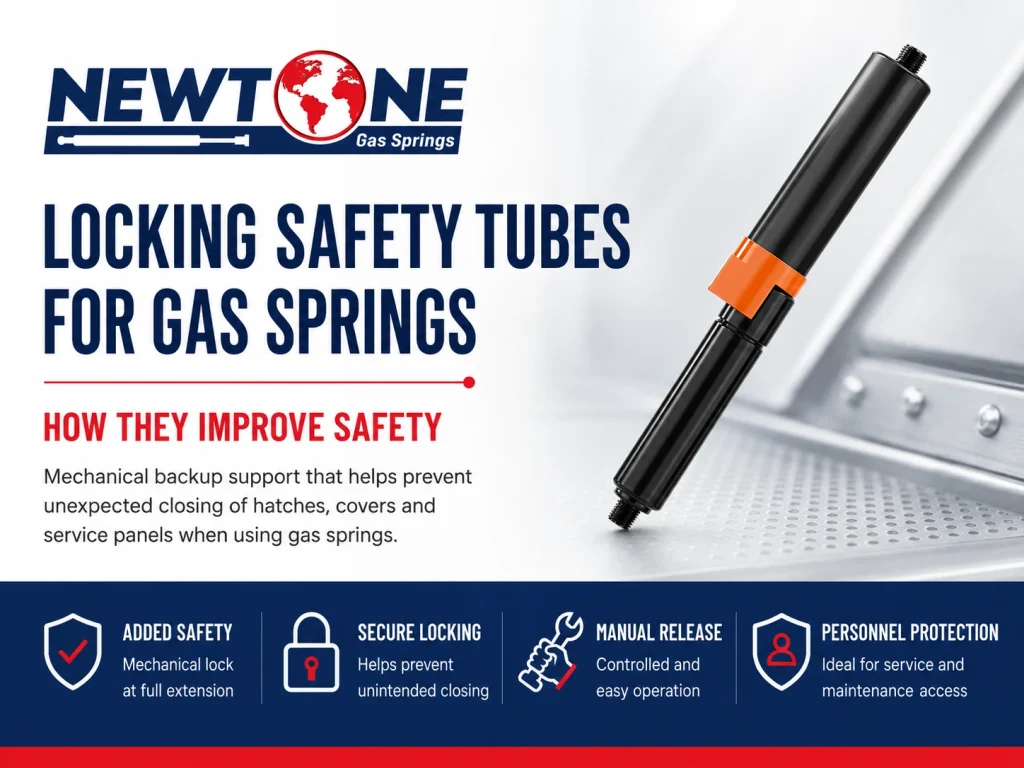
Locking safety tubes for gas springs improve safety by mechanically preventing a supported panel from closing unexpectedly when the gas spring is fully extended. The gas spring provides lift assistance and controlled movement; the locking safety tube adds a physical backup that holds the open position until the tube is deliberately released.
This matters whenever a hatch, cover, guard or service panel is opened near a person. A standard gas spring can support weight, but it is still a pressurised component. If force drops over time, if wind hits the panel, if the operator bumps the cover, or if the wrong spring was fitted, the panel can move. A locking safety tube is used when “the spring should hold it” is not enough as a safety argument.
What Are Locking Safety Tubes for Gas Springs?
Locking safety tubes for gas springs are external sleeves or shrouds fitted around the gas spring assembly to create a mechanical lock at the open position. They are also called safety locking shrouds, gas spring locking tubes or gas strut locking tubes depending on the market.
The function is simple. As the gas spring reaches full extension, the locking tube engages and prevents the rod from compressing again until the user manually releases the lock. In other words, the tube does not create the lifting force. The gas spring still does that. The tube prevents unintended closing after the panel is open.
This distinction is important for OEM engineers. A locking safety tube is not a stronger gas spring. It is a safety feature added around the spring to protect the open position. That is why it is often specified for service hatches, engine covers, machine guards, agricultural equipment panels, construction machinery covers, vehicle compartments and large lids that may be accessed by technicians.
How Locking Safety Tubes for Gas Springs Improve Safety
Locking safety tubes for gas springs improve safety by separating two jobs that are often confused: supporting the load and mechanically backing up the open position. The gas spring balances or assists the moving panel. The safety tube locks the open position so the panel cannot easily compress the spring and come down unexpectedly.
That backup becomes important in real use. A service cover may be opened dozens of times a day. A large vehicle door may be exposed to wind. A machine hatch may be hit by vibration while a technician is working nearby. A gas spring may also lose force gradually after years of use. In these cases, the locking tube provides a physical stop rather than relying only on gas pressure.
The best way to think about it is this: if a person’s hand, head, arm or tool may be under the supported panel, the design should be reviewed for mechanical backup. In many applications, a standard gas spring is enough for convenience. When injury or equipment damage is possible, a safety tube deserves serious consideration.
A Gas Spring Supports the Load; a Locking Safety Tube Backs It Up
A gas spring supports the load by applying force through its rod and mounting points. A locking safety tube backs it up by creating a mechanical hold when the assembly is open. Those are not the same job.
This is the section many supplier pages skip. A larger gas spring may make a lid feel stronger, but it does not automatically create a safe maintenance position. Too much force can even make the panel harder to close or increase bracket stress. A locking safety tube is different because it is not trying to solve the problem by adding more Newtons. It is solving the “what if the panel tries to close?” problem with a physical lock.
That is also why safety tubes should not be treated as a cure for poor geometry. The spring must still be correctly sized, the brackets must still be aligned, and the panel must still reach the lock position without bottoming out. The safety tube is a backup layer, not permission to ignore the rest of the design.
When Should You Specify Locking Safety Tubes for Gas Springs?
You should specify locking safety tubes for gas springs when the risk of unexpected closing is more serious than normal user inconvenience. The strongest trigger is service access. If a technician may work under a raised cover, inside a compartment or near a lifted guard, mechanical backup should be reviewed.
Common use cases include heavy machine covers, mobile equipment access panels, generator hatches, engine bay covers, agricultural machinery lids, trailer flaps, vehicle compartments and industrial doors. Outdoor applications add another concern: wind can change the load on a raised panel. Mobile equipment adds vibration, slope and impact.
We often see this question during first-article review. An equipment OEM sends a design where the gas spring force is technically enough to hold a service cover open, but the operator still has to place part of the body under the cover during maintenance. The issue is not that the spring is weak. The issue is that the consequence of closure is unacceptable. In that situation, a correctly sized gas spring plus a full-extension locking safety tube is a cleaner safety approach than simply increasing the spring force.
Standard Gas Spring vs Locking Safety Tube vs Locking Gas Spring
A standard gas spring, a locking safety tube and a locking gas spring solve different problems. Confusing them can lead to a part that looks safe on a drawing but behaves poorly in the field.
| Solution | What it does | Best used when |
|---|---|---|
| Standard gas spring | Provides lift support and controlled opening or closing. | The panel needs assistance, but no mechanical lock is required. |
| Locking safety tube | Adds an external mechanical backup at full extension. | The open position must be protected against unexpected closing. |
| Locking gas spring | Uses an internal valve and release system to hold position along the stroke. | The user needs adjustable positioning, not only full-open safety. |
| Prop rod | Provides a separate manual support. | A simple low-cost backup is acceptable and manual handling is not a problem. |
For many service hatches and heavy covers, the locking safety tube is attractive because it keeps the gas spring’s lift function while adding a simple mechanical lock. For adjustable seats, medical equipment or panels that must stop at different positions, a locking gas spring may be more appropriate.
Formula Block: Lid Torque and the Need for Mechanical Backup
The reason a locking safety tube matters can be shown with lid torque. Even when a hatch is open, gravity may still create a closing moment around the hinge.
T_lid = W × r_CG × cos φ
Where T_lid is the closing torque, W is the supported weight in Newtons, r_CG is the hinge-to-centre-of-gravity distance, and φ is the panel angle above horizontal.
First convert mass to force:
W = m × g
Example: a service hatch weighs 22 kg (49 lb). Its centre of gravity is 450 mm (17.7 in) from the hinge. At a 45° open position:
W = 22 × 9.81 = 216 N (49 lbf)
T_lid = 216 × 0.45 × cos45° = 68.7 N·m (50.7 lb·ft)
That closing torque does not disappear because the hatch is open. The gas spring must be sized and mounted to support the movement, but the locking safety tube adds a mechanical stop at the open position. If the spring loses pressure, if wind pushes the panel, or if the hatch is bumped, the lock helps prevent the panel from freely compressing the gas spring.
As a support check, the spring-side torque is:
T_spring = F × r_perp
If two gas springs each provide 350 N (79 lbf) and each has an effective perpendicular moment arm of 120 mm (4.7 in), the combined support torque is:
T_spring,total = 2 × 350 × 0.12 = 84 N·m (62 lb·ft)
This shows that the gas springs can support the hatch in normal operation. It does not replace the mechanical safety function. The locking tube is there for the abnormal case: loss of support, impact, misuse or service work under the open panel.
Common Specification Mistakes
The most common mistake is using a locking safety tube as a substitute for correct gas spring sizing. The tube should not be expected to fix a weak spring, a bad bracket position or a stroke that is too short. First make the gas spring work correctly. Then add the locking safety tube where the risk justifies it.
The second mistake is forgetting release access. The operator must be able to disengage the tube safely and naturally. If the release direction is awkward, hidden, too close to a pinch point or blocked by the equipment frame, the user may force the panel or avoid using the system correctly.
The third mistake is assuming one safety tube always covers every paired-spring application. In some designs, one locking tube may be enough. In others, the width, panel stiffness, torsion and access direction may make a different arrangement safer. This depends on geometry, not only on spring force.
Finally, do not ignore side-load. A safety tube mounted around a misaligned gas spring can still suffer from poor movement, wear or binding. Both pivots should stay in the same plane of motion, and the rod should not be used as a structural guide.
Material and Environment Selection
Material selection depends on where the safety tube will work. Painted steel is suitable for many indoor and general industrial environments. Stainless steel should be reviewed for outdoor, coastal, marine-adjacent, washdown or high-humidity applications where corrosion could affect the tube, spring or mounting hardware.
The gas spring itself must also match the environment. For most general applications, Newtone’s black nitrided rod and HNBR sealing package are a strong standard solution. For corrosive environments, stainless steel gas springs should be considered. If the safety tube survives but the gas spring rod pits and damages the seal, the system can still fail early.
Temperature matters as well. Newtone gas springs are designed for −40°C to +100°C (−40°F to +212°F), but force changes with temperature. A rough estimate is about 0.3% per °C. The safety tube should be specified as part of the full system, not as an isolated accessory.
Installation Guidance for Locking Safety Tubes
Installation should be checked in both closed and fully open positions. The gas spring must reach full extension cleanly so the safety tube can engage. If the spring bottoms out before the panel reaches its mechanical stop, the tube may not lock correctly and the brackets may see shock load.
Clearance around the tube is important. The safety sleeve needs enough space to move and lock without hitting nearby sheet metal, covers, wiring, hoses or operator handles. The release must remain accessible after the panel is open.
Bracket alignment should be treated as a safety detail, not a cosmetic detail. Angular movement must be allowed by the end fittings. Ball sockets are useful where the angle changes through the stroke. Eyelets can work well in simple linkages if the pivots are aligned. Poor alignment can shorten spring life and make the safety tube feel rough or unreliable.
During prototype review, check the user’s hand position while closing. If the user has to release the tube with one hand while supporting the panel with the other, the closing sequence should feel controlled and predictable. A safety device that operators dislike using is a design risk.
Why Source Locking Safety Tubes from Newtone?
System-Level Review
Newtone can review the gas spring, locking safety tube, brackets and mounting geometry as one motion-control system.
Manufacturer Capability
Newtone manufactures gas springs in Turkey and exports to more than 60 countries for OEM and aftermarket needs.
Material Options
Painted steel and stainless steel options can be reviewed depending on corrosion risk, duty cycle and environment.
Matched Components
Force, stroke, end fittings, mounting brackets and safety tubes can be specified together instead of treated as separate parts.
Frequently Asked Questions About Locking Safety Tubes for Gas Springs
What are locking safety tubes for gas springs?
Locking safety tubes for gas springs are external mechanical sleeves that lock when the gas spring reaches full extension. They act as a secondary safety support, helping prevent a hatch, cover or panel from closing unexpectedly during use or maintenance.
How do locking safety tubes improve gas spring safety?
Locking safety tubes improve gas spring safety by adding a mechanical backup at the open position. The gas spring provides lift support, while the safety tube prevents unintended compression until the lock is manually released.
Are locking safety tubes the same as locking gas springs?
No. A locking safety tube is an external mechanical sleeve that usually locks at full extension, while a locking gas spring uses an internal valve system to hold position along the stroke when released or locked by a control mechanism.
When should locking safety tubes be used?
Locking safety tubes should be used when a person may work under or near a supported panel, when accidental closing could cause injury or damage, or when wind, vibration, impact or gas pressure loss could move the panel unexpectedly.
Can a locking safety tube replace correct gas spring sizing?
No. A locking safety tube is a safety backup, not a substitute for correct gas spring sizing. The gas spring must still be correctly specified for force, stroke, mounting geometry, temperature and duty cycle.
Final Engineering Takeaway
Locking safety tubes for gas springs are used when a supported panel needs more than lift assistance. They add mechanical backup at the open position, helping reduce the risk of unexpected closure during maintenance, operation or exposure to external forces.
The correct system still starts with the right gas spring: force, stroke, end fittings, mounting points and environment must be specified properly. The locking safety tube then adds a safety layer where the consequence of closure is too serious to rely on gas pressure alone.