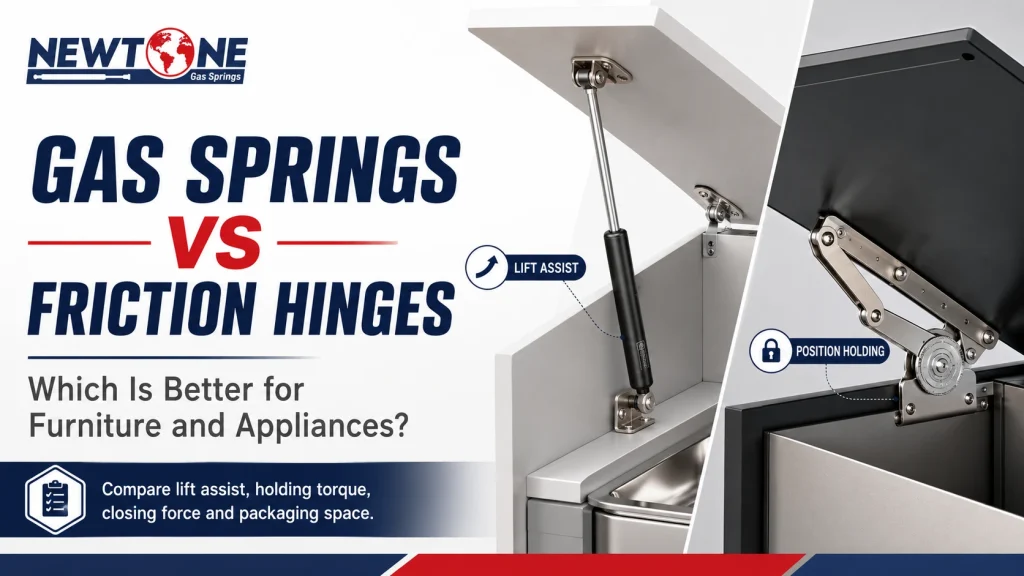
Gas springs vs friction hinges is mainly a choice between lift assistance and friction-based position holding: gas springs are usually better when a furniture or appliance lid needs active support, while friction hinges are usually better when a compact lid only needs resistance and controlled positioning. The right choice depends on lid weight, hinge geometry, opening angle, closing effort, available space, desired hold position and product feel.
A kitchen lift-up door, storage bench lid, appliance cover or compact service flap may look like a simple hinged panel. It is not simple once the user touches it. If the lid feels too heavy, drops too fast, refuses to stay open or fights the user during closing, the motion hardware was selected for the wrong job. The clean decision starts by asking what the mechanism must do: offload weight, resist motion, hold position, slow closing, or combine several of those functions.
- 1 Gas Springs vs Friction Hinges: The Quick Decision
- 2 A Friction Hinge Resists Motion; a Gas Spring Offloads Weight
- 3 Where Each Option Fits in Furniture and Appliances
- 4 Closing Force Calculation for Gas Spring Assisted Lids
- 5 Gas Spring Advantages in Furniture and Appliances
- 6 Friction Hinge Advantages in Furniture and Appliances
- 7 Where Friction Hinges Struggle
- 8 Where Gas Springs Struggle
- 9 Mounting and Packaging Guidance
- 10 Temperature, Damping and Soft-Close Behavior
- 11 Gas Springs vs Friction Hinges: Decision Checklist
- 12 Why Source Furniture and Appliance Gas Springs from Newtone?
- 13 Frequently Asked Questions About Gas Springs vs Friction Hinges
- 14 Final Engineering Takeaway
Gas Springs vs Friction Hinges: The Quick Decision
Gas springs are the better direction when the lid is heavy enough that the user needs lift assistance. Friction hinges are the better direction when the lid is lighter, the design needs compact packaging, and the main requirement is resistance or position holding rather than active counterbalance.
Choose a gas spring when…
The lid, flap or cover needs active support, reduced lifting effort, controlled opening, paired support on wide panels or help staying open during normal use. Gas springs fit heavier furniture lids, appliance covers, wall units, storage systems and service panels where the lid weight should be offloaded.
Choose a friction hinge when…
The lid is compact, relatively light, and the design needs a clean hinge-only solution that resists motion or holds position without a separate cylinder. Friction hinges fit small flaps, access lids and products where appearance and space are more important than lift assistance.
The boundary is not a fixed lid weight. A 4 kg (9 lb) lid with a long centre-of-gravity distance can feel harder to control than a heavier but better-balanced cover. Geometry decides the real load at the hinge.
A Friction Hinge Resists Motion; a Gas Spring Offloads Weight
A friction hinge resists motion, while a gas spring offloads weight. That difference is the core of the selection. A friction hinge creates torque at the hinge to slow or hold movement. A gas spring pushes through a separate line of action and helps counterbalance the lid.
This is why the two products can feel similar in a showroom but behave differently in a real mechanism. A friction hinge may hold a small lid at intermediate positions, but it does not actively lift the lid the way a gas spring does. A gas spring can make a heavy lid feel lighter, but it also adds force into the brackets and hinge structure. The hinge still carries structural load; the gas spring does not replace it.
In first-article reviews, we sometimes see a furniture or appliance OEM request a gas spring for a small lift-up lid because the target is “premium motion.” The prototype opens easily, but closing feels springy and the user has to push harder than expected. In that case, the better answer may be a lower-force gas spring with a different mounting point, or a friction hinge if the lid only needs resistance and position holding. The motion target decides the hardware, not the other way around.
Where Each Option Fits in Furniture and Appliances
Gas springs and friction hinges both fit furniture and appliance applications, but they solve different motion problems. Gas springs fit lift-up kitchen cabinet doors, storage bench lids, toy boxes, appliance service covers, wall-bed panels, heavy flaps and larger covers where the user needs help managing weight.
Friction hinges fit compact lids, lightweight access panels, small appliance flaps, display covers and clean visible hinges where a separate support cylinder would take too much space. They are especially useful when the lid needs to stay near the angle where the user leaves it, but the lid is not heavy enough to require active lift support.
Some products use both concepts. A larger appliance cover may use a gas spring for support and a hinge system for alignment. A product that needs slow closing may require damping in addition to support. The decision should be made by function: support, resistance, position holding, speed control or safety.
Closing Force Calculation for Gas Spring Assisted Lids
The closing or handling force relationship helps show one of the main trade-offs in gas springs vs friction hinges. A gas spring can make a lid easier to lift, but the same spring can create closing resistance the user must overcome.
Formula:
F_close = (n × F1 × r) ÷ L_lid
Where:
F_close = approximate user closing force at the handle or contact point
n = number of gas springs
F1 = gas spring force near the extended position
r = effective perpendicular moment arm of the gas spring
L_lid = distance from hinge to the user handle or contact point
Example: an appliance cover uses one 150 N (34 lbf) gas spring. The effective perpendicular spring moment arm is 70 mm (2.8 in), and the user pushes the cover down from a handle point 450 mm (17.7 in) from the hinge.
F_close = (1 × 150 × 70) ÷ 450
F_close = 23 N (5 lbf)
That may feel comfortable in many appliance or furniture applications. Now consider the same lid with one 250 N (56 lbf) gas spring because the first design team wanted a stronger hold-open feel.
F_close = (1 × 250 × 70) ÷ 450
F_close = 39 N (9 lbf)
The lid is now easier to lift, but harder to close. If the product is used by children, older users or one-handed operators, that extra closing effort may be noticeable. If two springs are used instead of one, the closing force roughly doubles unless the geometry or spring force is adjusted.
A support-force check is still required for heavier lids:
F = (W × Lg × cos φ) ÷ (n × r)
That moment-balance formula answers whether the gas spring can support the lid. The closing-force formula answers whether the user can comfortably close it. A friction hinge changes the trade-off because it resists rotation at the hinge rather than adding a separate gas-spring push force through brackets.
Gas Spring Advantages in Furniture and Appliances
Gas springs are strongest when the lid needs active lift assistance. They can reduce the hand force needed to open a heavy cover, help hold a panel open and create a smoother motion across a longer stroke.
In furniture, gas springs are useful for lift-up cabinet doors, wall-bed mechanisms, storage compartments and larger bench lids. In appliances, they can support service covers, top lids, access flaps and panels that need to stay open while a user or technician works.
Gas springs are also flexible because force, stroke, end fittings and mounting brackets can be selected around the application. That matters for OEMs because a small change in bracket position can make the lid feel much better without increasing force. Newtone’s ±5% force tolerance also supports repeatable motion when paired springs are used on wide lids.
Friction Hinge Advantages in Furniture and Appliances
Friction hinges are strongest when compact packaging, clean appearance and simple position holding matter more than active lift support. They keep the motion hardware at the hinge, which can be visually cleaner and easier to package than a separate gas spring.
For small cabinet flaps, lightweight appliance covers and compact access lids, a friction hinge can hold the lid at useful angles without needing a cylinder, rod clearance or separate body-side bracket. This can reduce visible hardware and simplify assembly.
Friction hinges also avoid gas-pressure temperature effects because they do not rely on compressed gas force. A gas spring force changes by about 0.3% per °C, while a friction hinge is governed by mechanical torque and wear behavior. That does not make one better in every case. It simply means the physics is different.
Where Friction Hinges Struggle
Friction hinges struggle when the lid is heavy, long, wide or has a centre of gravity far from the hinge. In those cases, holding torque alone can become too high, and the user may still need to lift most of the lid weight manually.
A friction hinge can resist motion, but it does not provide the same counterbalance effect as a gas spring. If the lid is large enough that users complain about lifting effort, a friction hinge may hold positions but still feel heavy. Increasing friction torque can also make the lid harder to move throughout the stroke.
Wear is another consideration. If the product is opened frequently, the hinge torque must remain consistent over the service life. In high-use furniture or appliance lids, the selection should consider cycle expectation, lid load and whether the hinge torque will stay stable enough for the product feel target.
Where Gas Springs Struggle
Gas springs struggle when the product has very limited packaging space, poor bracket locations or a lid so small that even a low-force spring over-assists the motion. In those cases, a friction hinge or damper may be more appropriate.
Gas springs also need clean alignment. Both pivots should stay in the same plane of motion, and the rod should not be side-loaded. If the spring is forced into a compact product without enough angular clearance, it can bind, make noise or shorten seal life.
Too much force is another common issue. A stronger gas spring may make a lid open impressively, then make it annoying to close. It can also add load to hinge screws, brackets or thin appliance sheet metal. The hinge still needs to be strong enough for the gas spring forces introduced into the system.
Mounting and Packaging Guidance
Gas springs need bracket space, rod clearance and a clean line of action; friction hinges need a strong hinge mounting area and the correct torque range. Both products fail as design choices when the surrounding structure is not considered.
For gas springs, mount the rod pointing down in the at-rest or closed position where geometry allows it. This helps keep oil near the seal and supports consistent damping. Keep both pivots in the same plane of motion and use end fittings that allow the angular movement required by the lid.
For friction hinges, the hinge mounting surface must be stiff enough to carry repeated torque. If the panel or frame flexes, the hinge may feel inconsistent even if the torque rating is correct. Compact does not mean load-free; it simply means the load is concentrated at the hinge instead of shared through a separate support strut.
In furniture and appliances, packaging should include the user’s hand path, storage clearance, wiring, seals, liners, cleaning access and service access. A mechanism that works on a bench can still be wrong if it blocks the product’s real use.
Temperature, Damping and Soft-Close Behavior
Gas springs and friction hinges respond differently to temperature and damping requirements. Gas spring force changes with temperature because internal gas pressure changes. The approximate relationship is:
F_T ≈ F_20 × [1 + 0.003 × (T − 20°C)]
A 150 N (34 lbf) gas spring at 20°C (68°F) may feel about 141 N (32 lbf) at 0°C (32°F). That is not failure; it is gas behavior. For outdoor appliances, garage storage products or cold environments, the force should be reviewed at the real operating temperature.
Soft-close behavior is a separate question. A gas spring can provide support, but a damper controls speed. The damping relationship is:
F_damp = c × v
This means damping force increases with movement speed. If the product must close quietly, a damper or damped motion characteristic may be needed even if a gas spring is already supporting the lid.
Gas Springs vs Friction Hinges: Decision Checklist
| Design question | Gas spring direction | Friction hinge direction |
|---|---|---|
| Does the lid need active lift assistance? | Usually stronger choice. | Usually limited. |
| Is the lid small and compact? | May be difficult to package. | Often cleaner. |
| Does the lid need any-position holding? | Possible with locking gas spring, depending on design. | Often suitable for lighter lids. |
| Is closing force critical? | Must be calculated to avoid over-assist. | Depends on hinge torque selection. |
| Is soft-close required? | May need damping in addition to support. | May need a damping hinge or separate damper. |
| Is hidden hardware important? | Needs cylinder and bracket space. | Usually more compact visually. |
| Is the lid wide or flexible? | Paired springs can spread load. | Hinge torque and frame stiffness become critical. |
Why Source Furniture and Appliance Gas Springs from Newtone?
Manufacturer, Not Distributor
Newtone manufactures gas springs in Turkey and exports to more than 60 countries for OEM and aftermarket applications.
Application Review
Engineering support is available for force, stroke, mounting geometry, closing effort and paired-spring layouts.
Controlled Components
HNBR sealing, black nitrided rods, ±5% force tolerance and 100,000+ cycle capability support repeatable product motion.
OEM + Aftermarket Supply
Newtone can support furniture and appliance programs with production and replacement supply from the same platform.
Frequently Asked Questions About Gas Springs vs Friction Hinges
What is the main difference between gas springs and friction hinges?
The main difference is that a gas spring actively offloads lid weight with pressurized force, while a friction hinge resists rotation with hinge torque. Gas springs help lift heavier lids; friction hinges hold or slow lighter lids in a compact hinge-based layout.
Are gas springs better than friction hinges for furniture lids?
Gas springs are better when the furniture lid is heavy, wide or needs lift assistance. Friction hinges are better when the lid is light, compact and mainly needs resistance or position holding without a separate support strut.
Can a friction hinge replace a gas spring?
A friction hinge can replace a gas spring only if the lid does not need active lift support. If the lid is heavy or users need help opening it, a gas spring usually remains the more suitable option.
Can a gas spring replace a friction hinge?
A gas spring can add lift assistance, but it does not replace the structural hinge. The lid still needs a hinge to carry alignment and rotation loads, and the brackets must be strong enough for gas spring force.
Which option is better for soft-close appliance covers?
Neither option alone guarantees soft close. Gas springs provide support and friction hinges provide resistance, but soft-close behavior usually depends on damping. A damper, damping hinge or damped gas spring layout may be needed to control closing speed.
Final Engineering Takeaway
Gas springs vs friction hinges is not a simple better-or-worse choice. It is a function choice. Use a gas spring when the lid needs lift assistance and controlled support. Use a friction hinge when the lid is lighter, compact and needs resistance or position holding without a separate cylinder.
The strongest designs start with the movement target: how heavy the lid feels, how it closes, how much space is available, how the hinge is loaded and what the user should feel. Newtone can review gas spring force, stroke, bracket geometry and closing effort for furniture and appliance projects so the final mechanism feels controlled rather than overpowered.