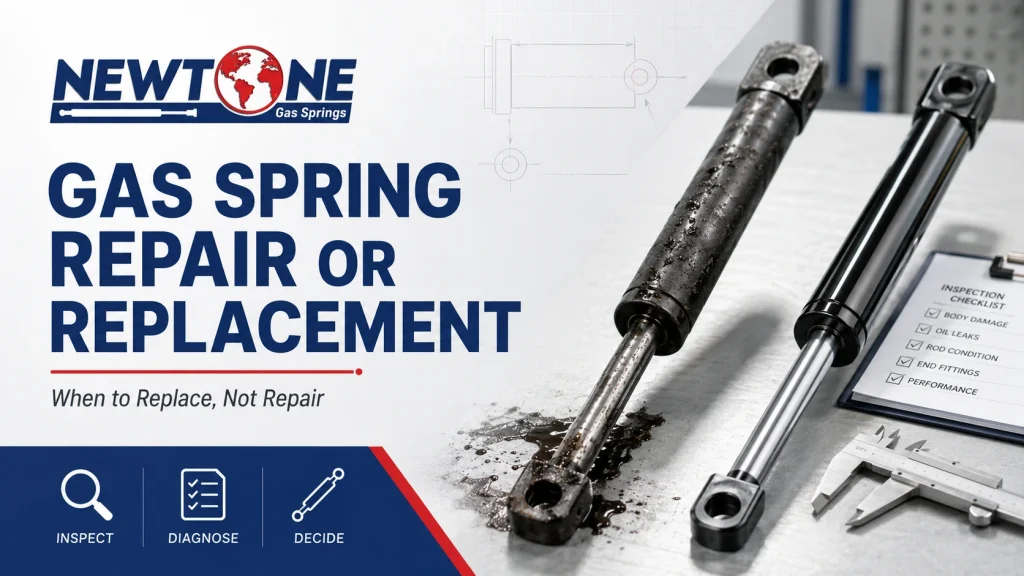
Gas spring repair or replacement usually comes down to one rule: most sealed gas springs cannot be economically or safely repaired, so replacement is normally the correct route when pressure is lost, oil leaks, or the rod and seal interface is damaged. Before replacing the part, however, the full system should be checked because a weak lid or dropping panel is not always caused by internal gas spring failure.
A machine cover may fall because the gas spring has lost nitrogen. A vehicle hatch may feel weak because the temperature dropped overnight. A cabinet lid may become hard to close because the replacement force is too high. A paired application may twist because only one spring was changed. The part may look simple from the outside, but the decision is not always “repair the spring” or “buy the same length again.” The correct decision is to diagnose the failure mode, then replace or re-specify the gas spring as part of the mechanism.
- 1 Gas Spring Repair or Replacement: The Quick Decision
- 2 Do Not Repair the Symptom Before You Diagnose the System
- 3 Why Most Gas Springs Are Replaced, Not Repaired
- 4 Effective Force Loss in a Weak Gas Spring
- 5 Regassing vs Replacement
- 6 Replacement Specification Checklist
- 7 Single vs Paired Replacement
- 8 When the Gas Spring Is Not the Real Problem
- 9 Common Replacement Mistakes
- 10 Gas Spring Repair or Replacement Decision Checklist
- 11 Why Source Replacement Gas Springs from Newtone?
- 12 Frequently Asked Questions About Gas Spring Repair or Replacement
- 13 Final Engineering Takeaway
Gas Spring Repair or Replacement: The Quick Decision
Gas spring repair or replacement should be decided by the failure symptom, not by appearance alone. Replace the gas spring when it has lost force permanently, leaks oil, has a scratched or pitted rod, moves roughly, or no longer holds the load after the application geometry has been checked.
Replace the gas spring when…
The rod is oily, the spring no longer supports the panel, the rod surface is scratched or corroded, the extension is weak at normal temperature, or the unit has lost pressure. Most sealed gas springs are not practical repair items once the internal seal system is damaged.
Inspect the system first when…
The problem appeared only in cold weather, the replacement spring is too hard to close, the hinge is stiff, the bracket is bent, the load has changed, or only one spring of a pair was replaced. In those cases, the spring may not be the only problem.
Regassing can exist for some serviceable or rechargeable gas struts, but it is not the normal route for standard sealed OEM gas springs. If the seal, rod or internal guide condition is already poor, adding gas does not solve the root cause.
Do Not Repair the Symptom Before You Diagnose the System
Do not repair the symptom before you diagnose the system, because a weak or dropping panel can be caused by internal pressure loss, temperature change, hinge friction, side-load, added weight, wrong mounting points or a mismatched replacement. The gas spring is only one part of the motion system.
A common aftermarket case starts with a simple request: “We need the same length gas spring.” The new part fits between the ball studs, but the lid either still does not stay open or becomes difficult to close. When the application is reviewed, the issue is often that force, stroke, compressed length, end fittings and mounting orientation were not matched together. Same length does not mean same behavior.
This is why Newtone treats replacement as a specification question, not only a part-number question. A correct replacement should restore the intended opening, holding and closing behavior without overloading the hinges, brackets or user.
Why Most Gas Springs Are Replaced, Not Repaired
Most gas springs are replaced, not repaired, because they are sealed high-pressure components filled with nitrogen and a controlled amount of oil. Once the main seal, rod surface or internal pressure system is damaged, opening and rebuilding the unit is usually not practical or safe for normal OEM and aftermarket applications.
A gas spring works because internal pressure acts on the rod area and creates extension force. The seal package keeps that pressure inside while the rod moves through the guide. If the seal is worn, cut or contaminated, the spring can lose gas pressure. If oil appears around the rod, the internal sealing system has already been compromised.
Repair also has a safety side. A gas spring is not an ordinary mechanical spring that can be opened casually on a workbench. It is a pressurized cylinder. Cutting, drilling, heating or disassembling a gas spring without correct equipment is dangerous. For most commercial, furniture, vehicle, machinery and access-panel applications, replacement is the safer and more economical decision.
Effective Force Loss in a Weak Gas Spring
The useful force felt at the panel is not only the theoretical gas force. Friction, seal drag, rod damage and contamination can reduce the effective output before the spring completely fails.
Formula:
F_eff = P × A − F_friction − F_seal
Where:
F_eff = effective force available to support the application
P = pressure differential acting on the rod area
A = rod cross-sectional area
F_friction = force lost to mechanical friction
F_seal = force lost to seal drag or seal damage
Example: a gas spring is rated at 300 N (67 lbf). In a healthy installation, normal friction and seal drag may consume about 8% of the output.
Normal loss = 300 × 0.08 = 24 N (5 lbf)
F_eff = 300 − 24 = 276 N (62 lbf)
Now consider a worn unit where rod contamination, seal wear and internal drag create an equivalent 25% force loss.
Damaged-system loss = 300 × 0.25 = 75 N (17 lbf)
F_eff = 300 − 75 = 225 N (51 lbf)
The label may still say 300 N (67 lbf), but the application feels only about 225 N (51 lbf) of useful support. On a marginal lid, hatch or cover, that difference can be enough for the panel to drop, move slowly or fail to stay open.
Temperature must also be separated from true failure. Gas spring force changes by about 0.3% per °C:
F_T ≈ F_20 × [1 + 0.003 × (T − 20°C)]
A 300 N (67 lbf) gas spring at 20°C (68°F) may feel about 282 N (63 lbf) at 0°C (32°F). That does not automatically mean the spring is dead. Permanent weakness at normal temperature, oil leakage or visible rod damage is a stronger replacement signal.
Regassing vs Replacement
Regassing can be possible only for gas springs designed to be rechargeable or serviceable, but most standard sealed gas springs used in OEM equipment, furniture, vehicles and access panels are better replaced. Regassing a sealed unit without fixing the seal problem usually creates a short-lived repair.
The practical question is not “can someone add gas?” The practical question is “will the repaired part remain safe, stable and repeatable in the application?” If the unit lost pressure because the seal was damaged, adding nitrogen does not restore the rod surface, seal lip or internal guide condition.
There are special industrial cases where serviceable gas springs or nitrogen cylinders are maintained differently. Those should be handled according to their product design and safety instructions. For ordinary sealed gas springs, replacement gives a cleaner result because force, stroke, end fittings and production tolerance can be specified together.
Replacement Specification Checklist
A gas spring replacement should match more than overall length. The correct replacement must match extended length, compressed length, stroke, force, end fittings, rod/body size, mounting orientation and the load behavior of the application.
The basic length relationship is:
Stroke = Extended length − Compressed length
If the stroke is wrong, the spring may bottom out before the panel closes or may not reach the full open position. If the compressed length is too long, the panel may not close. If the extended length is too short, the panel may not open far enough.
Force is just as important. A lower-force spring may not hold the panel open. A higher-force spring may make the panel hard to close, overload the brackets or push the hinge structure harder than intended. End fittings must also match the required movement. Ball sockets, eyelets, clevises and brackets are not interchangeable only because they fit the same space.
For replacement work, record these details before ordering: extended length, compressed length, stroke, force in N (lbf), rod diameter, body diameter, end fitting type, thread size if applicable, mounting direction and whether the application uses one spring or a matched pair.
Single vs Paired Replacement
Paired gas springs should usually be replaced together when they support the same lid, hatch, door or cover. Replacing only one spring can create uneven lift because the new spring has full force while the older one may have already lost output.
Uneven force can twist a wide panel, load one hinge harder than the other or make the motion feel rough. This is common on vehicle hatches, roof lids, machine covers, wide furniture lids and industrial access panels. The user may describe it as “the lid feels crooked” even though both springs are installed.
Newtone controls force tolerance at ±5%, which supports balanced paired behavior when the springs are specified and supplied as a matched solution. For OEM production and serious aftermarket replacement, same platform and same force class matter more than mixing parts that only look similar.
When the Gas Spring Is Not the Real Problem
The gas spring is not always the real problem when a panel feels weak, heavy or unstable. Hinge friction, side-load, bent brackets, added accessories, wrong mounting points and cold temperature can all create symptoms that look like gas spring failure.
A stiff hinge can make a good gas spring feel weak. A side-loaded rod can wear the seal and shorten life. A heavy accessory added to a lid changes the load calculation. A replacement with the wrong force can make the panel hard to close and encourage users to force it down. Each of these cases needs a system check, not only a new cylinder.
Mounting direction also matters. Where the geometry allows it, the gas spring should be mounted with the rod pointing down in the at-rest or closed position. This helps keep oil near the seal and supports smoother damping. Both pivots should stay in the same plane of motion so the rod is not bent sideways through the stroke.
Common Replacement Mistakes
The first mistake is choosing a replacement by extended length alone. Length may make the part fit, but it does not guarantee correct force, stroke, end fitting angle or closing behavior.
The second mistake is selecting a stronger spring because the old one felt weak. That may hide the real problem and create a new one. Too much force can make the application hard to close, overload brackets or keep the gas spring under unnecessary static load when closed.
The third mistake is trying to repair a leaking sealed gas spring. Oil around the rod usually means the sealing system is compromised. Wiping it clean does not repair the internal problem.
Other mistakes include replacing only one spring of a pair, ignoring temperature, reusing worn ball studs, mounting the rod upward where rod-down is possible, and installing the spring in a way that creates side-load through the stroke.
Gas Spring Repair or Replacement Decision Checklist
| Symptom | Likely decision |
|---|---|
| Oil visible around the rod | Replace the gas spring; the sealing system is likely compromised. |
| Panel drops at normal temperature | Replace or re-specify after confirming load and geometry. |
| Weak only in cold weather | Check temperature effect before assuming permanent failure. |
| New spring is hard to compress by hand | Often normal; check installed force and geometry rather than hand compression. |
| Replacement fits but lid will not close | Force, compressed length or mounting geometry may be wrong. |
| Wide lid lifts unevenly | Replace both springs as a matched pair and check hinge alignment. |
| Rod is scratched, pitted or bent | Replace the gas spring and check side-load or corrosion causes. |
| Hinge is stiff or bracket is bent | Repair the mechanism before blaming only the gas spring. |
Why Source Replacement Gas Springs from Newtone?
Manufacturer, Not Distributor
Newtone manufactures gas springs in Turkey and exports to more than 60 countries for OEM and aftermarket applications.
Replacement Specification Support
Engineering support is available for force, stroke, extended length, compressed length, end fittings and mounting review.
Controlled Components
HNBR sealing, black nitrided rods, ±5% force tolerance and 100,000+ cycle capability support repeatable replacement performance.
OEM + Aftermarket Supply
Newtone can support original equipment programs and replacement supply from the same manufacturing platform.
Frequently Asked Questions About Gas Spring Repair or Replacement
Can gas springs be repaired?
Most sealed gas springs cannot be economically or safely repaired. If a gas spring has lost pressure, leaked oil or damaged the rod and seal interface, replacement is usually the correct route.
Can a gas spring be regassed?
Some serviceable or rechargeable gas struts can be regassed, but most standard sealed gas springs are not designed for field regassing. If the seal or rod surface caused the pressure loss, regassing alone will not solve the root problem.
Should I replace one gas spring or both?
For paired lids, hatches and covers, both gas springs should usually be replaced together. A new spring paired with an old weak spring can create uneven lift, twisting and one-sided hinge wear.
Why will my new gas spring not compress by hand?
A new pressurized gas spring may be very difficult to compress by hand, especially at higher force ratings. That does not automatically mean it is defective. Check the installed geometry, force and compressed length instead.
How do I choose the correct gas spring replacement?
Choose the replacement by matching extended length, compressed length, stroke, force, end fittings, rod/body size, mounting orientation and whether the application uses a single spring or a matched pair.
Final Engineering Takeaway
Gas spring repair or replacement is usually a replacement decision for standard sealed gas springs, especially when pressure loss, oil leakage or rod damage is present. But the replacement should not be chosen by length alone.
The strongest approach is to diagnose the complete system first: temperature, hinge friction, side-load, mounting position, added weight, paired-spring balance and end fittings. Newtone can help review the replacement specification so the new gas spring restores the intended motion instead of repeating the same failure.