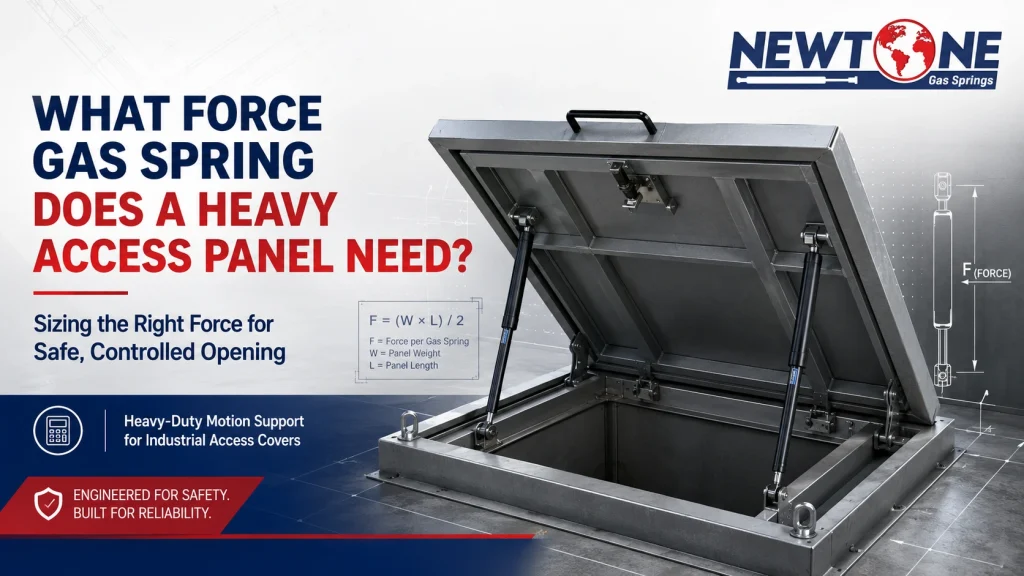
Gas spring force for access panel applications comes from a moment balance, not a lookup table: multiply the panel’s weight by the distance from its hinge to its centre of gravity, then divide by the spring’s moment arm and the number of springs carrying the load. For a typical heavy access panel on industrial equipment — 15 to 30 kg (33 to 66 lb), side- or top-hinged, opening 80–100° — that usually works out to 150–500 N (34–112 lbf) per spring, but the panel in front of you is what actually decides the number.
Picture a control-cabinet access panel mounted above head height on a packaging line, or a top-hinged enclosure lid on outdoor process equipment. Someone has to open it one-handed, often while holding a tool in the other, and it has to stay open — not drift shut, not fall — while they work. Get the force wrong in either direction and you’ve either built something a technician can’t close without leaning on it, or something that doesn’t hold and comes down on them. This page is for the OEM engineers and procurement teams specifying that spring, and for distributors sourcing a matched replacement for one already in the field.
Gas Spring Force for Access Panel Applications: The Formula
The equation that governs almost every hinged access panel is the moment balance about the hinge: F = (W × Lg × cos φ) ÷ (n × r). W is the panel’s weight in newtons, Lg is the distance from the hinge to the panel’s centre of gravity, φ is the panel’s angle above horizontal at the position you’re solving for, r is the spring’s perpendicular moment arm, and n is the number of springs sharing the load. The worst case — where the spring works hardest — is almost always at or near horizontal, where cos φ = 1.
Worked example — a 22 kg (49 lb) top-hinged equipment enclosure panel, 620 mm (24.4 in) from hinge to free edge, on two springs:
W = m × g = 22 × 9.81 = 215.8 N (48.5 lbf)
Lg = 620 ÷ 2 = 310 mm (12.2 in)
r = 125 mm (4.9 in)
φ = 0° at the start of opening → cos φ = 1
F = (215.8 × 310 × 1) ÷ (2 × 125) = 267.6 N (60.2 lbf) per spring
Add a 1.2 safety factor for an industrial, unmanned-load environment: F_design = 267.6 × 1.2 = 321.1 N (72.2 lbf) per spring.
That 1.2 multiplier (safety-factor surcharge, F_design = F × SF) isn’t decoration — it’s the margin that covers paint buildup on the hinge, a slightly heavier panel than the drawing says, and normal seal friction. For enclosures in unheated plant space or outdoors, factor in temperature too: force drops about 0.3% per °C below 20°C (formula F_T ≈ F_20 × [1 + 0.003 × (T − 20°C)]). At −20°C, our 321.1 N design figure falls to roughly 282.6 N (63.5 lbf) — a real difference on a panel that’s supposed to hold itself open on a cold winter morning, not just on the bench where it was tested.
Getting a Real Weight Number Before You Trust Any Formula
Every formula above is only as good as the weight you feed into it, and this is where a lot of spec sheets go wrong before the math even starts. Guessing a panel’s weight from “it feels heavy” routinely gets it wrong by 30% or more, and that error carries straight through to the force number. If the panel isn’t built yet, sum the actual material weights — sheet thickness, frame, any mounted components — rather than eyeballing a finished assembly. If it’s an existing panel you’re replacing springs for, the more reliable field method is to hook a fish or luggage scale near the free edge, lift just to the point the panel starts to move, and read the force at that point; then back-calculate the true weight using the same lever-arm ratio the moment balance uses, rather than assuming the scale reading is the weight itself. A bathroom scale under one corner will not give you a usable number for a hinged panel — the geometry doesn’t work that way, and that mismatch is a common, avoidable source of an oversized or undersized spring order.
Gas Spring Force for Access Panel Doors: Holding vs. Closing
Holding force and closing force are not the same number, and sizing for only one of them is a common, quiet mistake. At the open position, the spring’s job is to balance the panel’s weight moment — that’s the F we solved above. Closing the panel means pushing the spring’s rod back in, and the spring resists that compression through most of the stroke, with the resistance rising as the rod approaches full compression (a rising force-progression ratio, typically K = 1.2–1.4 for a standard spring). On a panel sized right at the edge of its holding requirement, the closing effort can feel disproportionately heavy, particularly with two springs working together on a wide panel. The practical fix isn’t more force — it’s checking both ends of the stroke against the real geometry, and, where the panel opens past vertical or has an awkward reach, considering whether the mounting position can be adjusted to shorten the effective moment arm on the close side rather than just adding spring capacity.
When a Standard Spring Isn’t Enough: Locking for Overhead and Service-Access Panels
A standard gas spring holds a panel open through gas pressure alone — reliable, but not a mechanical lock. That distinction matters most on panels positioned above or beside where someone is actually working. An industrial equipment builder we supplied had installed standard gas springs on an overhead cabinet access panel on a production line; the panel held fine on the bench, but in service, a technician working underneath it during a routine check had the panel start to settle as spring pressure eased with age and temperature swings — not a dramatic failure, but enough that the panel was no longer reliably clear of head height mid-task. Moving to a locking gas spring, which mechanically holds at full extension and only releases on a deliberate pull or lever action, removed that risk entirely without changing anything else about the enclosure. For any access panel that opens over a walkway, a workstation, or a technician’s own head or hands during maintenance, that’s the spring type to specify from the start, not to retrofit after a near-miss.
Single Spring
Suits narrow panels, generally under roughly 400–450 mm (16–18 in) of hinge-to-edge width, where one spring on the centreline or offset mount carries the full moment without inducing a visible twist as the panel opens.
Paired Springs
Required for wider or heavier panels. Specify both springs force-matched to within ±5% from the same production batch — mixing batches on a paired install is a common, avoidable cause of a panel that lifts cocked and wears one hinge faster than the other.
⚠ Most common spec mistake: rounding up “to be safe” past a sensible safety factor. Oversizing the force doesn’t just make closing harder — it puts the panel under constant static overload when closed, which is a recognised driver of premature seal wear and early failure, especially combined with lower-grade seals under UV and temperature cycling. Size from the real moment balance, apply one safety factor (1.1–1.3), and stop there.
Material and Environment: Stainless, Standard, or Locking
Match the spring material to what the panel actually faces, not to a default. A black nitrided rod (900–1000 HV, 20–30 µm) with HNBR seals — UV and ozone resistant — is the right call for dry indoor equipment and most moderate-climate outdoor enclosures. Coastal, marine, or consistently high-humidity installations are where 316L stainless earns its cost: standard rods on those panels tend to show pitting and seal degradation at the rod-seal interface well before their rated cycle life is used up. Locking, as covered above, is a functional decision tied to who’s near the panel when it’s open, not an environmental one — the two considerations are independent and a panel can need both.
| Parameter | Typical Spec for Heavy Access Panels |
|---|---|
| Force range (this application) | 150–500 N (34–112 lbf) per spring |
| Force tolerance | ±5%, matched batch for paired installs |
| Rod treatment | Black nitrided, 900–1000 HV, 20–30 µm (standard); 316L stainless (coastal/marine) |
| Seal standard | HNBR, UV and ozone resistant |
| Operating temperature | −40°C to +100°C (−40°F to +212°F) |
| Cycle rating | 100,000+ minimum |
| Recommended for service access | Locking gas spring, hold at full extension |
Sourcing the Spring
FAQ
A heavy access panel is a straightforward moment-balance problem once you have a real weight figure and a real geometry — the force number follows from there, not the other way around. Where it gets more judgment-dependent is the safety side: whether the panel needs to lock, whether it’s wide enough to need a matched pair, and what it’s exposed to over its service life. That’s the part worth sending to engineering support before you commit to a spec.