Which RV panels actually need a mechanical safety backup, and which don’t.
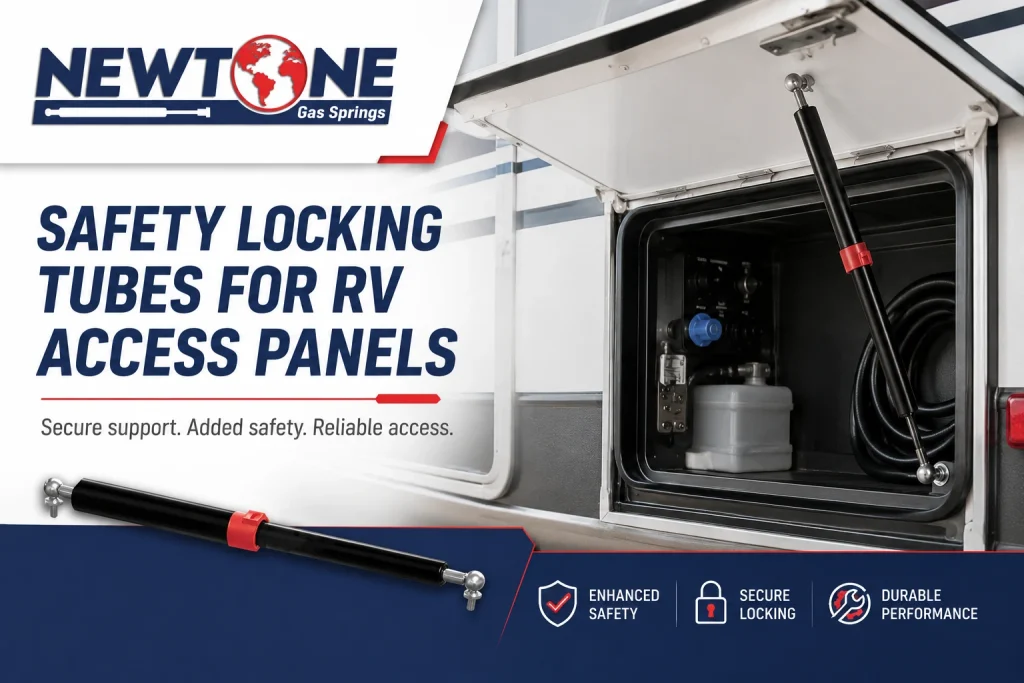
Gas spring safety locking tubes for RV access panels are worth specifying wherever a technician, dealer, or owner works underneath or beside a panel that’s held open by gas springs alone — generator compartments, engine hatches, and battery access covers being the most common cases. They’re not needed on every RV panel; a simple storage compartment nobody stands under doesn’t carry the same risk profile as a hatch someone works beneath during service.
A locking tube is a separate mechanical accessory fitted around an existing gas spring. It doesn’t add lifting force — it adds a physical backstop that keeps the panel from closing unexpectedly if the spring loses pressure, gets bumped, or the vehicle shifts on uneven ground while someone’s reaching into the compartment below. For RV builders and service networks, the real question isn’t whether the product works — it’s which panels on the vehicle actually justify it.
Which RV Panels Actually Need a Safety Locking Tube
Not every gas-spring-supported panel on an RV carries the same risk if it closes unexpectedly. The deciding factor isn’t the panel’s weight or force rating — it’s whether a person is likely to be positioned underneath or directly beside it while it’s open. That distinction gets skipped in most general safety-tube guidance, which tends to list every possible application without ranking them by actual exposure.
On a typical RV, three panel categories carry real exposure: generator compartments, where a technician reaches in with both hands during servicing; engine or drivetrain access hatches, worked on from below or beside; and battery compartments, opened for inspection or replacement with hands close to the hinge line. A simple exterior storage door, by contrast, is usually opened, reached into briefly from the side, and closed — nobody positions themselves under it the way they would a service hatch.
Sizing the Panel Before Sizing the Tube
Moment balance about the hinge
F = (W × Lg × cos φ) ÷ (n × r)
Worked example — a generator compartment hatch on a Class A motorhome, weighing 11 kg (24.3 lb), hinge-to-CoG distance of 380 mm (15 in), checked at 65° open, one spring with a 95 mm (3.7 in) perpendicular moment arm:
W = 11 × 9.81 = 107.9 N (24.3 lbf)
F = (107.9 × 0.38 × cos65°) ÷ (1 × 0.095) = (107.9 × 0.38 × 0.4226) ÷ 0.095 = 181.6 N (40.8 lbf)
With a 1.2 safety factor for a service-access safety case: Fdesign = 181.6 × 1.2 = 217.9 N (49 lbf)
The locking tube’s job starts after this number, not instead of it. The gas spring still has to be correctly sized for the panel — the tube is a backup, not a substitute for getting the force calculation right. A locking tube added to an undersized spring just means the panel drops less far before the tube catches it; it doesn’t fix the underlying spec problem.
Mounting a Locking Tube on RV Compartments
The locking tube fits around the gas spring’s cylinder body and is sized to the spring’s diameter and stroke, not to the panel itself. On RV compartments this generally means confirming three things before ordering: the spring’s cylinder diameter, so the tube’s inner dimension matches; the stroke length, so the tube provides coverage through the full range the technician needs supported; and the available clearance around the spring, since RV compartments are often tighter than industrial equivalents and a tube that can’t be engaged by hand in the installed position doesn’t help anyone.
Where the geometry allows it, mount the gas spring with the rod pointing down in the closed position — standard good practice that keeps oil at the seal regardless of whether a locking tube is also fitted. The tube itself should remain easily reachable when the panel is open; a locking tube mounted somewhere a technician has to stretch or use a tool to engage tends to get skipped in practice, which defeats the purpose.
A Field Case: When a Panel Gets Reclassified
We worked with an RV service network that had specified standard gas springs, no locking tube, on a mid-range motorhome’s engine access hatch — reasonable at the time, since the original design treated it as an occasional-access panel. Once the vehicle was in service, their technicians reported regularly working underneath the open hatch for routine maintenance, not just occasional repairs, which changed the actual exposure well beyond what the original spec assumed. Adding a locking tube to the existing spring, without changing the door or bracket, closed that gap without a design revision. The lesson generalizes: how a panel is used in the field can end up different from how it was classified on paper, and it’s worth checking that against the original assumption periodically rather than only at the design stage.
Most common spec mistake: applying safety locking tubes uniformly across every RV compartment, or skipping them entirely, instead of reviewing panel by panel. Over-specifying adds unnecessary cost across a product line; under-specifying leaves genuine service-access panels without a backup that would have been inexpensive to include at the design stage.
Frequently Asked Questions
Do all RV access panels need a safety locking tube?
No. Panels where a technician or owner works underneath or beside the open panel — generator compartments, engine hatches, battery access — benefit most. A simple storage door that’s opened, reached into briefly, and closed generally doesn’t carry the same exposure.
Does a safety locking tube replace the need to size the gas spring correctly?
No. The tube is a mechanical backup, not a substitute for correct force sizing. An undersized spring with a locking tube still isn’t holding the panel the way it should during normal operation — the tube only helps if the spring loses pressure or fails unexpectedly.
Can a safety locking tube be added to an RV panel that’s already in production?
Yes. It fits around the existing gas spring’s cylinder and doesn’t require changes to the door, hinge, or mounting hardware, provided there’s enough clearance around the spring for the tube to be positioned and engaged.
What information is needed to select a locking tube for an RV compartment?
The gas spring’s cylinder diameter and stroke length are the starting point, along with the available installation clearance around the spring in the compartment.
How do I know if an RV panel’s risk classification has changed after it’s in service?
Check with the service or dealer network on how the panel is actually being accessed in the field. A panel originally designed for occasional access can end up seeing regular hands-under-the-panel servicing once the vehicle is in real-world use, which changes whether a locking tube is worth adding.
Sourcing RV Safety Locking Tubes from Newtone
A safety locking tube earns its place on the panels where someone actually works underneath or beside the open compartment, not as a blanket spec across every door on the vehicle. Size the gas spring correctly first, then review the panel list for real exposure before deciding where the tube belongs.