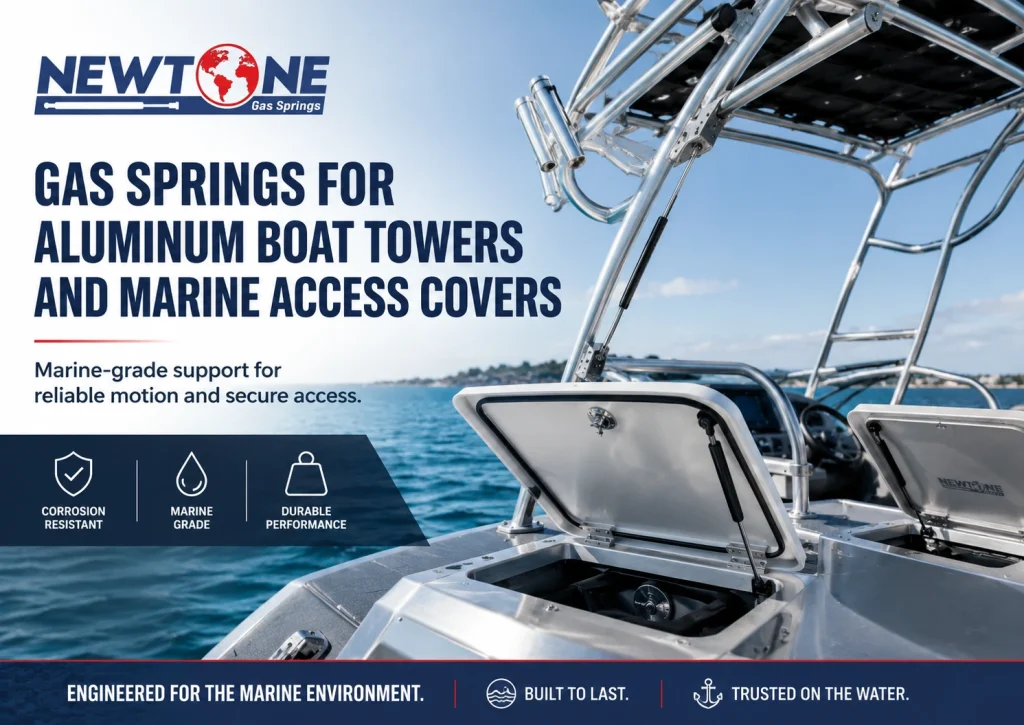
Force-matched gas springs for aluminum tower fold arms, hatches, and engine access covers — sized for saltwater, vibration, and real deck geometry, not a single catalogue number.
Gas springs for boat towers and marine access covers are not the same specification job, even though they often get ordered as one line item. A tower fold-arm strut has to hold a moving aluminum structure against wind, tow-rope shock, and boat-wake vibration; a hatch strut just has to hold a lid against its own weight. Size both from the same number and one of them will be wrong — usually the tower, because it carries loads the hatch never sees.
Take a 26-foot center console with a folding aluminum tower and three flush hatches over rod storage and the engine box. The yard building it specified one gas spring part number across all five locations to keep the purchase order simple. The hatches have held up fine for years. The tower struts went soft within a season — undersized for a load path that also has to survive vibration and shock, not just static weight.
How Gas Springs for Boat Towers Differ from Hatch Struts
A tower fold arm and a hatch lid are both hinged panels, so the same governing equation applies to both — but the numbers that go into it are very different. The tower’s center of gravity sits further from the hinge, the mounting geometry is tighter because of tube diameter, and the whole assembly is exposed to dynamic loading the moment the boat is underway. A hatch, by contrast, is a static problem: weight, angle, done.
Moment balance about the hinge (governs both cases):
F = (W × Lg × cos φ) ÷ (n × r)
W = supported weight (N) · Lg = hinge-to-CoG distance · φ = load-arm angle above horizontal · r = spring’s perpendicular moment arm · n = number of struts
The variable that actually separates the two applications is r and how it moves through the stroke. On a hatch, r stays fairly constant because the geometry is simple. On a folding tower arm, the strut’s effective moment arm changes shape more sharply as the arm swings through its range, which is why tower struts are more sensitive to a mounting point moved even 20 mm off spec than a hatch strut is — see the mounting notes below before you drill anything.
Sizing Gas Springs for Boat Towers: A Worked Example
Here’s a real worked case for a typical two-strut aluminum fold arm, using the moment balance above.
Given: Fold-arm assembly weight W = 18 kg (176.6 N / 39.7 lbf) · hinge-to-CoG distance Lg = 550 mm (21.7 in) · worst-case angle φ = 0° (arm horizontal, cos φ = 1) · strut moment arm r = 90 mm (3.5 in) · n = 2 struts (paired)
F = (176.6 N × 550 mm) ÷ (2 × 90 mm) = 539.6 N (121.3 lbf) per strut
Apply a safety-factor surcharge for outdoor, wind- and vibration-exposed loads (SF = 1.2, within the standard 1.1–1.3 range):
F_design = 539.6 N × 1.2 = 647.5 N (145.6 lbf) per strut → round up to the nearest catalogue rating, 650 N (146 lbf) per strut
That 20% margin isn’t padding — it’s what keeps the arm from feeling heavy the moment it’s loaded with a bimini, antenna, or a hand pulling down on it to fold it, none of which show up in a bare static weight-in-the-shop measurement. A hatch strut, carrying only its own lid weight in a sheltered compartment, rarely needs more than a 1.1 factor. This is one of the two places most competitor gas-spring pages get boat towers wrong: they either quote a single generic force range for “marine gas springs” or they only ever work the math for a hatch.
Single vs. Paired Struts on a Fold-Down Tower
Single Strut
Appropriate for light hatches and access panels under roughly 8 kg (18 lb) — rod storage lids, small electronics hatches, most flush deck plates. One strut, centered, is enough to hold the panel without side-load risk.
Paired Struts
Standard for tower fold arms and larger engine or storage hatches. Two struts split the load (F_each = F_total ÷ n) and, just as important, balance it — an uneven pair twists the arm off-axis under fold. Paired struts must come from the same production batch and stay within Newtone’s ±5% force tolerance of each other, or the arm will visibly lean to one side through the fold cycle.
Two Metals, One Boat: Galvanic Isolation Between Aluminum Towers and Stainless Fittings
The most common corrosion problem on an aluminum tower has nothing to do with the gas spring itself — it’s what happens where a stainless steel end fitting or bracket bolts directly against bare aluminum tube. Aluminum is anodic relative to stainless steel; in a wet or salt-exposed connection, the aluminum becomes the sacrificial metal and pits at the contact point, often faster than the strut’s own rod ever would in normal service. This is a real, specific problem for boat towers that a hatch mounted into fiberglass or a composite deck never encounters, and it is the one gap almost every marine gas-spring page skips.
The fix is mechanical, not material: isolate the contact. A nylon or HNBR bushing at the fastener, a dielectric washer between bracket and tube, or a powder-coated barrier at the mating face all break the electrical path. Newtone’s standard black-nitrided rod (900–1000 HV, 20–30 µm) is a fine choice for a tower in moderate exposure once that isolation is in place; for continuous salt-spray zones, our stainless steel gas springs are worth the added cost — though switching rod material alone does not solve a galvanic-contact problem, isolation still has to be done at the mount.
We’ve seen this play out directly. A boat builder supplying a commercial fishing fleet along the Gulf Coast was getting early rod pitting on standard chrome-plated struts — switching to 316L stainless resolved that. A season later the same fleet operator noticed pitting on the aluminum tower legs themselves, right around the new stainless mounting bolts. The stainless fittings were sitting flush against bare aluminum with no isolation. Adding isolating bushings at the mounts stopped it. The strut material was never the actual problem the second time — the metal-to-metal contact was.
Cold Weather and Salt Spray: What Actually Changes the Force
Gas spring force drops with temperature, at roughly 0.3% per °C below the 20°C bench-test baseline (F_T ≈ F_20 × [1 + 0.003 × (T − 20)]). For the 650 N strut sized above, at −20°C that’s F_T ≈ 650 N × [1 + 0.003 × (−40)] = 650 N × 0.88 ≈ 572 N (128.6 lbf) — about 12% under the design target of 647.5 N. For boats stored or launched in cold-climate marinas over winter, that gap is worth building into the initial spec rather than discovering it as a “the tower feels heavy in January” complaint. Salt spray, by contrast, doesn’t change force — it changes seal and rod life, which is what HNBR seals (UV- and ozone-resistant) and the corrosion path above are actually addressing.
Mounting the Strut Correctly
A few points apply to both towers and access covers and are easy to get wrong on a retrofit:
Rod orientation: mount with the rod pointing down in the closed/stored position wherever the geometry allows it — gravity keeps the internal oil at the seals, which keeps damping consistent and the stroke quiet. End fittings and brackets: choose mounting brackets and ball socket or eyelet ends rated for the load and able to tolerate slight angular misalignment through the stroke; a rigid, perfectly axial mount on day one can still side-load the rod once the tower flexes under load. Pivot placement: moving the strut’s lower mount point changes the effective moment arm more than swapping to a higher-force strut does — if a fold arm feels wrong, check geometry before ordering a stronger spring. Side-load avoidance: gas springs are built for axial load only; keep both pivots in the same plane of motion, especially on a tower arm that can twist slightly under wind load.
Quick Specification Reference
| Application | Typical Force Range | Recommended Build | Configuration |
|---|---|---|---|
| Aluminum tower fold arm | 400–800 N (90–180 lbf) | Black nitrided rod + HNBR, isolated mount; stainless steel in heavy salt-spray zones | Paired, same batch |
| Small hatch / access panel (<8 kg / 18 lb) | 50–100 N (11–22 lbf) | Black nitrided rod + HNBR | Single |
| Large engine hatch or storage lid | 150–250 N (34–56 lbf) | Stainless steel for coastal/saltwater exposure | Paired |
| Maintenance access requiring hands-free hold | Per geometry — engineering support available | Locking gas spring | Single or paired |
Why Source Gas Springs from Newtone
Production facility in Turkey, exporting to 60+ countries — OEM and aftermarket supplied from the same platform.
Same-batch pairing available for tower and multi-strut hatch applications.
UV- and ozone-resistant, standard across the range.
−40°C to +100°C (−40°F to +212°F) operating range.
Frequently Asked Questions
What force gas spring do I need for a boat tower fold arm?
It depends on the arm’s weight, the hinge-to-center-of-gravity distance, and where the strut mounts on the arm — use the moment-balance formula above as a starting point. Because tower geometry varies by model, Newtone’s engineering support can confirm the final figure from your actual dimensions rather than a generic estimate.
Should tower struts be stainless steel?
Only where the boat sees continuous salt-spray or saltwater exposure. Elsewhere, a black-nitrided rod with HNBR seals is sufficient and more cost-effective — the more important detail is isolating any stainless fitting from bare aluminum at the mount, regardless of rod material.
Why is my aluminum tower corroding near the gas spring mounts?
This is usually galvanic corrosion from a stainless bracket or fastener in direct contact with bare aluminum, not a fault of the strut itself. Adding a dielectric bushing or washer at the fastener interface breaks the electrical path and stops it.
Can I use the same gas spring on my tower and my engine hatch?
Not reliably. Tower fold arms typically need 400–800 N (90–180 lbf) with a higher safety factor for wind and vibration; hatches usually need 50–150 N (11–34 lbf) for static hold. Specifying one part number for both usually means one of the two is wrong.
How does cold weather affect gas spring force on a boat?
Force drops roughly 0.3% per °C below the 20°C bench baseline. A strut rated at 650 N at room temperature delivers roughly 572 N at −20°C — about 12% less holding force — so cold-climate applications should be sized with that margin from the start.
Boat towers and marine access covers share the same underlying physics but almost never the same numbers, and treating them as one spec is the single most common mistake we see on aluminum builds. Get the geometry, the force, and the mount isolation right on each one separately, and both parts of the boat outlast the rest of the hardware around them.