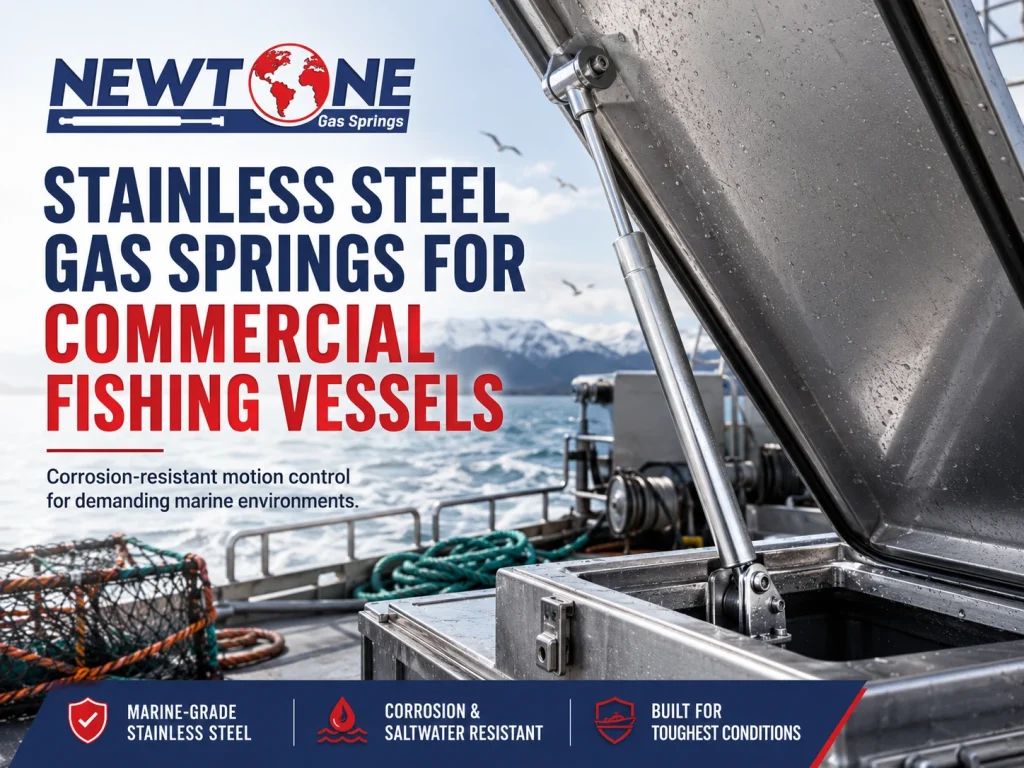
Commercial Fishing Vessels
Lift support for fish hold hatches, deck hatches, wheelhouse doors, and engine room access — specified for daily cycling, washdown chemicals, and crew safety, not weekend boating.
What Gas Springs for Commercial Fishing Vessels Need to Handle
Gas springs for commercial fishing vessels need to do three things a recreational boat hatch spring rarely has to: lift a heavier, often wet or iced panel, survive daily washdown with chlorine-based deck sanitizers as well as salt spray, and hold up under a duty cycle measured in cycles per day, not cycles per season. Get any one of those wrong and the hatch that used to open with one hand starts needing two — or worse, starts dropping.
Picture an offload morning on a trawler: the fish hold hatch comes up before first light and stays open through several separate lifts as the catch comes aboard, then gets shut against spray before the next set starts. By mid-season that hatch has been cycled more times than a car trunk lid sees in a decade. At Newtone Gas Springs, we manufacture in Turkey and export to more than 60 countries, and a meaningful share of that volume goes into commercial marine and fishing fleet applications alongside our OEM programs for RV, industrial, and automotive builders. This page covers what actually changes once the application moves from a weekend boat to a working vessel.
Who this page is for: naval architects and OEM engineers specifying hatch and door hardware for new-build trawlers, purse seiners, and longliners; shipyard refit teams replacing worn-out hatch springs; and fleet procurement managers standardizing hardware across a fishing fleet.
Where Gas Springs for Commercial Fishing Vessels Actually Work Hardest
Five components account for most of the gas spring demand on a working fishing vessel, and each one wears differently depending on how it’s used and what it’s exposed to.
Fish Hold Hatch Covers
The single heaviest-duty application on the boat. Steel or insulated aluminum covers, cycled multiple times per offload, exposed to brine, ice slurry, and direct spray. Usually paired springs, stainless recommended.
Deck & Weather Hatches
Storage, gear, and net-locker access across the open deck. Full salt spray exposure and the first place corrosion typically shows up on fittings and brackets rather than the spring body.
Wheelhouse & Cabin Doors
Lower cycle count but real load: holding a door steady against wind and vessel roll in a seaway matters more here than raw lift force.
Engine Room Access Hatches
Heavy steel plate, opened daily for checks and maintenance. A locking gas spring is worth considering here — nobody wants a hatch dropping on them mid-inspection.
Processing & Gutting Station Lids
Cycled constantly during a catch run, often several times an hour rather than several times a day. Highest exposure to sanitizing chemicals of any panel on the boat.
How Duty Cycle and Crew Safety Change the Spec
The gas spring rated correctly for a recreational boat hatch is very often undersized for a working fishing vessel — not because the water is any saltier, but because the hatch opens far more often, and someone is usually standing under it when it does.
We heard a version of this from a trawler operator in the Pacific Northwest a couple of seasons back: fish hold hatch springs that should have lasted years were feeling weak within a single season. The springs weren’t defective — they were sized correctly for a recreational hatch cycled a handful of times per outing, but this hold was being opened a dozen-plus times a day through an active offload season. The fix wasn’t a stronger spring; it was matching the cycle rating to the actual duty cycle and choosing a spring built to tolerate frequent compression without static-load creep.
There’s also a safety dimension recreational marine suppliers rarely mention. A fish hold or processing station lid failing to hold open isn’t just an inconvenience — it’s dropping onto a crew member’s hands or head during gutting or offload, when attention is on the catch, not the hatch. On any panel a crew member routinely works under, a locking gas spring — one that holds mechanically at full extension instead of relying on gas pressure alone — is worth the modest added cost.
Washdown chemistry is the other overlooked factor. Fishing vessels get sanitized daily with chlorine-based or quaternary-ammonium compounds around processing areas, not just rinsed with seawater. HNBR seals hold up well against UV and ozone, which is why we specify them as standard, but the seal package and end-fitting coatings are still worth reviewing separately for a vessel running an aggressive sanitizing routine rather than a purely saltwater one.
Sizing for Duty Cycle: A Service-Life Calculation
The number that matters most for fishing vessel gas springs isn’t just force — it’s how many years of service a given cycle rating actually buys at real-world usage rates, and that’s a straightforward calculation.
Service-Life Formula
Service years ≈ Rated cycles ÷ cycles-per-day ÷ 365
Take a fish hold hatch on an active trawler, cycled an average of 12 times per day across a full operating year (offload days run higher, off-season days run near zero, and 12/day is a reasonable full-year average). At Newtone’s minimum 100,000-cycle rating:
Service years ≈ 100,000 ÷ 12 ÷ 365 ≈ 22.8 years
Now run the same duty cycle against a commodity-grade strut built for occasional automotive or consumer use, typically rated closer to 20,000 cycles:
Service years ≈ 20,000 ÷ 12 ÷ 365 ≈ 4.6 years
That gap — roughly two decades versus under five years — lines up closely with the early-failure complaints seen in owner forums, where hatch struts on working boats are frequently replaced every few seasons. The spring wasn’t necessarily wrong for a boat; it was wrong for this boat’s usage pattern.
Cycle life is only half of correct sizing. The other half is the moment balance for the hatch’s actual weight and pivot geometry — F = (W × Lg × cos φ) ÷ (n × r) — and a safety-factor surcharge of 10–30% is worth adding to the calculated force on any hatch exposed to wind or following-sea loading: Fdesign = F × SF. Share your hatch dimensions and expected usage pattern and we’ll run both calculations rather than quote off a single force number.
Stainless Steel or Black-Nitrided: What Actually Needs to Be Stainless
Not every gas spring on a fishing vessel needs to be stainless steel — exposure, not vessel type, decides the material. Fish hold hatches, deck hatches, and processing lids sit in direct spray and washdown chemical contact, which puts them squarely in stainless-steel territory. A protected interior door, like a wheelhouse or cabin door with no direct spray or chemical exposure, can usually run on a black-nitrided rod (900–1000 HV, 20–30 µm treatment depth) with HNBR seals at a meaningfully lower cost without giving up service life.
The deeper material comparison — chloride resistance between grades, seal-interface wear mechanics, whole-system corrosion across fittings and brackets — is its own subject. For a fishing vessel component list, the practical decision usually comes down to one question: does this panel sit in direct exposure, or is it protected inside the hull?
Single Spring or Paired: Sizing Fish Hold and Deck Hatches
⬤ Single Spring Setup
- Panel weight under ~6 kg (13 lb)
- Narrow processing or utility lids
- Centered hinge, no lateral flex
- Wheelhouse and cabin doors
- Lower cost, simpler installation
⬤ Paired Spring Setup
- Fish hold hatch covers, 6 kg and above
- Wide deck or insulated hatches
- Steel or heavy composite covers
- Applications needing even load distribution
- Springs must be force-matched (±5% tolerance)
Specifying Gas Springs for Commercial Fishing Vessels: Quick-Reference Table
| Component | Typical Weight | Recommended Force | Spring Count | Material Direction |
|---|---|---|---|---|
| Fish hold hatch (large steel) | 15–30 kg (33–66 lb) | 250–500 N each (56–112 lbf) | 2 | Stainless 316 recommended |
| Fish hold hatch (aluminum, small) | 6–14 kg (13–31 lb) | 130–220 N each (29–49 lbf) | 2 | Stainless 316 recommended |
| Deck / weather hatch | 4–10 kg (9–22 lb) | 100–200 N (22–45 lbf) | 1–2 | Stainless recommended |
| Wheelhouse / cabin door | 3–8 kg (7–18 lb) | 80–150 N (18–34 lbf) | 1 | Black-nitrided sufficient |
| Engine room access hatch | 10–20 kg (22–44 lb) | 180–320 N each (40–72 lbf) | 2 | Consider locking + stainless |
| Processing / gutting station lid | 2–6 kg (4–13 lb) | 60–120 N (13–27 lbf) | 1 | Stainless — chemical washdown |
These figures are starting-point estimates. Final force depends on hinge offset distance, opening angle, and the actual duty cycle for that vessel’s operating pattern — so share your hatch dimensions and usage rate with our team, and we’ll return a force recommendation along with the service-life calculation.
Why Fishing Fleet Builders Source from Newtone
We’re a manufacturer, not a distributor. Every spring is built in our own facility in Turkey, which means we control tolerances, material sourcing, and lead times — not a third party.
Frequently Asked Questions
It depends on the component and its exposure. Fish hold hatch covers, deck hatches, and processing station lids are usually best specified in stainless steel due to direct spray and washdown chemical exposure, while protected interior doors such as wheelhouse or cabin doors can typically use a black-nitrided rod with HNBR seals. All should carry a cycle rating matched to actual daily usage, not a generic marine rating.
Small aluminum hatches under roughly 6 kg (13 lb) with a centered hinge can often use a single spring. Most fish hold hatch covers are heavier and wider than that, so two paired, force-matched springs are the standard approach to avoid uneven lift and one-sided hinge wear.
Not universally. Stainless steel is the right call for anything exposed to direct salt spray, deck washdown, or chlorine-based sanitizing chemicals — fish hold hatches, deck hatches, and processing lids fall into that category. A protected interior door with no direct exposure can usually run on a black-nitrided rod with HNBR seals at a lower cost.
It depends on the cycle rating versus actual daily use, not calendar time. A fish hold hatch cycled a dozen or more times a day during active operation will use up a 100,000-cycle rating in roughly two decades of service, but a spring rated for occasional recreational use can be exhausted in under five years under that same duty cycle, which is the most common cause of premature failure complaints.
Yes. Newtone manufactures gas springs in Turkey and exports to more than 60 countries, supplying both new-build OEM programs and aftermarket replacement from the same product platform, so a shipyard’s service network can source an exact match to the original specification.
Conclusion
A correctly specified gas spring on a fishing vessel does its job through hundreds of offload cycles, seasons of washdown, and years of salt exposure without becoming a maintenance item. A poorly specified one — sized for recreational use, or missing the chemical exposure on a processing deck — turns into a recurring safety and repair problem within a season or two. The gap between the two comes down to matching force, material, and cycle rating to how the vessel is actually used, not just where it’s used.
Newtone supplies gas springs for OEM fishing vessel builds and shipyard refit programs alongside our broader marine and industrial product range. If you’re specifying hatch hardware for a new hull, replacing worn springs during a refit, or standardizing hardware across a fleet, share your component list and duty cycle with us. We’ll come back with a force and service-life recommendation, a product datasheet, and a quote.
Get a Specification or Quote
Tell us your hatch or door type, weight, mounting geometry, and how often it’s cycled. Our engineering team handles the rest — force and service-life calculation, sample datasheet, and competitive pricing.