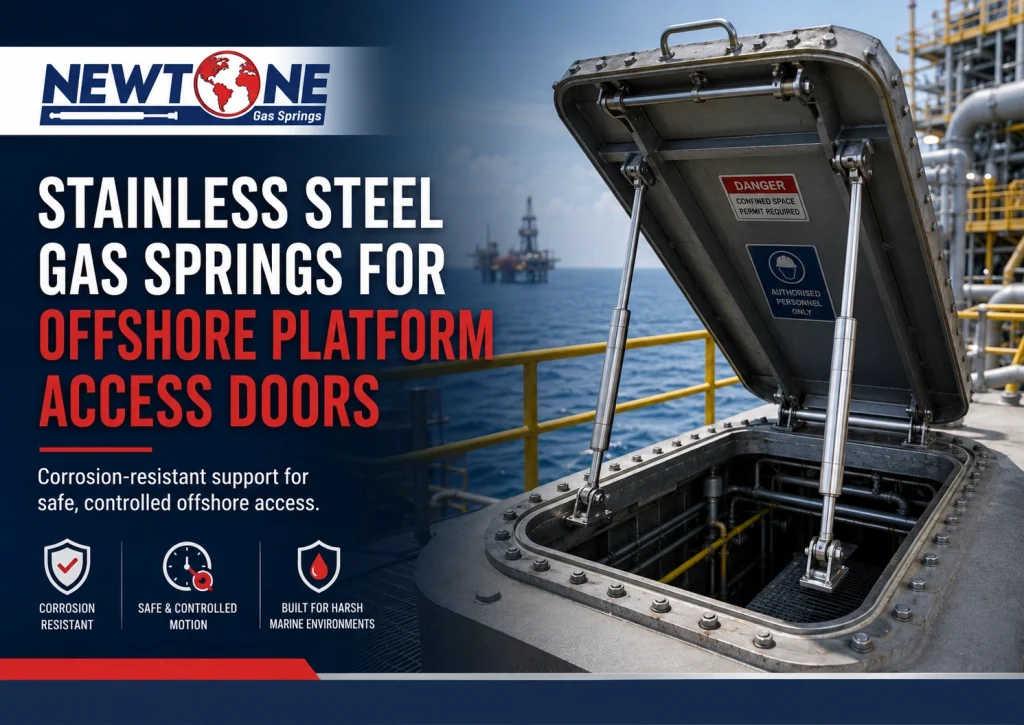
Stainless steel gas springs for offshore platform access doors should be specified when salt spray, humidity, washdown, wind exposure or corrosion risk can threaten rod surface, seal life and safe hold-open behavior. In offshore service, corrosion is not just a cosmetic issue; once the rod surface pits or the fittings bind, the access door can lose smooth motion, force support and predictable service behavior.
An offshore platform access door may protect electrical cabinets, valve areas, inspection points, utility covers, generator enclosures or maintenance compartments. These doors are opened in salt air, high humidity, strong wind, vibration and wet service conditions. If the gas spring corrodes, sticks, loses force or side-loads the rod, the technician feels it immediately. The door becomes heavier, less controlled and less trustworthy.
Why Offshore Platform Access Doors Need Stainless Steel Gas Springs
Offshore platform access doors need stainless steel gas springs when the environment can attack the rod, end fittings, brackets or sealing system. A standard industrial gas spring may work well in a clean inland environment, but offshore exposure is different: salt air, water spray, condensation, wind-driven particles and regular washdown all work against exposed metal surfaces.
The most sensitive area is the rod-seal interface. The gas spring rod moves through the seal on every cycle. If corrosion creates pitting on that rod, the surface can act like a file against the seal. Once the seal is damaged, oil leakage, force loss and rough movement can follow.
This is why stainless steel is not only about appearance. On offshore access doors, stainless steel protects the motion system. It helps preserve rod surface quality, keeps fittings more reliable and reduces the chance that a service hatch becomes difficult to open at the worst moment.
Offshore Corrosion Is a Motion-Control Failure, Not Just a Surface Finish Problem
Offshore corrosion becomes a motion-control failure when it changes how the access door moves, holds and closes. Rust on a bracket may look minor at first. Pitting on a gas spring rod is more serious because it directly affects the seal path.
A pitted rod can damage the seal. A damaged seal can allow oil or gas loss. Loss of gas pressure changes the force available to support the door. At that point, the problem is no longer “the finish looks bad.” The access door may drop faster, feel heavier, fail to hold open or require a technician to support it manually.
We have seen this pattern with coastal equipment operators: standard or poorly protected rods look acceptable during early use, then small surface defects appear after repeated exposure. The door still opens, so the issue gets ignored. Months later, the spring feels weak and the seal area shows wear. Switching to stainless steel gas springs, and reviewing the fittings and bracket alignment at the same time, is the cleaner fix than replacing failed parts repeatedly.
Where Stainless Steel Gas Springs Are Used Offshore
Stainless steel gas springs are used offshore on access doors, inspection hatches, electrical enclosures, valve covers, generator and utility covers, service panels, deck access points and equipment cabinets. The common factor is not the door name; it is exposure plus the need for controlled access.
On a platform, an access door may need to stay open while a technician checks instruments, valves, wiring, ventilation components or mechanical assemblies. If the door is heavy or located in a windy area, uncontrolled movement can create a real maintenance problem.
For smaller inspection covers, a single stainless gas spring may be enough. For wide or heavy access doors, paired stainless gas springs are usually better because they spread the load and reduce twisting. The door geometry, not the product category, decides the correct layout.
Force Calculation for Offshore Platform Access Doors
The first force calculation for a hinged offshore access door is the moment balance about the hinge. Door weight alone is not enough because the hinge-to-centre-of-gravity distance and spring mounting position decide the required force.
Formula:
F = (W × Lg × cos φ) ÷ (n × r)
Where:
F = required force per gas spring
W = door weight in Newtons
Lg = hinge-to-centre-of-gravity distance
φ = door angle above horizontal
n = number of gas springs
r = effective perpendicular moment arm of the spring
First convert mass to Newtons:
W = m × g
Example: an offshore access door weighs 28 kg (62 lb). The centre of gravity is 500 mm (19.7 in) from the hinge. The door is checked at a 55° open angle. Two stainless steel gas springs are used, and each spring has an effective perpendicular moment arm of 140 mm (5.5 in).
W = 28 × 9.81 = 275 N (62 lbf)
F = (275 × 0.50 × cos55°) ÷ (2 × 0.14)
F = 78.9 ÷ 0.28 = 282 N per spring (63 lbf per spring)
With a moderate offshore service factor of 1.2 for wind, vibration and field variation:
F_design = 282 × 1.2 = 338 N per spring (76 lbf per spring)
This does not mean every offshore access door needs 338 N (76 lbf). It means this geometry points to that range. Changing the bracket position or the open angle can move the required force significantly. Guessing from door weight alone is not reliable.
316 / 316L Stainless vs Coated or Black Nitrided Rods
316 or 316L stainless steel should be reviewed when the access door works in salt spray, coastal air, washdown, high humidity or offshore exposure where corrosion can shorten gas spring life. In cleaner industrial environments, black nitrided rods with HNBR seals are often a strong standard solution. Offshore exposure changes the decision.
Newtone’s black nitrided rods are used widely in demanding industrial applications, with a typical surface hardness of 900–1000 HV and treatment depth of 20–30 µm. That is a strong rod surface for many environments. But where chloride exposure and constant humidity are present, stainless steel becomes the safer material choice.
The decision should include the whole assembly. A stainless gas spring mounted with weak or corroding brackets is not a complete offshore solution. End fittings, brackets and fasteners should be reviewed together so the system does not fail at the hardware around the spring.
Single vs Paired Stainless Steel Gas Springs
Single stainless steel gas springs can work on narrow or lighter offshore access doors, but paired springs are usually better for wide, heavy or safety-sensitive panels. Two springs share the load and help prevent twisting across the hinge line.
Paired springs should be force-matched. If one side produces noticeably more force than the other, the door may open unevenly, load one hinge harder or create side-load through the motion. Offshore doors are already exposed to wind and vibration, so poor matching adds another unnecessary stress.
Newtone controls gas spring force tolerance at ±5%, which supports repeatable paired behavior. For OEM production, matched stainless gas springs from the same platform are cleaner than mixing parts that only look similar by nominal force.
Mounting Guidance for Offshore Access Doors
Mounting guidance for offshore access doors starts with alignment. Gas springs are designed for axial load, not side-load. Both pivots should stay in the same plane of motion, and the end fittings should allow the angular movement required by the door.
Where the geometry allows it, mount the gas spring with the rod pointing down in the at-rest or closed position. This helps keep oil near the seal and supports smoother damping. On offshore equipment, consistent damping matters because doors may be opened in wind, spray and difficult service conditions.
The spring should not be used as a hard mechanical stop. The access door should have a proper open stop or structural limit where needed. If the gas spring bottoms out before the door reaches its intended stop, the rod, brackets and seals can see shock loads.
Service clearance matters as well. The gas spring and brackets should not block handles, latches, wiring access, valve access, inspection ports or technician hand paths. A door that opens well but blocks maintenance is still a poor design.
When to Use Locking Gas Springs or Safety Tubes Offshore
Locking gas springs or safety tubes should be reviewed when an offshore access door must stay open while a person works under or near it. A stainless steel gas spring can resist corrosion and support motion, but corrosion resistance is not the same as a mechanical safety lock.
For heavy top-hinged covers, inspection hatches and service doors exposed to wind, a locking safety tube can add full-extension backup. For panels that need intermediate position holding, a locking gas spring may be more suitable. The choice depends on how the door is used and what happens if it closes unexpectedly.
In offshore service, the consequence of a falling door can be serious. If a technician needs both hands free under a raised cover, the design should not rely only on gas pressure. Mechanical backup deserves review.
Common Specification Mistakes
The most common mistake is specifying a stainless steel gas spring but ignoring the surrounding hardware. If the spring is stainless but the brackets, pins or fittings corrode, the motion system can still bind, misalign or side-load the rod.
The second mistake is overspecifying force. More force may seem safer, but too much force can make the access door hard to close, increase hinge load and keep the gas spring under unnecessary stress when the door is closed. Correct geometry is usually better than simply adding Newtons.
The third mistake is treating offshore as only a material problem. The material matters, but so do rod orientation, side-load avoidance, paired-spring matching, open stops, locking support and service clearance. A stainless spring in a bad geometry is still a bad installation.
Finally, do not assume every offshore access door needs the same spring. A small instrument cabinet door and a large service hatch may both require stainless steel, but their force, stroke, mounting and safety needs can be completely different.
Offshore Access Door Gas Spring Specification Checklist
| Specification point | Why it matters offshore |
|---|---|
| Door weight | Defines the supported load, but does not determine force by itself. |
| Hinge-to-CG distance | Controls the closing moment around the hinge. |
| Spring moment arm | Often affects required force more than the door weight alone. |
| Stainless material choice | Protects against salt spray, humidity, washdown and corrosion exposure. |
| End fittings and brackets | Must resist corrosion and allow movement without side-loading the rod. |
| Single or paired layout | Wide doors often need matched pairs to avoid twisting and uneven lift. |
| Rod orientation | Rod-down mounting helps keep oil near the seal where the geometry allows it. |
| Safety requirement | Locking gas springs or safety tubes should be reviewed if a person works under the door. |
Why Source Offshore Stainless Steel Gas Springs from Newtone?
Manufacturer, Not Distributor
Newtone manufactures gas springs in Turkey and exports to more than 60 countries for OEM and aftermarket applications.
Stainless Steel Options
Stainless steel gas springs can be reviewed for offshore, coastal, washdown and high-humidity access-door applications.
Engineering Review
Support is available for force, stroke, mounting points, paired springs, brackets, fittings and service-access safety.
Controlled Performance
±5% force tolerance, HNBR sealing and 100,000+ cycle capability support consistent behavior across production batches.
Frequently Asked Questions About Stainless Steel Gas Springs for Offshore Platform Access Doors
Why use stainless steel gas springs for offshore platform access doors?
Stainless steel gas springs should be used when salt spray, humidity, washdown or corrosion risk can damage the rod, fittings or brackets. Offshore corrosion can lead to rod pitting, seal wear, force loss and unreliable access-door movement.
Are stainless steel gas springs always required offshore?
They are strongly recommended where the gas spring is exposed to salt air, water spray, washdown or high humidity. If the part is fully protected inside a clean enclosure, the requirement should be reviewed by application, but exposed offshore access doors usually justify stainless steel.
How do you calculate force for an offshore access door gas spring?
Calculate force from the door weight, hinge-to-centre-of-gravity distance, opening angle, number of springs and effective spring moment arm. Door weight alone is not enough because mounting geometry changes the required force significantly.
Should offshore access doors use one gas spring or two?
Narrow and lighter access doors may use one gas spring, but wide or heavy offshore access doors usually work better with two matched stainless steel gas springs. Paired springs help reduce twisting and uneven hinge loading.
When should locking gas springs or safety tubes be used offshore?
Locking gas springs or safety tubes should be reviewed when a technician may work under or near a raised access door, or when wind and vibration could move the panel unexpectedly. A standard gas spring supports motion, but it is not a mechanical safety lock.
Final Engineering Takeaway
Stainless steel gas springs for offshore platform access doors should be selected as part of the whole access-door system. The spring material matters, but so do force, stroke, hinge geometry, paired matching, rod orientation, fittings, brackets and safety requirements.
Offshore corrosion is not just a surface finish issue. It can damage the rod-seal interface, reduce force retention and make an access door less predictable in service. Newtone can review stainless steel gas springs, mounting brackets and locking options together so offshore access doors open smoothly, hold safely and survive the environment better.