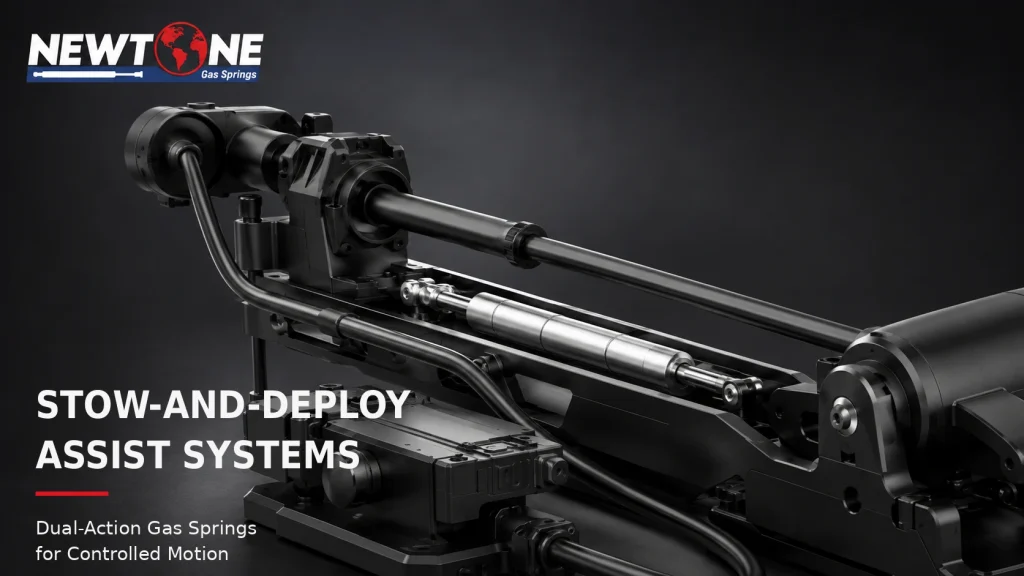
How dual-action gas springs assist deployment and control return in marine, medical, industrial, military and aerospace mechanisms.
A dual-action gas spring is a custom-engineered gas spring built to support or control motion in more than one movement phase — typically assisting deployment and controlling the return stroke — rather than only pushing one way like a standard compression gas spring.
Some mechanisms do not move in one simple direction. They need help during deployment, control during return, and sometimes different force behavior at different points of travel. In these cases, a standard compression gas spring may not be enough. This is where dual-action gas springs become useful.
Depending on the design, it may also be described as a double action gas spring, double rod gas spring, compression traction gas spring, or stow-and-deploy assist gas spring.
One of the clearest applications is a stow-and-deploy mechanism. These systems need assistance when moving from the stored position into the working position, and they also need controlled movement when returning back to the stowed position. But this product concept is not limited to stow-and-deploy systems. The same principle can be used in marine equipment, machinery covers, special access panels, medical equipment, food-processing machinery, military hardware, aerospace access systems and other mechanisms where one-way support is not enough.
- 1 What Is a Dual-Action Gas Spring?
- 2 Why the Name Can Be Confusing
- 3 Where Dual-Action Gas Springs Are Used
- 4 How Dual-Action Gas Springs Work in Stow-and-Deploy Systems
- 5 What Is a Double Rod Gas Spring?
- 6 Compression and Traction Support in One Custom Concept
- 7 Why a Standard Gas Spring May Not Be Enough
- 8 Fully Stainless Steel Production Option
- 9 Custom Anodized-Compatible Connection Heads
- 10 Geometry Matters More Than the Product Name
- 11 When Should You Consider a Dual-Action Gas Spring?
- 12 What Information Is Needed for a Custom Quote?
- 13 Why Choose Newtone for Dual-Action Gas Springs?
- 14 Frequently Asked Questions About Dual-Action Gas Springs
- 15 Final Takeaway
What Is a Dual-Action Gas Spring?
A dual-action gas spring is a special gas spring solution designed to support, control or balance motion in two functional directions or movement stages.
A standard compression gas spring pushes outward. It is commonly used on lids, hatches, covers, doors and access panels. A traction gas spring works in the opposite direction and pulls components toward each other.
A dual-action gas spring can be engineered around these different motion needs. In some applications, it may support deployment and control return. In others, it may combine compression and traction behavior, include damping, or use a double rod gas spring design to fit a compact mechanism. This makes it different from a normal catalog gas spring.
The first question should not be only: “How many Newtons do we need?” The better question is: “What should the mechanism do during each movement phase?”
Why the Name Can Be Confusing
There is no single global name for this product family. Different industries and catalogs may use different names for similar motion-control concepts.
Common terms include:
- Dual-action gas spring
- Double action gas spring
- Double action cylinder
- Double rod gas spring
- Compression traction gas spring
- Two-way gas spring
- Stow-and-deploy assist gas spring
For technical clarity, dual-action gas spring is usually the best main term. It keeps the product inside the gas spring and motion-control category while still explaining that the part does more than a standard one-direction support spring.
The term double action cylinder can also appear in catalogs, but it is broader and can create confusion with powered hydraulic or pneumatic cylinders. For Newtone’s positioning, dual-action gas spring and double rod gas spring are clearer and safer terms.
A simple definition would be: a dual-action gas spring is a custom gas spring solution used when a mechanism needs controlled assistance in more than one movement phase.
Where Dual-Action Gas Springs Are Used
Dual-action gas springs are used when the movement is more complex than a simple open-and-hold action. The most obvious example is a stow-and-deploy system. A marine mechanism, foldable device or compact equipment assembly may need help when deploying and controlled support when returning to its stored position.
However, the same product idea can be reviewed for many other applications. Possible use areas include:
- Marine stow-and-deploy systems
- Trolling motor lift-assist mechanisms
- Foldable marine equipment
- Special access panels and hatches
- Heavy-duty service covers
- Machine guards with two-stage movement
- Medical equipment covers and adjustable housings
- Food-processing machinery guards
- Military access covers
- Aerospace access systems
- Compact OEM motion systems
The industry can change. The motion problem stays the same. If the mechanism needs controlled movement during both deployment and return, a dual-action gas spring may be worth reviewing.
How Dual-Action Gas Springs Work in Stow-and-Deploy Systems
In a stow-and-deploy system, the moving assembly usually has two important phases. The first phase is deployment. The user wants the mechanism to move from its parked or stored position into its working position with less effort. A gas spring can help reduce the manual force required and make the motion feel smoother.
The second phase is stowing. When the mechanism returns to its stored position, the movement should not feel uncontrolled, heavy or unstable. Depending on the design, the gas spring can help guide, cushion or balance that return movement.
This is why a stow-and-deploy assist gas spring is different from a simple lid support. A simple gas spring might only help a cover stay open. A stow-and-deploy assist gas spring must work with the full movement path of the mechanism. It may need to assist in one phase, resist in another phase, or behave differently through different parts of travel. That is why geometry matters so much. Stroke length, mounting points, rod direction, moving pivots, force level, return speed and end fittings must all be reviewed together.
Formula — Moment balance about the hinge (deployment-phase force):
F = (W × Lg × cos φ) ÷ (n × r)
Where: W = supported weight (N), Lg = hinge-to-CoG distance, φ = load-arm angle above horizontal at the check position, r = spring’s perpendicular moment arm, n = number of springs.
Worked example — fold-out mast, single dual-action strut:
A 6 kg (13 lb) fold-out mast gives a weight of W = 6 × 9.81 = 58.9 N (13.2 lbf). The hinge-to-CoG distance Lg = 350 mm (13.8 in), the check angle φ = 30° above horizontal (cos 30° = 0.866), and the strut’s moment arm at that position r = 40 mm (1.57 in), with n = 1 spring.
F = (58.9 × 350 × 0.866) ÷ (1 × 40) = 446.3 N (100.3 lbf)
Outdoor, dynamically loaded deployment gets a safety-factor surcharge (F_design = F × SF, SF ≈ 1.15 for wind/motion load): F_design = 446.3 × 1.15 ≈ 513 N (115 lbf).
That figure sizes the deployment phase only. The stow (return) phase is a separate design decision — the force curve and damping behavior on the way back in are tuned independently, which is the core reason this is normally a custom project rather than a single-number catalog spec. The force ratio between the two ends of stroke (K = P2 ÷ P1) is one of the values reviewed when the deployment and stow phases need noticeably different force behavior.
On one recent project, a compact-equipment OEM building a fold-out marine antenna mount sent us their travel dimensions and their own estimate for the deployment force. When we ran the moment balance on their actual mounting geometry, their planned lower pivot point put the moment arm much closer to the hinge than they had assumed, and their force estimate was meaningfully off. We adjusted the mount point instead of simply raising the spring’s rating, and the finished dual-action strut deployed the mast smoothly while controlling the stow return without needing a separate damper.
What Is a Double Rod Gas Spring?
A double rod gas spring is a special gas spring design where the motion-control function may involve rod movement from both sides of the cylinder body, or a custom internal structure that supports two-phase movement.
This term is important because many buyers describe the product by what they see. If the component has a cylinder body and rod movement from both ends, “double rod gas spring” becomes a natural search term.
A double rod gas spring may be considered when:
- The mechanism needs support in two directions
- The available installation space is limited
- A standard compression gas spring cannot follow the motion path
- Compression and traction behavior are both required
- Return movement needs to be controlled
- The design needs special damping or speed behavior
- The complete mechanism must stay compact
A double rod gas spring is normally not a simple replacement item. It is usually a custom-engineered product built around the application.
Compression and Traction Support in One Custom Concept
A dual-action gas spring can be designed with different motion behaviors depending on the application. One project may need stronger assistance during deployment and lighter control during return. Another may need the opposite. A third may need compression behavior in one direction and traction gas spring behavior in another.
This is why these products are normally discussed as custom projects, not standard catalog parts. Possible design requirements may include:
- Compression force
- Traction force
- Different force values in each movement phase
- Different movement speeds
- Damping in extension
- Damping in compression
- Damping in both directions
- Double rod gas spring configuration
- Special end fittings
- Compact installation space
- Stainless steel construction
- Custom mounting geometry
The right design is not always the strongest design. It is the one that makes the mechanism move safely, smoothly and predictably.
Why a Standard Gas Spring May Not Be Enough
A standard compression gas spring is still the right choice for many applications. If the job is to lift a hatch, hold a cover open or reduce the weight of a lid, a standard gas spring can be simple and reliable.
But some mechanisms need more. A standard gas spring may not be enough when:
- The system has two active movement phases
- Deployment and return both need support
- The mechanism needs compression and traction behavior
- Return speed must be controlled
- Space is too compact for separate components
- A standard spring creates too much force in one position
- The mechanism needs a special force curve
- Damping and force support must be integrated
In these cases, a dual-action gas spring or double rod gas spring may be the better direction. The goal is not to make the part more complicated. The goal is to make the mechanism easier, safer and more controlled for the user.
⚠ Most common mistake: treating a dual-action requirement as a force question first. Deployment force, stow-phase behavior, damping and mounting geometry are separate decisions — sizing one spring number before the movement path is reviewed is the fastest way to end up with a mechanism that deploys fine but slams, drags, or binds on the way back in.
Fully Stainless Steel Production Option
Newtone can manufacture dual-action gas springs and special gas spring solutions in fully stainless steel construction when the application requires corrosion resistance, cleanability or outdoor durability. See our stainless steel gas springs range for the standard-catalog equivalent of this material direction.
This can be important for:
- Marine equipment
- Outdoor mechanisms
- Food-processing machinery
- Medical equipment
- Laboratory systems
- Military access covers
- Aerospace access systems
- Washdown areas
- High-humidity environments
- Corrosive working conditions
A stainless steel design can help reduce corrosion risk and support longer service life in demanding environments. This is especially important when the product is exposed to saltwater, moisture, cleaning chemicals or outdoor weather.
Not every application needs stainless steel. If the part works indoors in a clean and dry environment, standard material options may be enough. But when exposure is severe, stainless steel should be reviewed from the beginning.
Custom Anodized-Compatible Connection Heads
The connection heads are just as important as the cylinder body. A dual-action gas spring may work inside a compact or visible mechanism where the end fittings must match the surrounding structure. In some applications, the connection heads may need to be produced from materials suitable for an anodized surface process.
Newtone can manufacture special connection heads and end fittings according to the project requirement. These can be designed for compatibility with anodized processes when the application needs a specific surface finish, improved appearance or compatibility with aluminum structures.
This can be useful for:
- Marine aluminum structures
- Premium equipment assemblies
- Aerospace components
- Medical device frames
- Defense equipment
- Custom OEM mechanisms
- Visible connection points
The end fitting is not only an appearance detail. It affects alignment, side-load, installation quality and service life. A clean-looking fitting that cannot rotate correctly may damage the mechanism. A custom connection head that matches the movement path can make the complete assembly more reliable.
Geometry Matters More Than the Product Name
A dual-action gas spring must be designed around the mechanism geometry. The product name alone does not define the right solution. Before production, the movement should be reviewed carefully:
- Where does the mechanism start?
- Where does it finish?
- Which component moves?
- How much stroke is available?
- What force is needed during deployment?
- What force is needed during return?
- Is damping required?
- Is the rod exposed to side-load?
- How much installation space is available?
- Can the end fittings rotate correctly?
- Is stainless steel required?
- Are anodized-compatible heads required?
Side-load is especially important. Gas springs are designed to work mainly in an axial direction. If the rod is forced sideways during movement, the seal, guide and rod surface can wear faster. In a custom dual-action system, this matters even more because the movement path is often more complex than a normal lid support.
When Should You Consider a Dual-Action Gas Spring?
A dual-action gas spring should be considered when a standard compression gas spring, traction gas spring or damper cannot solve the complete movement requirement. It may be the right direction when:
- The mechanism needs support during deployment and return
- The application uses a stow-and-deploy movement
- Compression and traction behavior are both needed
- A double rod gas spring design is required
- Movement speed must be controlled in both directions
- Installation space is too compact for separate components
- The mechanism must feel smooth and controlled to the user
- The product works in marine, medical, industrial, military or aerospace environments
- Fully stainless steel construction is required
- Connection heads must be custom or anodized-compatible
If the movement is simple, a standard gas spring may be the better choice. If the mechanism has two active phases, a dual-action design may solve the problem more cleanly.
What Information Is Needed for a Custom Quote?
To design a dual-action gas spring, the manufacturer needs more than a general force request. The most useful information includes:
- Application photos or CAD drawings
- Open and closed positions
- Deploy and stow positions
- Available installation space
- Required stroke
- Moving part weight
- Mounting points
- Direction of movement
- Required force during deployment
- Required force during return
- Damping requirement
- Desired movement speed
- Material requirement
- End fitting type
- Environmental conditions
- Cycle expectation
- Need for stainless steel
- Need for anodized-compatible connection heads
If an existing product is already used, share its extended length, compressed length, stroke, rod diameter, body diameter, end fitting type and any markings on the part. For stow-and-deploy mechanisms, a short video is often very useful. It shows where the system feels heavy, fast, unstable or uncontrolled.
Why Choose Newtone for Dual-Action Gas Springs?
Newtone is a gas spring manufacturer with custom production capability, built in our own facility in Turkey and exported to more than 60 countries.
Dual-action gas springs are not simple catalog parts. They usually require engineering review, geometry evaluation and special production planning.
Fully stainless steel production and anodized-compatible connection heads can be reviewed for marine, medical, industrial, military and aerospace projects.
Support for custom force values, custom stroke and length, and special damping behavior across stow-and-deploy and other two-phase mechanisms.
The goal is not only to manufacture a part that fits. The goal is to manufacture a product that works with the movement of the mechanism. A good dual-action gas spring should reduce effort, improve control, support safety and make the complete system feel more reliable.
Frequently Asked Questions About Dual-Action Gas Springs
What is a dual-action gas spring?
A dual-action gas spring is a custom motion-control component designed to support or control movement in more than one direction or movement phase. It can be engineered for compression, traction, damping or double rod behavior depending on the application.
Is a dual-action gas spring the same as a double rod gas spring?
Not always. A double rod gas spring is one possible design style within this product family. Dual-action gas spring is the broader term, while double rod gas spring describes a more specific construction or appearance.
Are dual-action gas springs used in stow-and-deploy systems?
Yes. Stow-and-deploy mechanisms are one of the clearest applications. The gas spring can help deploy the system and also help control or support the return movement when the mechanism is stowed.
Can these products be used outside stow-and-deploy mechanisms?
Yes. The same concept can be used in marine equipment, machine covers, access panels, medical equipment, food-processing machinery, military hardware, aerospace access systems and other mechanisms that need controlled support in two movement phases.
Can Newtone manufacture dual-action gas springs in stainless steel?
Yes. Newtone can manufacture dual-action gas springs and special gas spring solutions in fully stainless steel construction when corrosion resistance, cleanability or outdoor durability is required.
Can the connection heads be produced for anodized processes?
Yes. Newtone can produce special connection heads and end fittings suitable for anodized processes, depending on the application requirement and selected material.
Final Takeaway
Dual-action gas springs are designed for mechanisms that need more than simple lift support. They are clearly used in stow-and-deploy systems, but they are not limited to them. Any mechanism that needs controlled deployment, controlled return, compression and traction support, double rod behavior or special damping may require a custom dual-action solution.
Newtone can manufacture these products with custom force, stroke, length, fully stainless steel construction and anodized-compatible connection heads. When the motion is more complex than a standard open-and-hold application, a dual-action gas spring can help turn a difficult mechanism into a controlled, reliable and user-friendly system.